Best Books on Healing from Betrayal That Actually Help
When Trust Breaks: Why the Right Book Can Be Part of Your Healing

If you're searching for the best books on healing from betrayal, here are the top picks worth your time:
| Book | Best For | Approach |
|---|---|---|
| Living and Loving After Betrayal — Steven Stosny, Ph.D. | Chronic resentment, emotional abuse | Compassion-empowerment |
| Beyond Infidelity — Lauren LaRusso, LPC, LMHC | Personal growth after infidelity | Seven-step framework |
| The Gift of Betrayal — Eve Wood, M.D. | Self-empowerment and reframing | 14 key lessons |
| Healing from Betrayal, Infidelity, and Problematic Sexual Behaviors — Dr. Bianca R. Sclavi | Couples and individual recovery | Attachment-based, three-phase model |
One moment, everything feels solid. The next, the ground has shifted beneath you in a way that is hard to explain to anyone who hasn't lived it. Betrayal — whether through infidelity, emotional deception, or a hidden life revealed — doesn't just hurt. It rewires the way you see yourself, your relationship, and the world around you.
Research shows that infidelity alone is cited as a reason in 60 percent of divorces. Yet the emotional aftermath — the shock, the anger, the obsessive replaying of events — rarely gets the honest, practical attention it deserves. Many people feel utterly alone in it.
The right book won't erase that pain. But it can help you name what you're experiencing, understand why your nervous system is responding the way it is, and give you a real path forward — whether you're rebuilding a relationship or rebuilding yourself.
I'm May Han, a Licensed Marriage and Family Therapist at Spark Relational Counseling, and I've worked extensively with individuals and couples navigating exactly this kind of relational rupture. In curating this guide to the best books on healing from betrayal, I've drawn on both clinical experience and the approaches I find most effective — including emotionally focused and experiential methods that honor the full depth of what you're going through.
Understanding Betrayal Trauma and Its Unique Impact
To begin healing, we must first understand what makes intimate betrayal so uniquely devastating. When we experience a traumatic event like a natural disaster, our nervous system goes into survival mode, but our core assumptions about our loved ones remain intact. Betrayal trauma is different. It is a form of relational trauma that occurs when the very person we rely on for safety, security, and connection is the source of our emotional injury.
From the lens of attachment theory, humans are wired for connection. We look to our partners as a safe harbor in a chaotic world. When that partner lies, cheats, or manipulates, the safe harbor itself becomes a threat. This creates a profound state of emotional dysregulation. Your brain is caught in an agonizing paradox: the person who hurt you is the person you instinctively want to turn to for comfort.
This relational rupture is not merely an emotional disappointment; it is a physiological shock. It triggers a chronic fight-or-flight response, leaving you hyper-vigilant, constantly scanning for clues, and struggling to sleep. To explore the science behind this response, you can read the Scientific research on betrayal trauma, which highlights how deeply these experiences impact our psychological architecture. Understanding this biological reality is the first step in learning How to process betrayal without self-blame.

Why the Best Books on Healing from Betrayal Focus on Attachment and Emotion
Many traditional self-help resources focus heavily on cognitive strategies, advising readers to simply "change their thoughts" or "move past the anger." However, when you are in the thick of betrayal recovery, your cognitive brain is offline. Your emotional brain is in charge.
This is why the most effective literature on betrayal recovery aligns with experiential therapies like Emotionally Focused Therapy (EFT) and Accelerated Experiential Dynamic Psychotherapy (AEDP). These modalities recognize that healing does not happen through intellectualizing; it happens through processing the raw, somatic, and emotional experience of the trauma.
By focusing on attachment, these books help you track your emotional thresholds. They teach you to notice when your nervous system is becoming overwhelmed, allowing you to find moments of regulation before you spiral into panic or numbing. This somatic awareness is essential for Navigating the emotional rollercoaster of affair recovery, helping you anchor yourself when the waves of grief and anger feel too intense to bear.
The Best Books on Healing from Betrayal: Our Curated Selection
When you are navigating the fog of deception, choosing a book can feel overwhelming. Bibliotherapy — the practice of using books to support mental health — is incredibly powerful, but only if the material is emotionally safe and clinically sound. Some older texts rely on victim-blaming dynamics or outdated relationship advice that can inadvertently cause more harm.
The books we have selected below are trauma-informed, compassionate, and focused on self-healing. They do not pathologize your anger or rush you toward forgiveness. Instead, they offer structured frameworks to help you reclaim your sense of self. Whether you are looking to understand your partner's behavior, process your own trauma, or decide whether to stay or leave, these resources — which are highly rated on the Goodreads list of betrayal recovery books — provide a solid foundation for Healing after betrayal.

1. Living and Loving After Betrayal by Steven Stosny, Ph.D.
For those struggling with the slow-burning poison of chronic resentment and emotional abuse, Living and Loving After Betrayal by Steven Stosny, Ph.D., is an invaluable guide. Stosny, who has spent decades treating thousands of individuals, focuses heavily on the less-discussed forms of betrayal, such as emotional manipulation, dishonesty, deceit, and financial cheating.
The core of this book is the "CompassionPower" program, which emphasizes compassion-empowerment. Stosny argues that true strength does not come from responding to injury with aggression or chronic anger, but from relating compassionately to ourselves and remaining true to our deeper values.
The book provides practical, workbook-like exercises designed to help you:
- Overcome betrayal-induced trauma and depression.
- Rebuild your inner resilience and restore faith in your own judgment.
- Decide whether to repair your relationship with a reformed partner or walk away to find a new, compassionate connection.
Rather than keeping you stuck in the details of what happened, Living and Loving after Betrayal guides you toward personal mastery, showing you how to build a meaningful life beyond the shadow of past pain.
2. Beyond Infidelity by Lauren LaRusso, LPC, LMHC
Written by a psychotherapist who personally experienced the devastation of discovering her husband's affair, Beyond Infidelity is a beautifully written, compassionate guide. Lauren LaRusso combines her clinical expertise with raw personal storytelling to offer a structured, seven-step framework for moving from heartbreak to healing.
LaRusso’s approach is refreshing because she explicitly reframes infidelity not as a permanent life sentence of suffering, but as a potential catalyst for unparalleled personal growth. She gently guides readers through the five stages of grief, helping them release the heavy burden of shame and self-blame that so often accompanies being cheated on.
Key takeaways from Beyond Infidelity include:
- Identifying and changing unhealthy relationship patterns.
- Understanding how avoidance and defensiveness block true relational healing.
- Unlearning beliefs that no longer serve you so you can rebuild your life with clarity and strength.
This book is particularly helpful for individuals who feel stuck in the "why" of the betrayal and are ready for a no-nonsense, deeply empathetic roadmap to reclaim their sanity.
3. The Gift of Betrayal by Eve Wood, M.D.
If you are looking for an inspirational, self-empowering perspective, The Gift of Betrayal by Eve Wood, M.D., offers a unique lens. While the title might sound provocative, Dr. Wood does not minimize the horrific pain of relational rupture. Instead, she invites readers to make a conscious choice: to refuse to remain a victim and instead use this life-shattering experience to build the life they have always wanted.
From her clinical experience and the stories of hundreds of women who have survived deep deception, Dr. Wood outlines 14 key lessons for healing. She highlights a sobering reality: conservative estimates suggest that 40 percent of women and 60 percent of men have betrayed their significant other at some point.
Through The Gift of Betrayal, readers are encouraged to:
- Reframe their trauma as an unexpected opportunity for self-discovery.
- Learn from their personal histories to break toxic relationship cycles.
- Access practical tools to find a unique, authentic path to wholeness and joy.
This book is a warm, supportive companion for anyone ready to transition from survival mode into active, intentional thriving.
4. Healing from Betrayal, Infidelity, and Problematic Sexual Behaviors by Dr. Bianca R. Sclavi
For those seeking an evidence-based, highly structured approach to relational recovery, Healing from Betrayal, Infidelity, and Problematic Sexual Behaviors is an exceptional resource. This book is deeply rooted in attachment theory and offers a compassionate, inclusive, and non-shaming framework suitable for all relationship dynamics.
The book introduces the "Connected Recovery Model," a structured three-phase approach:
- Repair: Creating emotional safety through truth, containment, and boundary-setting.
- Reconnect: Deepening empathy, processing trauma, and understanding family-of-origin patterns.
- Restore: Redefining boundaries around intimacy and rebuilding a healthy, mutual sexual connection.
This guide is incredibly practical, featuring interactive worksheets, diagrams, and exercises for couples and individuals. It also includes crucial, rarely discussed topics such as parenting after betrayal and breaking intergenerational trauma patterns. If you are struggling with the physiological and psychological symptoms of relational trauma, this book serves as an excellent companion guide on How to recover from infidelity PTSD.
Practical Strategies and Mindfulness Exercises for Recovery
Reading is a vital step, but integration is where true healing occurs. To move the insights from the page into your body, we recommend practicing somatic mindfulness.
When a betrayal trigger occurs, your nervous system immediately floods with adrenaline. Instead of trying to "think" your way out of the panic, try a simple somatic tracking exercise:
- Pause and Breathe: Place a hand on your chest or belly. Slow your exhale.
- Locate the Sensation: Where is the anxiety living in your body? Is it a tight chest, a clenched jaw, or a heavy stomach?
- Acknowledge the Threshold: Name it without judgment. "My nervous system is feeling highly threatened right now. I am safe in this physical room."
- Set a Boundary with Your Thoughts: If your mind is racing with obsessive questions, set a gentle limit. "I will allow myself ten minutes to write down these questions, and then I will step outside for a walk."
Using mindfulness to recognize your emotional thresholds allows you to set manageable boundaries with yourself and others, preventing the emotional exhaustion that often derails recovery. For more practical guidance on self-directed healing, read our guide on How to heal myself from infidelity.
To help you decide which style of book fits your current needs, consider this comparison:
| Clinical Workbooks | Personal Memoirs & Narratives |
|---|---|
| Focus on structured, step-by-step models (e.g., Connected Recovery Model) | Focus on emotional validation and shared human experience |
| Include interactive worksheets, boundary-setting exercises, and somatic tools | Include raw storytelling, processing of grief, and personal reflections |
| Best for active stabilization, containment, and relationship repair decisions | Best for reducing isolation, releasing shame, and finding hope |
Integrating Bibliotherapy with Professional Relational Counseling
While books provide an excellent foundation, they are most effective when paired with professional support. Relational trauma is deeply complex, and a book cannot offer real-time containment when a trigger sends your nervous system into a tailspin.
In our practice, we integrate bibliotherapy with experiential therapies such as Emotionally Focused Therapy (EFT), Accelerated Experiential Dynamic Psychotherapy (AEDP), and Brainspotting. These modalities do not just talk about the trauma; they allow you to process the physical and emotional survival patterns held in your nervous system.
If you are working through this as a couple, Betrayal trauma couples counseling can provide the structured container needed to have painful conversations safely. If you are navigating this individually, specialized Therapy for infidelity can help you untangle your trauma responses, regain your self-worth, and decide how you want to move forward.
At Spark Relational Counseling, May Han and our clinical team offer virtual individual and couples therapy tailored specifically to these challenges, serving clients throughout Oregon, Washington, and Illinois.
How to Choose the Best Books on Healing from Betrayal for Your Unique Journey
As you look for the right book, keep these three criteria in mind:
- Author Credentials: Look for licensed clinical professionals (LMFTs, LPCs, Ph.Ds) who specialize in trauma, sex addiction, or relational therapy.
- Trauma-Informed Approach: Avoid books that use shame, victim-blaming, or outdated gender stereotypes. A good book should validate your anger as a natural, healthy response to a broken boundary.
- Inclusivity: Ensure the book's framework respects your personal values, identity, and relationship structure.
For a broader list of therapeutic tools and support networks, you can explore the Best resources for betrayal trauma recovery.
Frequently Asked Questions about Betrayal Recovery
Does the hurt from betrayal ever truly go away?
Yes, but it transforms. The initial sharp, suffocating pain of discovery eventually softens into a duller, manageable ache, and over time, it stops defining your daily life. Thanks to neuroplasticity, your brain can form new neural pathways of safety and trust. Healing doesn't mean you forget what happened; it means the memory no longer triggers a survival response in your body. To read more on this, check out our article: Does the hurt from betrayal ever go away.
What are the primary phases of recovering from an affair?
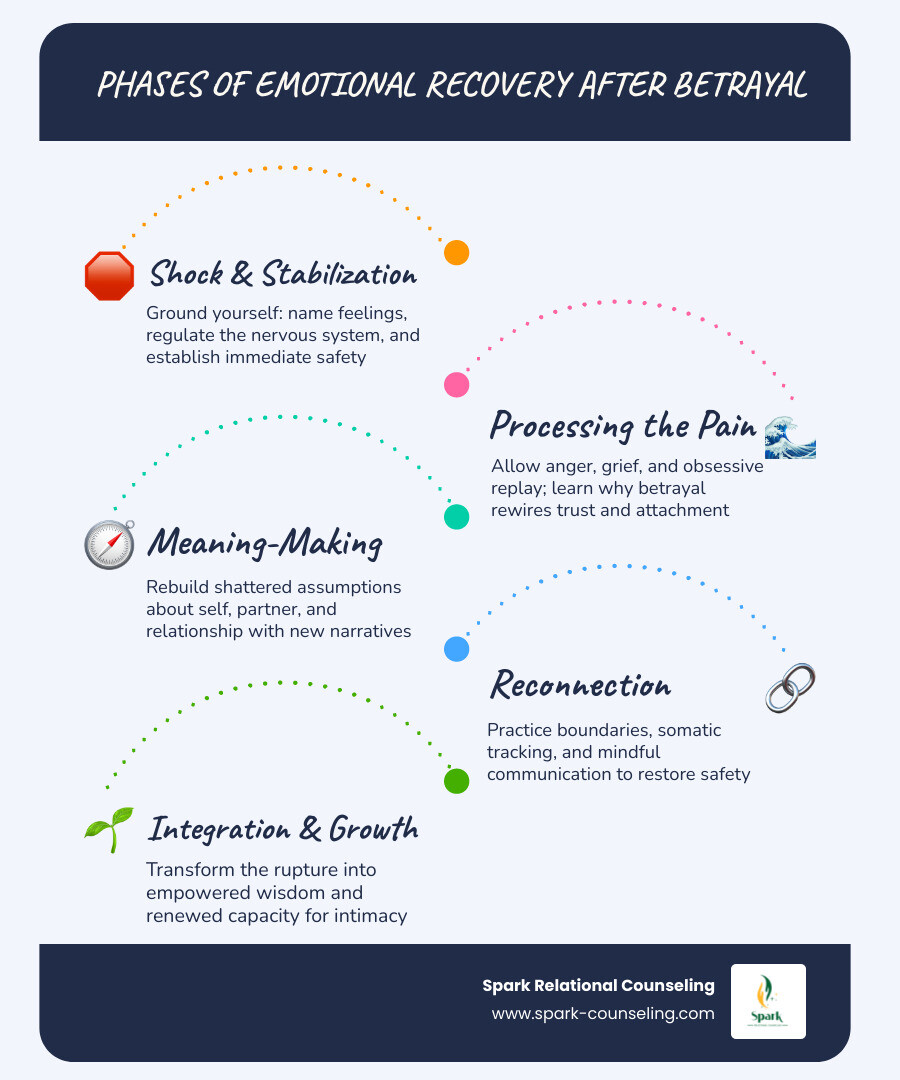
Recovery typically occurs in three distinct phases:
- Crisis and Stabilization: Managing the immediate shock, setting safety boundaries, and establishing emotional containment.
- Deconstruction and Meaning-Making: Processing the pain, understanding how the betrayal occurred, and building empathy.
- Reconstruction and Integration: Rebuilding trust (either together or separately) and redefining your identity.
For a deeper dive into these stages, read our guide on What are the phases of affair recovery.
Can a relationship survive betrayal without professional therapy?
While some couples attempt to navigate this alone, relational repair after a deep rupture is incredibly difficult without professional guidance. Experiential therapies like EFT are specifically designed to de-escalate the painful cycles of attack-and-defend that naturally occur after betrayal. Without a therapist to provide containment, couples often find themselves trapped in chronic resentment. To understand what it takes to rebuild, explore our article: Will the pain of infidelity ever go away.
Conclusion
Healing from betrayal is a non-linear journey that requires immense courage, patience, and self-compassion. The books highlighted in this guide are powerful tools to help you find your footing, understand your nervous system, and begin the process of reclaiming your life.
At Spark Relational Counseling, May Han and our clinical team are dedicated to walking alongside you through this process. We offer compassionate, virtual individual and couples counseling across Oregon, Washington, and Illinois. Our mindfulness-based relational therapy is designed to counter negative brain autopilots, helping you find lasting peace and build truly loving relationships.
If you are ready to move beyond the pain of betrayal and begin the work of deep relational healing, May Han and the team at Spark Relational Counseling invite you to learn more about our approach to Affair recovery counseling at Spark Relational Counseling.