Stop the Sizzle with a Custom Prevention Plan

You're Running on Fumes — Here's How to Stop
How to create a burnout prevention plan starts with one honest question: Is what I'm carrying actually sustainable?
If you're in your 30s or 40s, high-achieving, and quietly exhausted — you already know the answer. You're still showing up. Still delivering. But something has gone flat.
Here is a quick-start guide to building your plan:
| Step | What to Do |
|---|---|
| 1. Know your warning signs | Track physical and emotional signals before they compound |
| 2. Map your demands and resources | Identify where pressure exceeds support across your work and life |
| 3. Build a Minimum Viable Day | Design a bare-minimum routine that protects your baseline on hard days |
| 4. Set relational boundaries | Stop overfunctioning — at work and in relationships |
| 5. Create recovery architecture | Pre-schedule rest, not just boundaries, before burnout signals arrive |
| 6. Measure and adjust | Revisit your plan regularly — it's a living document, not a one-time fix |
Burnout doesn't announce itself loudly. It creeps in through a flattening of enthusiasm, a shortening of patience, a body that no longer bounces back after a weekend. According to a 2024 Deloitte survey, 77% of professionals report experiencing burnout at their current job. And yet most burnout advice still defaults to "take a break" and "set boundaries" — generic tips that miss the structural and relational roots of chronic exhaustion.
This guide goes deeper. It draws on systemic frameworks, somatic awareness, and relational therapy principles to help you build something that actually holds.
I'm May Han, a Licensed Marriage and Family Therapist at Spark Relational Counseling, and I've worked closely with high-achieving adults navigating the intersection of workplace stress, relational strain, and identity depletion — exactly the terrain a thoughtful burnout prevention plan needs to address. In the sections ahead, I'll walk you through a layered, practical framework you can begin using today.
Understanding the Sizzle: Burnout vs. Everyday Stress
How do you distinguish burnout from ordinary tiredness or a busy week? Everyday stress is characterized by over-engagement. Your nervous system is revved up, but you still believe that if you can just get through your to-do list, you will finally feel better.
Burnout, on the other hand, is defined by disengagement. The World Health Organization classifies burnout as an occupational phenomenon characterized by three distinct dimensions:
- Emotional exhaustion: A profound, chronic depletion of your physical and emotional reserves. You wake up exhausted even after eight hours of sleep.
- Cynicism and depersonalization: A growing sense of detachment, irritability, and negativity toward your work, clients, or colleagues.
- Reduced professional efficacy: A persistent feeling of ineffectiveness and a lack of accomplishment, no matter how much you produce.

When we cross the threshold into burnout, our nervous system undergoes a shift. Under chronic stress, the body remains trapped in a persistent fight-or-flight response, eventually collapsing into a state of "freeze" or functional collapse. According to Polyvagal Theory, this is the dorsal vagal state — a survival mechanism where the body conserves energy by shutting down non-essential systems.
In our clinical practice, we utilize Accelerated Experiential Dynamic Psychotherapy (AEDP) and experiential therapy to help individuals tune into these somatic thresholds. When you are burned out, your capacity to process stress is compromised. You might notice physical markers like a tight chest, persistent muscle tension, digestive issues, or a flat recovery pattern on your wearable health trackers.
Recognizing these Signs of burnout symptoms is the first step toward reclaiming your agency. If you are interested in a deeper look at protecting your well-being, the American Psychiatric Association offers excellent foundational insights in their guide on Preventing Burnout: A Guide to Protecting Your Well-Being.
The IGLOO Model: Mapping Demands and Resources Systemically
A common mistake is treating burnout as a purely individual failure — a lack of personal resilience. In reality, burnout is a system-wide design problem. To build a truly effective burnout prevention plan, we look at work stress through the IGLOO model, which maps demands and resources across five distinct levels:
- Individual (I): Your personal demands (e.g., perfectionism, overfunctioning) and resources (e.g., emotional regulation, somatic awareness, sleep hygiene).
- Group (G): The dynamics of your immediate team. Are colleagues supportive, or is there a culture of competitive overwork where taking a break is viewed as "selfish"?
- Leader (L): The role of your direct supervisor. Do they model healthy boundaries, provide clear expectations, and offer meaningful recognition?
- Organization (O): The structural constraints of your workplace, such as administrative friction, outdated software, and unrealistic staffing models.
- Overarching Context (O): The broader environment, including industry-wide funding challenges, market volatility, or societal pressures.

To identify the gap between your current demands and available resources, you must audit each level. For example, a supervisor facing high turnover might realize that while their individual coping skills are strong, organizational constraints — like outdated software and lack of administrative support — are draining their team's daily capacity.
Addressing these gaps requires a dual approach: demand reduction (such as eliminating unnecessary meetings or streamlining workflows) and resource enhancement (such as introducing structured peer support, clear role definitions, or professional clinical guidance).
If you feel stuck in a toxic cycle of overwork, finding The best therapy for burnout can help you unpack the deeper psychological patterns that keep you saying yes to unsustainable demands. For those navigating corporate or institutional environments, you can also explore structured organizational approaches through Strategies for Preventing Burnout in the Workplace.
How to Create Burnout Prevention Plan: The Core Framework
The difference between a plan that works and one that fails lies in the shift from reactive self-care to proactive recovery architecture. Reactive self-care is taking a bath or booking a vacation only after you have reached a crisis point. Proactive recovery architecture is building systemic, non-negotiable micro-habits into your weekly routine to protect your nervous system before depletion occurs.
| Reactive Self-Care (Emergency Response) | Proactive Recovery Architecture (System Design) |
|---|---|
| Taking a mental health day after a panic attack | Scheduling weekly, non-negotiable transition blocks |
| Binge-watching television to "zone out" | Engaging in active rest that induces low-stakes flow states |
| Setting boundaries only when you are angry | Establishing clear, upfront communication rules for after-hours |
| Hoping your workload will decrease next month | Conducting regular workload audits to negotiate task delegation |
To build your custom plan, we recommend mapping out a clear path that integrates somatic, behavioral, and relational elements.
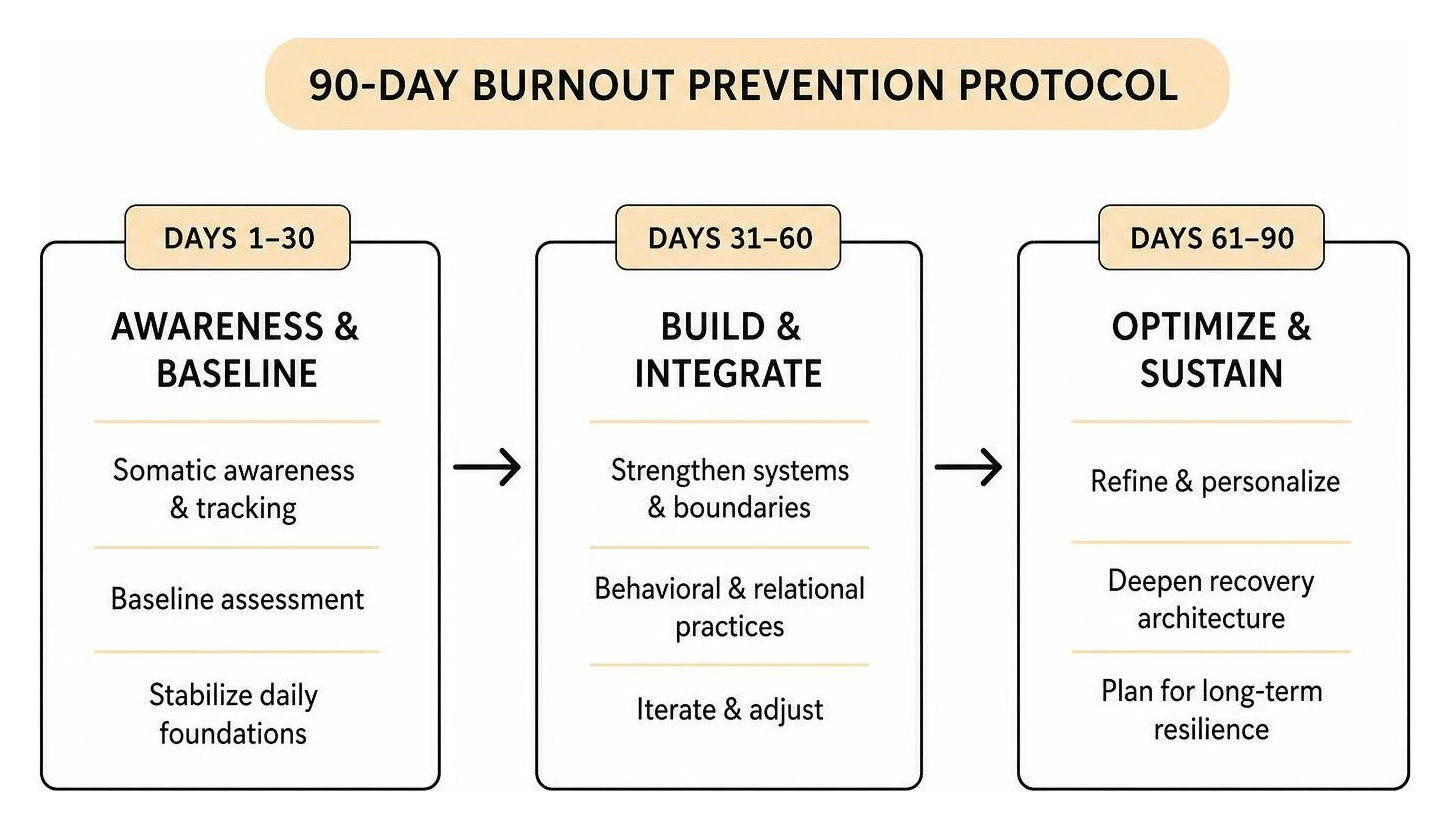
Let's break down the essential steps to customize your prevention strategy.
Step 1: How to Create Burnout Prevention Plan Foundations Through Somatic Awareness
Your body knows you are burned out long before your mind admits it. To build a sustainable foundation, you must develop the skill of somatic tracking. This means paying attention to how stress registers physically in your body.
In our therapy sessions, we often use Brainspotting and experiential techniques to help clients locate where they hold emotional pressure. Is it a tightening in your throat when you open your email? A heavy sensation in your stomach when a specific colleague calls?
By learning How to track burnout symptoms, you can identify your personal "somatic yellow lights" — the early warning signs that tell you your nervous system is reaching its limit. This awareness allows you to pause and implement grounding exercises before you cross into functional collapse.
Step 2: Establishing a Minimum Viable Day and Recovery Architecture
When you are deeply depleted, your prefrontal cortex — the part of the brain responsible for planning, decision-making, and willpower — is physically compromised. Expecting yourself to execute a complex, high-effort wellness routine when you are running on empty is neurologically unrealistic.
Instead, we design a Minimum Viable Day (MVD). This is a pre-planned, low-energy protocol for your hardest days. It requires less than ten minutes of active effort and might include:
- Taking five slow, conscious breaths before picking up your phone in the morning.
- Stepping outside for ten minutes of direct sunlight to regulate your cortisol awakening response.
- Eating a simple, protein-rich breakfast within 90 minutes of waking.
- Physically closing your laptop at a designated time and walking away.
By focusing on tiny, consistent micro-habits, you bypass the brain's resistance and allow the behaviors to automate within the basal ganglia, requiring almost zero executive energy. For a step-by-step breakdown of managing routines when your energy is low, you can read Marty Wolner's insights on Medium.
Additionally, you can build a sequential physical recovery protocol. To see a real-world case study of how to rebuild sleep, movement, and nervous system health from the ground up, explore The Recovery Stack for Burnout: How I Climbed Out (And What I Use Daily) — RecoveryStack.
Step 3: Setting Relational Boundaries and Countering Autopilot Habits
For many high-achievers, burnout is not just a workplace issue; it is a relational one. If you identify as a helper, giver, or fixer, you likely have a deeply ingrained habit of overfunctioning — anticipating others' needs, absorbing emotional labor, and solving problems that are not yours to solve.
This is a classic negative brain autopilot. It is often fueled by a belief that your worth is tied directly to your usefulness. In our work with couples and individuals using Emotionally Focused Therapy (EFT), we help clients recognize these relational patterns.

Learning to step back is not about abandoning others; it is about trusting them to navigate their own emotional experiences. You can begin practicing this by setting compassionate relational boundaries, such as:
- Pausing for ten seconds before saying yes to any new request.
- Asking a friend or partner: "Do you want support or a solution right now?"
- Allowing others to support you without immediately trying to "earn" or repay it.
To explore how these relational dynamics affect your daily life and career, read our guide on Finding Balance in Work & Life: How Therapy in Seattle, WA Can Help with Chronic Workplace Stress and Burnout. For those balancing the unique pressures of running a business, our resource on Finding a Work-Life Balance: Essential Tips for Entrepreneurs provides tailored boundary-setting strategies. You can also review practical tools for setting limits in Boundaries Are Self-Care: Practical Tools to Prevent Burnout.
How to Create Burnout Prevention Plan Systems for High-Stress Teams
If you are a manager, supervisor, or executive, you have a unique responsibility. You cannot self-care your team out of an unsustainable workload. Burnout prevention at the team level is an operational capacity design task, not a personal resilience test.
To build a burnout-resistant team culture:
- Conduct Workload Audits: Regularly review who is carrying what. Watch out for "invisible labor" — your high-trust employees who silently absorb extra mentoring, cleanup, and coordination tasks.
- Model Healthy Boundaries: Employees do not evaluate whether it is safe to take time off by reading the HR handbook; they evaluate it by watching you. If you send emails at midnight or work during your vacation, your team will feel pressured to do the same.
- Establish Clear Communication Norms: Define response-time expectations (e.g., no internal emails required after 6:00 PM) and protect dedicated focus blocks on team calendars.
- Normalize Rest: Ensure that paid time off (PTO) is truly guilt-free by establishing clear coverage plans so work does not pile up while a team member is away.
For a comprehensive operational playbook on supporting your staff, see How to Prevent Employee Burnout: A Manager's 2026 Plan. If you are looking for a structured timeline to implement these systemic changes, check out the Burnout Recovery Plan: 90-Day Reset That Actually Works (2026).
To synthesize these individual and organizational steps, it can be helpful to put your ideas into a concrete, written document. You can find a structured framework to draft your personal strategy in Put It All Together: Create Your Own Personal Action Plan for .... To customize your plan based on your professional style, you can also explore archetype-specific strategies in 7 Ways to Prevent Burnout in 2026: 4 Universal Moves and 3 Archetype-Specific Ones | MyPassion.AI.
Frequently Asked Questions About Burnout Prevention
What is the difference between burnout and depression?
While they share overlapping symptoms like fatigue and low motivation, they are clinically distinct. Burnout is specifically tied to your situational and occupational context. If your exhaustion, cynicism, and feelings of ineffectiveness lift when you are away from work for an extended period, it is likely burnout. Depression, however, is a clinical condition that pervades all areas of life, regardless of changes in your work environment.
How long does it take to recover from severe burnout?
For mild to moderate chronic stress, a structured 90-day reset focusing on sleep, load reduction, and boundary redesign can yield significant relief. However, for severe, long-standing burnout where the nervous system has been deeply dysregulated, the recovery window typically spans 12 to 18 months. This process requires sequential physiological retuning, behavioral adjustments, and often structural career changes.
Can mindfulness-based relational therapy help with workplace burnout?
Yes. Workplace burnout is rarely just about the tasks on your plate; it is deeply connected to how you relate to your work, your colleagues, and yourself. Mindfulness-based relational therapy helps you cultivate the somatic awareness needed to recognize when you are crossing your emotional thresholds. By identifying and countering negative brain autopilots — like people-pleasing, overfunctioning, or tying your self-worth to productivity — you can build a sense of inner safety and establish boundaries that actually hold.
Conclusion
Creating a custom plan is not a luxury; it is a vital act of self-preservation. When you design a sustainable weekly routine, set clear boundaries, and listen to your body's physical warning signs, you protect your energy, your relationships, and your long-term well-being.
At Spark Relational Counseling, May Han and our clinical team work together to help high-achieving professionals, leaders, and creatives break free from chronic exhaustion. We offer virtual individual and couples counseling across Oregon, Washington, and Illinois, utilizing mindfulness-based relational therapy to help you recognize emotional thresholds, quiet negative brain autopilots, and build a life of lasting peace and deeper connection.
If you are ready to stop running on fumes and design a path forward that honors your well-being, we invite you to explore our specialized services:
- Learn about our targeted support for business owners and leaders through Therapy for Entrepreneurs.
- Unpack how chronic stress and overfunctioning impact your closest connections with Individual Therapy for Relationship Issues.
- Explore support for navigating persistent fatigue and flat moods with our guide on High-Functioning Depression.
Reach out today to schedule a free 15-minute consultation. Let's work together to stop the sizzle and build a sustainable, intentional routine that supports your life.