Finding an Anxiety Therapist in Portland

To find an anxiety therapist in Portland, look for an Oregon-licensed clinician who treats your specific concern, whether that is constant worry, panic, health anxiety, or a phobia. Ask which approaches they use, whether they offer online sessions, and what a session will cost after insurance or sliding-scale fees. A brief consultation can help you decide if you feel comfortable working together.
You do not need to wait until anxiety takes over your life. If worry is disrupting sleep, work, or relationships, therapy can help you understand what is happening and build ways to respond.
I'm May Han, an LMFT at Spark Relational Counseling and an anxiety therapist in Portland. I use mindfulness and emotionally focused techniques to help people manage stress and change patterns that affect their relationships.
Understanding Anxiety Symptoms and Unique Pacific Northwest Stressors

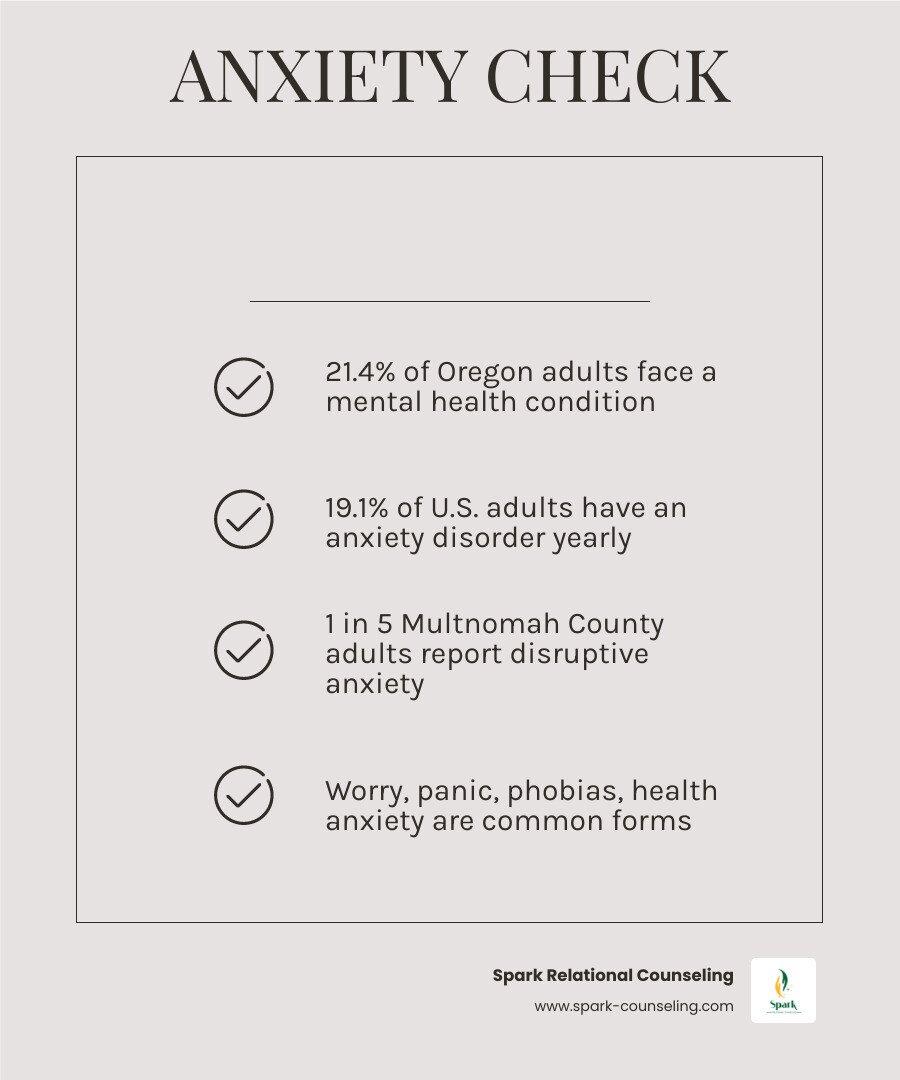
Living in the Pacific Northwest offers breathtaking natural landscapes, yet our unique environment can also amplify underlying nervous system strain. Across Oregon, mental health challenges are notably prevalent. Approximately 21.4% of Oregon adults experience a mental health condition, placing the state among the top ten nationally for overall prevalence. An estimated 19.1% of adults nationwide navigate an anxiety disorder each year, and within Multnomah County, 1 in 5 adults report anxiety symptoms severe enough to disrupt their everyday routines.
When internal tension begins to build, it rarely stays compartmentalized. You might find yourself experiencing chronic anxiety at workplace settings, struggling to concentrate during team check-ins, or second-guessing routine emails. For others, distress manifests as intense health worries, specific phobias, or sudden surges of panic that feel completely unmanageable.
Identifying Physical and Emotional Symptoms of Anxiety Disorders
Anxiety is not merely "overthinking"; it is an embodied physiological response. When your brain perceives a threat—whether emotional, social, or physical—it triggers an automatic survival protocol. According to clinical resources detailing anxiety disorders - symptoms and causes, these manifestations can vary widely across individuals:
- Physical sensations: Heart palpitations, shallow breathing, chronic tightness in the jaw or shoulders, stomach distress, dizziness, and muscle fatigue.
- Cognitive patterns: Intrusive "what-if" scenarios, hypervigilance regarding minor bodily sensations, anticipatory dread, and racing thoughts.
- Relational and behavioral patterns: People-pleasing out of fear of rejection, avoiding social gatherings, isolating from partners, or over-checking reassurance loops.
To help determine whether your current distress warrants dedicated support, consider these self-assessment questions:
- Are you constantly monitoring your body for signs of illness or panic?
- Does your worry feel difficult to pause, even when you know you are safe?
- Are professional tasks or personal relationships suffering because of mental exhaustion?
- Have you stopped participating in activities you love in Northwest Portland, Eugene, or Lake Oswego out of fear of triggering distress?
Portland-Specific Triggers: Weather, Urban Pressure, and Lifestyle Factors
Our local surroundings play a meaningful role in shaping nervous system capacity. In Portland, several regional factors intersect with mental health:
- Extended seasonal overcast: Months of low natural light and persistent rain can drain serotonin pathways, making emotional self-regulation significantly harder and heightening vulnerability to high functioning depression.
- Urban and economic pressures: Rising housing costs, commuting hurdles, and shifting downtown dynamics place sustained financial and safety burdens on working professionals and families.
- Tech and creative sector burnout: The Pacific Northwest's competitive tech and entrepreneurial sectors foster high expectations, leading many to push past their physical limits. Seeking dedicated therapy Portland Oregon helps individuals untangle these localized stressors from their core sense of self.
Why Finding the Right Anxiety Therapist in Portland Matters for Lasting Recovery
Healing from anxiety is not about aggressively fighting your thoughts or forcing yourself to stay positive. True recovery occurs when you build safety within your nervous system through an attuned therapeutic alliance. In specialized counseling, we provide a calm, nonjudgmental container where you can experience your emotions safely rather than running from them.
Discovering the best therapy for stress and anxiety involves identifying modalities that move beyond surface-level symptoms to transform your automatic neural pathways.
Mindfulness-Based Relational Therapy for Anxiety
At Spark Relational Counseling, May Han, LMFT, and our clinical team emphasize experiential, relational, and depth-oriented modalities such as Emotionally Focused Therapy (EFT), Accelerated Experiential Dynamic Psychotherapy (AEDP), Experiential Therapy, and Brainspotting.
These approaches help you step out of defensive autopilots and cultivate genuine internal connection. By integrating mindful awareness, you learn to track emotional thresholds in real time—recognizing precisely when your system begins to flood so you can implement calm, manageable boundaries.
| Modality | Core Mechanism | How It Supports Anxiety Recovery |
|---|---|---|
| Emotionally Focused Therapy (EFT) | Explores underlying attachment needs and relational triggers. | Transforms insecurity and isolation into soothing, secure interpersonal connections. |
| AEDP | Processes deep emotions within an explicit, safe therapeutic bond. | Undoes chronic aloneness and unlocks resilience through positive affective states. |
| Brainspotting | Uses focused eye positions to access subcortical emotional processing. | Releases trauma and somatic tension stored deep within the neurobiology. |
| Mindfulness-Based Experiential Work | Tracks somatic sensations without judgment in the present moment. | Resets automatic survival alarms, restoring internal calm and emotional choice. |
When applied within anxiety disorders treatment complete guide frameworks, these experiential therapies reorganize how your mind and body respond to stress, fostering deep, lasting stability.
What to Expect When Meeting an Anxiety Therapist in Portland for the First Time
Starting therapy can feel intimidating, especially when your system is already on high alert. Knowing how to start therapy demystifies the intake process.
In your opening sessions, we move at a pace that honors your nervous system:
- Somatic and symptom intake: We explore how anxiety shows up in your body, identifying primary triggers such as health worries, phobias, or professional fatigue.
- Mapping relational patterns: We observe how stress affects your close bonds, romantic partnership, and daily boundaries.
- Collaborative stabilization: We establish grounded somatic practices, ensuring you leave every session with clear, nervous-system-friendly tools.
Navigating Specialized Care, Credentials, and Session Logistics

When selecting a practitioner, understanding clinical credentials ensures you receive regulated, ethical care. In Oregon, licensed professionals include:
- LMFT (Licensed Marriage and Family Therapist): Systemically and relationally trained clinicians skilled in treating anxiety within personal and interpersonal contexts.
- LPC (Licensed Professional Counselor): Mental health clinicians trained in individual psychotherapy and experiential interventions.
- LCSW (Licensed Clinical Social Worker): Clinicians focusing on clinical therapy integrated with broader environmental and systemic understanding.
Reviewing practical guides on how to choose the right therapist empowers you to ask meaningful questions regarding an expert's clinical modalities and cultural perspectives.
Licensing, Insurance, and Sliding-Scale Therapy Costs in Multnomah County
Navigating session investments involves balancing clinical access with long-term privacy considerations. While in-network insurance benefits offer immediate financial reductions, relying on insurance coverage comes with important structural constraints that every client should understand:
- Mandatory mental health diagnoses: Insurance reimbursement requires a formal psychiatric diagnosis on your permanent medical record, which cannot always be removed.
- Long-term privacy implications: Diagnostic records can negatively impact future applications for life insurance, private disability policies, specialized employment clearances, or international adoptions.
- Treatment autonomy: Insurance payers frequently dictate session length, frequency, and approved therapeutic modalities, limiting deep experiential work.
For these reasons, many Portlanders opt for private pay, utilizing out-of-network superbills, health savings accounts (HSAs), or flexible spending accounts (FSAs). Standard private practice rates in the Portland metro area typically range from $150 to $250 per session, with select community programs and sliding-scale spots available for those with financial limitations.
How to Choose an Anxiety Therapist in Portland for Specialized Concerns
Your background and life circumstances deserve nuanced, attuned clinical care. Specialized therapy options throughout Portland, Happy Valley, and West Linn include:
- Culturally sensitive individual counseling: Tailored care that honors diverse cultural values, systemic factors, and intergenerational family narratives.
- Therapy for entrepreneurs: Specialized support addressing hyper-responsibility, investor pressures, and rapid startup pacing.
- Affirmative care for LGBTQ+ and neurodivergent adults: Therapeutic spaces free of pathologizing assumptions, validating authentic lived experiences.
Frequently Asked Questions About Portland Anxiety Treatment
How do I know if my anxiety requires professional therapy versus self-care?
Self-care practices like trail walks in Forest Park, journaling, and restful sleep are vital foundations. However, when daily anxiety causes ongoing relationship friction, impairs your work performance, leads to panic attacks, or leaves you feeling perpetually overwhelmed, professional therapy provides the experiential processing needed to rewire entrenched survival loops.
What is the average wait time and cost for counseling in Portland?
Portland is home to over 200 licensed anxiety specialists. The average wait time for an initial appointment in Portland is approximately 2 to 4 weeks—notably faster than the national average of 6 to 8 weeks. Out-of-pocket session investments typically average between $150 and $250, depending on practitioner experience and session length.
Can virtual counseling effectively treat panic, phobias, and health anxiety?
Yes. Virtual psychotherapy is highly effective for anxiety disorders. Engaging in sessions from your own living room or home office allows you to process emotional distress in the very environments where your anxiety typically surfaces. Our clients across Portland, Seattle, and Chicago benefit immensely from accessible online therapy in Oregon, eliminating commute fatigue while receiving high-level clinical care.
Conclusion
Living under the heavy weight of chronic health anxiety, sudden phobias, or unrelenting daily worry can feel exhausting, but your brain possesses remarkable neuroplasticity. With attentive, experiential guidance, you can disarm defensive autopilots and cultivate genuine emotional security.
At Spark Relational Counseling, May Han, LMFT, and our clinical team offer dedicated virtual individual and couples therapy across Oregon, Washington, and Illinois. When you are ready to find deep, lasting calm, connect with us to explore our specialized anxiety treatment.
