The Ultimate Guide to Couples Therapy

What Is a Couples Therapy Relationship — and Could It Help You?
A couples therapy relationship is a structured, professionally guided process where two partners work with a licensed therapist to understand and shift the patterns keeping them stuck. If you're trying to decide whether couples therapy is right for you, here's a quick overview:
| Question | Quick Answer |
|---|---|
| What is it? | A form of therapy where the relationship itself — not either individual — is treated as the client |
| Who is it for? | Any couple feeling stuck, disconnected, or wanting to grow — not just those in crisis |
| Does it work? | Yes — research shows most people who complete couples therapy feel better than 70–80% of those who don't seek help |
| When should you start? | Sooner than you think — the average couple waits six years after problems begin before seeking support |
| What approaches are used? | Emotionally Focused Therapy (EFT), experiential methods, somatic modalities, and attachment-based work |
Most couples don't walk into therapy because everything fell apart overnight. It's usually quieter than that — a slow drift, a conversation that never quite lands, a distance that builds so gradually you barely notice it. By the time many partners seek help, years of small disconnections have compounded into something that feels much harder to name.
The good news? That distance is rarely the full story. Underneath most conflict and withdrawal are two people who still care — and who simply haven't yet had the right support to find their way back to each other.
This guide walks you through everything you need to know: how couples therapy works, what the research says, which approaches are most effective, and how to find the right fit for your relationship.
I'm May Han, a Licensed Marriage and Family Therapist at Spark Relational Counseling, and my work in couples therapy relationship support draws on emotionally focused and mindfulness-based techniques to help partners break through reactive cycles and rebuild genuine connection. Whether you're navigating a specific rupture or simply feeling like something important has gone quiet between you, this guide is written to meet you where you are.
Understanding the Couples Therapy Relationship
When partners step into our virtual therapy space, they often carry a subtle but heavy assumption: that the therapist is there to act as a judge, deciding who is right and who is wrong. In a true therapeutic space, however, the dynamic is entirely different.
In a dedicated couples therapy relationship, we do not treat one partner as the "problem" and the other as the "victim." Instead, we treat the relationship itself as the client.

This shift in perspective is incredibly liberating. When the relationship is the client, neither of you has to wear the armor of self-defense. We can step back and look at the invisible patterns that weave between you—the words spoken, the silences held, and the underlying needs for safety and warmth that drive both.
While some couples find that pursuing individual relationship support helps them unpack their personal histories, working together in the same room offers a unique, real-time container for relational healing. According to insights from Harvard Health, couples therapy is uniquely suited to address both shared conflicts and the individual vulnerabilities that directly impact the partnership.
Distinguishing Therapy from Counseling
While the terms are often used interchangeably in casual conversation, there is a meaningful difference between couples counseling and couples therapy.
Couples counseling is typically a shorter-term, highly focused intervention. It is often educational and problem-focused, designed to help partners navigate a specific, immediate challenge—such as budgeting disagreements, scheduling logistics, or negotiating a specific life decision. You can learn more about these foundational approaches in our guide to marriage counseling basics.
In contrast, couples therapy goes much deeper. It is designed to explore and transform long-standing relational patterns, emotional injuries, and attachment dynamics. Rather than simply teaching you how to resolve a single argument, couples therapy helps you understand why the argument happens in the first place. It targets the neurobiological and emotional roots of your interactions, paving the way for long-term healing and sustainable intimacy.
The Systemic View of Distress
From a systemic perspective, relationship distress is never the fault of just one person. Instead, it is the result of reciprocal behaviors—what relationship scientists often call "bow-tie patterns" or self-perpetuating loops.
Imagine a common scenario: Partner A feels lonely and asks for connection in a tone that sounds critical. Partner B, sensing criticism, feels a somatic spike of anxiety and withdraws to keep the peace. Partner A interprets this withdrawal as abandonment, which increases their panic and prompts more intense criticism. Round and round the loop goes.
Partner A: Feels lonely -> Expresses criticism -> Partner B withdraws
Partner B: Feels criticized -> Withdraws -> Partner A feels abandoned
In systemic therapy, we focus on cycle disruption. We help you map this loop in real time, pausing at critical emotional thresholds so both of you can see how your protective reactions inadvertently trigger each other's deepest insecurities.
The empirical support for this approach is robust. A comprehensive study published in the Journal of Family Therapy outlines the extensive evidence base for systemic interventions. The research demonstrates that systemic couple interventions are just as effective as evidence-based individual psychotherapies for addressing not only relationship distress, but also coexisting challenges like anxiety, mood disorders, psychosexual struggles, and adjustment to chronic physical illness.
Evidence-Based Approaches: The Power of Emotionally Focused Therapy
To shift these deeply ingrained, automatic cycles, we must move beyond simple intellectual understanding. We have to engage the heart and the nervous system. This is where evidence-based, somatic, and attachment-focused modalities show their true power.
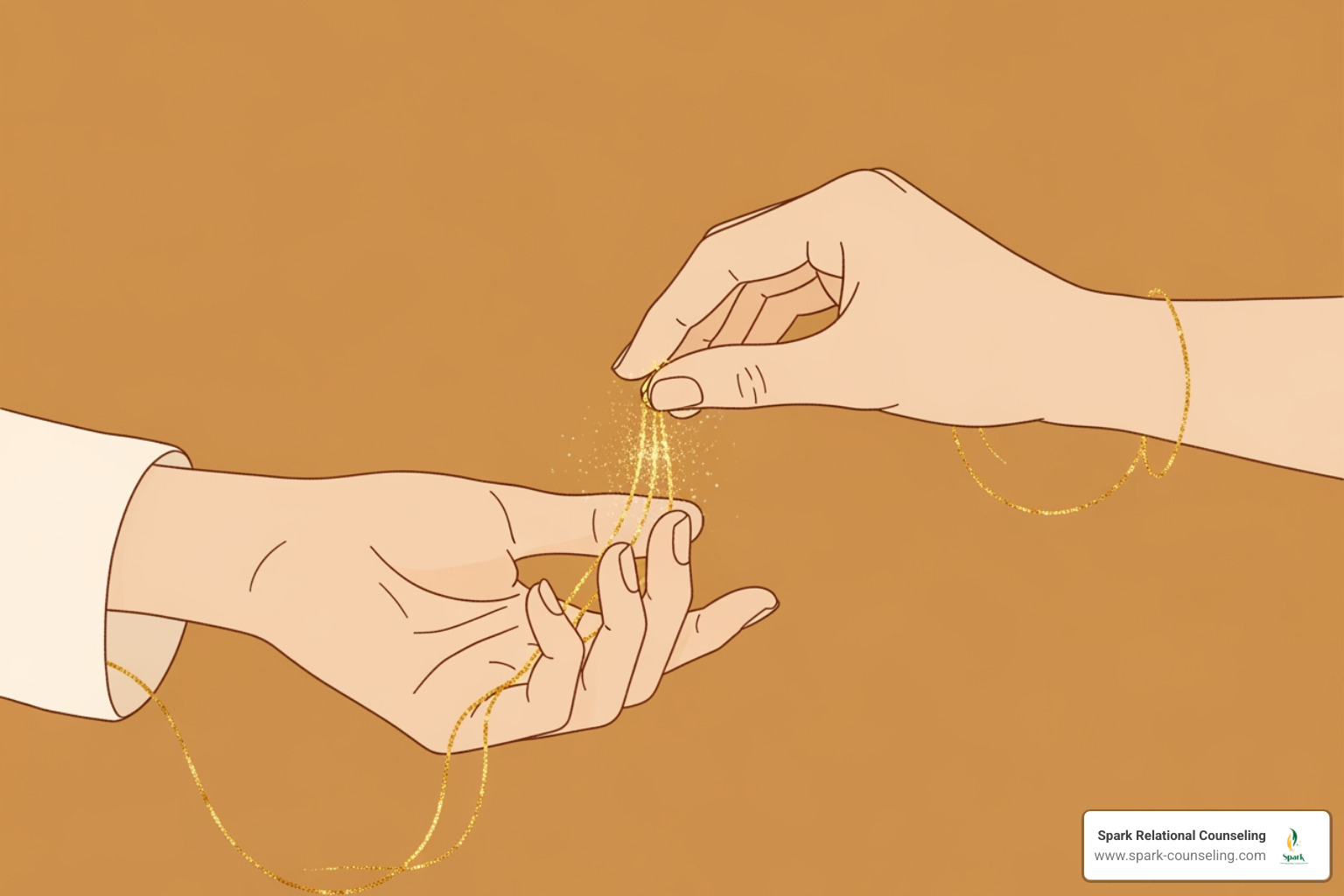
At Spark Relational Counseling, May Han and our clinical team utilize Emotionally Focused Therapy (EFT) as the cornerstone of our relational work. Developed by Dr. Sue Johnson, EFT is grounded in attachment science—the study of how humans are biologically wired to seek safety, reassurance, and emotional accessibility in their primary relationships.
When we look at our partners through the lens of attachment, we begin to understand that repetitive arguments are rarely about the dishes, the finances, or the calendar. They are protests against emotional disconnection. They are somatic cries asking: Do I matter to you? Are you there for me?
To explore how these dynamics manifest based on your personal history, you can read our deep dive into attachment styles in therapy.
Rebuilding Connection Through a Secure Couples Therapy Relationship
EFT is recognized by the American Psychological Association (APA) as the gold standard in evidence-based couples therapy. Rather than focusing on surface-level behavioral modifications, EFT focuses on reshaping the emotional bond between partners.
In the safety of the therapeutic space, we guide you to:
- Identify the negative cycle: Map out the automatic, defensive moves that leave both of you feeling isolated.
- Access primary emotions: Move beneath anger, numbness, or frustration to touch the softer, more vulnerable feelings underneath—such as fear of rejection, grief, or longing.
- Shape new interactions: Share these vulnerable feelings directly with your partner, allowing them to respond with warmth and comfort.
By experiencing these new, emotionally responsive moments in session, you gradually build a secure attachment. You can read more about how this transformation unfolds in our resource on attachment and connection.
Experiential and Somatic Modalities
Our brains are incredibly fast. When we feel relationally threatened, our limbic system takes over, triggering a fight, flight, freeze, or fawn response long before our logical brain can process what is happening. This is why standard communication checklists often fail in the heat of an argument; your nervous system is in survival mode.
To counter these negative brain autopilots, we integrate experiential and somatic modalities, including:
- AEDP (Accelerated Experiential Dynamic Psychotherapy): A warm, relationally focused approach that emphasizes processing deep emotional experiences in the present moment with the therapist, helping you feel "undone-alone."
- Brainspotting: A somatic tool that uses the visual field to access and process trauma, anxiety, and deeply held emotional blocks stored in the subcortical brain.
- Experiential Therapy: Moving beyond talking about problems to actively experiencing and practicing new ways of relating and feeling within the session itself.
Through these somatic interventions, we help you slow down and recognize your emotional thresholds. You learn to notice when your chest tightens or your breath grows shallow, allowing you to set manageable boundaries and self-regulate before your defensive autopilot takes the wheel.
Recognizing the Signs: When to Seek Professional Support
It is a common myth that couples therapy is a last-resort effort reserved only for relationships on the verge of divorce. In reality, waiting until a relationship is in acute crisis makes the healing process significantly longer and more complex.
Research shows that the average couple waits six years after problems begin before seeking professional support. Six years of repetitive conflict, accumulating resentment, and emotional withdrawal can build a thick layer of protective armor around both partners.
Seeking support early—when you first notice the patterns beginning to harden—is an investment in the longevity and joy of your partnership. If you find yourselves stuck in circular disagreements, our guide on breaking argument cycles offers practical insights into how professional guidance can help you step off the merry-go-round.
Navigating Vulnerability in Your Couples Therapy Relationship
In almost every distressed relationship, a classic pursuer-withdrawer dynamic emerges. One partner, feeling disconnected, pursues contact, reassurance, or resolution—sometimes through intense, urgent, or critical communication. The other partner, feeling overwhelmed or inadequate, withdraws, shuts down, or leaves the room to de-escalate the tension.
This dynamic is incredibly painful for both. The pursuer feels abandoned and unimportant; the withdrawer feels criticized and rejected.
[ Pursuer: Feels isolated -> Seeks reassurance urgently ]
 ^
 | (Trigger Loop)
 v
[ Withdrawer: Feels overwhelmed -> Shuts down to protect ]
In therapy, we create the emotional safety required to slow this cycle down. According to a research-driven flowchart designed to approach change in couples published in Frontiers in Psychology, identifying these reciprocal patterns and establishing systemic goals is the crucial first step toward lasting relational change.
When both partners feel safe enough to drop their protective armor, they can express their true vulnerabilities without fear of attack or abandonment.
Proactive Relationship Maintenance
You do not need to be in distress to benefit from relational therapy. Many couples utilize therapy as a form of proactive, preventative care.
Whether you are preparing for a major life transition—such as moving in together, navigating career shifts, or stepping into parenthood—or simply wanting to deepen your emotional intimacy, therapy provides a dedicated, structured space to align your values and dreams. For couples preparing to make a lifelong commitment, our specialized premarital counseling sessions offer a beautiful space to build a resilient, secure foundation before the wedding day.
What to Expect: Inside a Relational Therapy Session
Stepping into therapy can feel intimidating, especially if you do not know what to expect. At Spark Relational Counseling, May Han and our clinical team design our sessions to feel warm, collaborative, and entirely non-judgmental.

Unlike standard individual sessions, which typically last 50 minutes, our relational therapy sessions are structured around a 75-minute duration. This extended format is crucial. It ensures that both partners have ample space to drop into their somatic experience, explore complex emotions, and practice new relational connections without feeling rushed.
Throughout the process, the therapist maintains strict neutrality. We do not take sides, nor do we determine who is "right." Instead, our role is to act as an active, compassionate guide, helping both of you navigate the emotional currents of your relationship. For a detailed breakdown of how to prepare for your first appointment, explore our guide on preparing for a session.
The Virtual Therapy Experience
In today's world, finding time to commute to an office together can be a significant barrier to getting support. To make therapy as accessible and comfortable as possible, May Han and the team at Spark Relational Counseling offer comprehensive virtual sessions.
Our online platform allows you to engage in deep, transformative relational work from the comfort and privacy of your own home. Virtual therapy is highly effective, offering the same level of emotional depth and somatic attunement as in-person sessions, with the added benefit of fitting seamlessly into your busy schedules.
We provide specialized virtual couples therapy tailored to the unique licensing requirements of our clinical footprint. If you are located in the Pacific Northwest, you can read more about virtual marriage counseling in Oregon and our virtual offerings across Washington and Illinois.
Frequently Asked Questions about Relationship Therapy
Can therapy help after infidelity or trust ruptures?
Yes. Infidelity, whether emotional or physical, creates a profound attachment injury—a rupture in the fundamental safety of the relationship. While the pain of a trust betrayal is immense, it is entirely possible to heal.
In therapy, we do not sweep the betrayal under the rug. Instead, we use the EFT framework to process the trauma of the rupture safely. We help the hurting partner express their grief and fear, and we guide the participating partner to offer genuine, somatic responsiveness and accountability. Over time, this process allows couples to rebuild a secure attachment and establish a new, stronger foundation of trust. To understand more about this healing process, read our guide on secure attachment and trust.
What are the limitations of couples therapy?
While couples therapy is highly effective for a wide range of relational challenges, there are certain situations where joint therapy is not appropriate or safe:
- Active Intimate Partner Violence (IPV) or Abuse: If there is ongoing physical abuse, severe emotional coercion, or fear for physical safety, joint couples therapy is contraindicated. In these cases, the safety of the vulnerable partner is the absolute priority, and individual support or specialized domestic violence advocacy is required.
- Unmanaged Active Addiction: If one partner is experiencing an active, unmanaged substance use disorder that prevents them from being emotionally present or safe, individual recovery treatment must be established alongside or prior to relational work.
- Lack of Relational Commitment: If one partner has completely checked out of the relationship and has no desire to participate in the healing process, joint therapy may not be effective.
In these circumstances, pursuing individual counseling for relationship issues can provide a vital space to process your experiences, gain clarity, and make healthy decisions for your future.
How do we choose the right therapist for our needs?
Choosing a couples therapist is a highly personal decision. Because the therapeutic relationship is a crucial catalyst for change, finding a strong clinical fit is essential.
When searching for a therapist, consider the following:
- Specialized Training: Ensure the therapist has specific, advanced training in relational and attachment-based systems, such as Emotionally Focused Therapy (EFT) or somatic modalities. General individual therapists may not have the systemic training required to manage the complex dynamics of a couple.
- Licensing: Look for licensed professionals, such as Licensed Marriage and Family Therapists (LMFTs), Licensed Clinical Social Workers (LCSWs), or Licensed Professional Counselors (LPCs), who are legally registered to practice in your state.
- Clinical Attunement: During your initial consultation, notice how you both feel in the therapist's presence. Do you both feel equally heard, respected, and safe? A great therapist should feel warm, clear, and balanced.
For more detailed guidance on navigating this process, read our expert advice on choosing a therapist.
Conclusion
Every relationship experiences seasons of winter—moments when the warmth fades, the communication grows cold, and the distance feels vast. But these seasons do not have to be permanent. With the right support, the patterns that once felt like dead ends can become the very pathways through which you build a deeper, more resilient love.
At Spark Relational Counseling, May Han and our dedicated team are passionate about helping couples step out of their negative brain autopilots and step into lasting peace and loving connection. Through virtual, mindfulness-based relational therapy, we meet you exactly where you are, providing the clinical expertise, somatic tools, and emotional safety needed to transform your partnership.
We proudly support couples across our licensed states of Oregon, Washington, and Illinois—including our local communities in Portland, Seattle, Chicago, Tualatin, Lake Oswego, Happy Valley, West Linn, Sammamish, Redmond, Bellevue, Spokane, Eugene, Ballard, and Northwest Portland.
If you are ready to stop repeating the same cycle and begin building a secure, vibrant relationship, May Han and the team invite you to take the first step. Begin your healing journey with Spark Relational Counseling today.
