
Can You Un-ring the Bell? How Couples Actually Recover From Cheating
When Everything Feels Broken: A Real Look at How Couples Recover From Cheating

How do couples recover from cheating? It starts with understanding that recovery is not about returning to the relationship you had — it is about building something more honest in its place. Here is a direct answer:
| Step | What It Involves |
|---|---|
| 1. Stabilize | End the affair completely and establish emotional safety |
| 2. Disclose | Share the basic facts of what happened in a structured way |
| 3. Process | Allow both partners to grieve and express pain without judgment |
| 4. Rebuild trust | Practice radical transparency and consistent accountability over time |
| 5. Reconnect | Restore emotional intimacy before reintroducing physical closeness |
| 6. Seek support | Work with a therapist trained in betrayal trauma and affair recovery |
Picture this: it is a quiet Tuesday evening. You are reaching for your partner's phone to look up a restaurant, and in one unguarded moment, your entire understanding of your relationship shifts. Your chest tightens. Your mind races. Your body registers what your words cannot yet hold.
That moment of discovery does not just hurt — it destabilizes. Research shows that betrayal trauma activates the same neurological pathways as post-traumatic stress disorder, flooding the nervous system with threat signals that no amount of willpower can simply switch off. The pain is real, it is biological, and it is not a sign that something is wrong with you.
What matters most in those early days is not having all the answers. It is learning to recognize where your emotional threshold is — and giving yourself permission to take this one step at a time.
Recovery is possible. Studies suggest that 30 to 50 percent of couples who experience infidelity choose to stay together, and a meaningful number of those who do the deeper work describe their relationship afterward as stronger and more honest than before. That is not a small thing.
I'm May Han, a Licensed Marriage and Family Therapist and founder of Spark Relational Counseling, and I have supported many couples through the tender, non-linear process of how do couples recover from cheating using mindfulness-based and Emotionally Focused approaches that go beyond surface-level fixes. In the sections ahead, I will walk you through each stage of that journey with clarity and care.
The Neurobiology of Betrayal: Understanding the Two Stages of Pain
Infidelity is not “just relationship stress.” It is an attachment injury.
When the person who has been your emotional home becomes associated with danger, the nervous system can react as if the floor has disappeared. The amygdala, the brain’s threat detector, may become highly activated. That can create:
- Intrusive thoughts
- Panic sensations
- Hypervigilance
- Sleep disruption
- Loss of appetite
- Sudden anger or numbness
- Repetitive questioning
- “Mind movies” about the affair
This is why telling yourself, “I should be over this by now,” usually does not help. Your body is not being dramatic. It is trying to protect you.
We often describe betrayal pain in two stages.
Stage one is the involuntary pain.
This is the initial shock and trauma response. You did not choose it. Your body reacts before your mind can organize the story. This stage can feel like free fall: crying, shaking, obsessing, freezing, rage, disbelief, or emotional numbness.
Stage two is the pain of response and meaning-making.
This is where choice slowly returns. Not easy choice. Not tidy choice. But real choice. You begin asking: How will I relate to this pain? Will I numb it, avoid it, transmit it, let it define me, or work through it with support?
The difference matters because stage one requires stabilization, not judgment. Stage two requires careful, compassionate participation.
If you are the betrayed partner, this does not mean you are responsible for what happened. You are not. It means your healing will eventually involve reclaiming agency over your life, your body, and your decisions.
If you are the partner who cheated, this means your job is not to rush your partner into stage two because stage one is uncomfortable for you. Your job is to become emotionally steady enough to witness the pain you helped create.
For a deeper look at the brain-body impact of betrayal, we recommend reading What Happens to the Brain After Infidelity and Will the Pain of Infidelity Ever Go Away.
How Do Couples Recover from Cheating through Structured Disclosure?

One of the most delicate parts of affair recovery is disclosure: what gets shared, when, how much, and in what setting.
Too little truth keeps the betrayed partner trapped in confusion. Too much graphic detail can create images that become difficult to unsee. The goal is not secrecy. The goal is structured truth.
A helpful disclosure process usually includes the basic facts:
- Who was involved
- When it started and ended
- Whether it was emotional, sexual, digital, or ongoing
- Whether there is still any contact
- Who else knows
- Whether there are health, financial, work, or family implications
- What boundaries are now in place
A structured disclosure should not include unnecessary sexual mechanics, comparisons, or details that serve curiosity but deepen trauma. The betrayed partner deserves reality. They do not need a permanent movie trailer playing in their nervous system at 2:00 a.m.
And yes, the questions may repeat. This is normal. Repetitive questioning is often the brain’s attempt to rebuild a shattered map of reality. The partner who cheated may think, “But I already answered that.” The more healing response is, “I understand why your brain needs to check the story again.”
A few guidelines help disclosure become healing rather than re-injuring:
Set a time limit.
Try 30 to 60 minutes, not a four-hour midnight interrogation in the kitchen under fluorescent lighting. No one is at their best there. Not even the refrigerator.Pause when either person passes their emotional threshold.
Mindfulness helps here. Notice the signs: tight throat, clenched jaw, racing heart, tunnel vision, shaking, blankness. These are cues to slow down.Use grounding before and after.
Feet on the floor. Slow exhales. Name five things you see. Sip water. Let the body know the conversation is hard, but not endless.Do not disclose in fragments.
Trickle-truth is deeply damaging. Each new revelation resets the betrayed partner’s nervous system and makes trust harder to rebuild.Avoid blaming the relationship for the affair.
Relationship problems may need attention, but they did not force the betrayal. The choice to cheat belongs to the person who cheated.
If you are preparing for this conversation, our guide to 10 Questions to Ask Your Unfaithful Spouse can help you focus on what actually supports clarity. If you need support holding these conversations safely, our Infidelity Counseling Services are designed for this exact kind of repair work.
Rebuilding the Attachment Bond: The Three Pillars of Trust
Trust does not return because someone says, “You can trust me now.”
That would be lovely. Also, wildly unrealistic.
Trust returns through repeated experiences of safety. In affair recovery, we often think of three core pillars:
- Emotional presence
- Radical transparency
- Consistent accountability
These pillars help repair the attachment bond: the felt sense that “you are safe with me, and I matter to you.”
Genuine remorse is central here. Remorse is different from guilt. Guilt says, “I feel bad that I did this.” Remorse says, “I understand that I harmed you, and I am willing to stay present with the impact without defending myself.”
Signs of true remorse include:
- The affair has ended completely
- The partner who cheated answers questions without resentment
- They do not minimize, blame, or rush forgiveness
- They initiate repair conversations instead of avoiding them
- They show transparency without being forced
- They seek their own therapy or reflective work
- Their behavior changes consistently over months, not days
- They tolerate the betrayed partner’s pain without making themselves the victim
A helpful apology focuses on impact, not just behavior. “I’m sorry I cheated” is a start. But a deeper apology sounds more like: “I understand that my choices shattered your sense of safety and made you question what was real. I am sorry for the fear, humiliation, grief, and confusion I caused. I will show you through my actions that I am committed to repair.”
For more on this, read How Therapy Helps Couples Rebuild Trust After Infidelity and Why Some Apologies Help After Betrayal and Others Make Things Worse.
How Do Couples Recover from Cheating by Practicing Radical Transparency?
Radical transparency is not punishment. It is scaffolding.
In the early recovery period, the betrayed partner’s nervous system often cannot rest on verbal reassurance alone. Verification can help create safety while trust is being rebuilt.
This may include:
- Open access to phones, devices, and accounts
- Shared calendars and schedules
- Clear location information
- No private contact with the affair partner
- Immediate disclosure if the affair partner reaches out
- Transparent financial activity if money was involved
- Willingness to answer questions calmly
- Consistent follow-through on promises
This does not mean the relationship should become a permanent surveillance state. The goal is not control. The goal is repeated evidence that reality is no longer being hidden.
Over time, if the partner who cheated remains consistent, the urge to check often decreases naturally. Trust becomes less about monitoring and more about felt safety.
The betrayed partner also has work here, though not the same work. Gradually, they may practice noticing: “Is checking right now giving me useful information, or is my nervous system searching for certainty that no amount of checking can fully provide?”
That is a tender question. No shame. Just awareness.
If the pain feels relentless, How to Stop the Pain of Infidelity offers additional support for understanding what helps the nervous system settle.
How Do Couples Recover from Cheating While Navigating the Emotional Rollercoaster?
Affair recovery is not linear. It is more like a spiral staircase in a beautiful old building: you may pass the same view many times, but from a slightly different height.
One day you may feel hopeful. The next day a song, restaurant, date, or random sweatshirt can trigger fresh grief. This does not mean recovery is failing. It means the nervous system is integrating the injury in layers.
Communication must be structured because unstructured processing can take over the whole relationship. We often suggest couples create two kinds of time:
Processing time:
Scheduled conversations about the affair, feelings, questions, and repair.
Protected connection time:
Time where the affair is not the focus. A walk. A meal. A show. A small shared ritual. Not pretending everything is fine, but reminding the relationship that it is more than the wound.
This balance matters. If couples only process pain, the relationship can feel like a courtroom. If they never process pain, the relationship becomes a museum of locked doors.
Emotional intimacy usually needs to return before physical intimacy feels safe. For some couples, sex resumes quickly and brings comfort. For others, physical closeness feels impossible for a while. There is no universal timeline.
What matters is consent, patience, and emotional honesty.
Helpful phrases include:
- “I want closeness, but I am not ready for sex.”
- “I feel drawn to you and afraid at the same time.”
- “Can we just hold hands tonight?”
- “I need reassurance before physical touch feels safe.”
- “I want to reconnect, but I do not want to rush my body.”
The partner who cheated must not pressure physical intimacy as proof of forgiveness. The betrayed partner must not force themselves to perform “normal” before their body feels safe. Bodies are very honest. Sometimes inconveniently so, but still honest.
This is also the stage where couples begin addressing the underlying patterns in the relationship. Not as an excuse for cheating, but as part of building something healthier.
Common patterns may include:
- Emotional disconnection
- Conflict avoidance
- Loneliness inside the relationship
- Sexual shutdown
- Resentment that was never named
- Work, parenting, or stress crowding out intimacy
- Attachment injuries from earlier in the relationship
- Difficulty expressing needs directly
In Emotionally Focused Therapy, we look beneath surface fights to the attachment question underneath: “Are you there for me?” Affairs rupture that question. Recovery requires answering it differently, repeatedly, and with the whole body.
For more support, see Navigating the Emotional Rollercoaster of Affair Recovery.
When to Seek Professional Support: EFT and Experiential Therapy
Couples should seek professional support when:
- Conversations keep escalating
- One partner shuts down or avoids all discussion
- The betrayed partner feels trapped in intrusive thoughts
- The partner who cheated becomes defensive or impatient
- Disclosure is incomplete or changing
- There has been gaslighting or long-term deception
- Physical intimacy feels confusing or painful
- There are children, co-parenting, or family stressors involved
- Either partner is unsure whether reconciliation is healthy
- The couple wants to rebuild but cannot find stable footing alone
Therapy is especially important when betrayal trauma symptoms are present. Many betrayed partners experience PTSD-like responses: flashbacks, panic, hypervigilance, avoidance, and emotional flooding. These are not character flaws. They are trauma signals.
At Spark Relational Counseling, May Han and our clinical team offer virtual individual and couples counseling in Oregon, Washington, and Illinois, including support for clients in Portland, Seattle, Chicago, Bellevue, Lake Oswego, Redmond, Spokane, Eugene, Ballard, and surrounding areas where we are licensed to practice.
Our work is mindfulness-based and relational. That means we help couples slow down the automatic threat responses that take over after betrayal. We often integrate:
Emotionally Focused Therapy, or EFT
EFT helps couples understand the attachment injury beneath the conflict. Instead of staying stuck in blame and defense, partners learn to name fear, grief, longing, and needs in a way the other person can actually receive.
AEDP, or Accelerated Experiential Dynamic Psychotherapy
AEDP focuses on healing through emotionally corrective experiences. In affair recovery, this can help partners move from isolation and shame into secure, regulated connection.
Experiential therapy
Rather than only talking about feelings, experiential work helps couples notice what is happening in the body, in the room, and between them in real time.
Brainspotting
Brainspotting can help process trauma stored somatically. For betrayed partners, this may support the nervous system in metabolizing images, shock, and body-based fear responses.
Mindfulness-based relational therapy
Mindfulness helps you recognize emotional thresholds before you cross them. Instead of pushing through a conversation until someone explodes or disappears emotionally, you learn to pause, regulate, and return.
If you are wondering what kind of support fits betrayal trauma, read What is the Therapy for Infidelity Trauma or learn more about our Infidelity Counseling.
Frequently Asked Questions about Infidelity Recovery
Is it possible to fully heal and build a "Marriage 2.0" after betrayal?
Yes, it is possible for some couples to heal deeply and build what many call a “Marriage 2.0” — not the old relationship patched up, but a more honest relationship built with clearer boundaries, braver communication, and deeper emotional intimacy.
That said, healing does not always mean staying. A relationship is more likely to recover when:
- The affair has fully ended
- The partner who cheated takes responsibility
- There is genuine remorse
- Both partners are willing to do sustained emotional work
- Transparency is consistent
- The betrayed partner is allowed to grieve without being rushed
- The couple addresses deeper relational patterns
- There is no ongoing abuse, coercion, or intimidation
Studies suggest that only a portion of couples who experience infidelity stay together and report improved satisfaction afterward. Research also indicates that couples who seek professional counseling and remain mutually committed tend to have stronger recovery outcomes. One study noted that many couples who complete therapy after an affair report increased trust and intimacy within a couple of years.
In plain English: recovery is possible, but it is not magic. It is a craft.
For more on whether the hurt changes over time, read Does the Hurt from Betrayal Ever Go Away.
How long does the recovery process typically take?
Most couples should think in terms of months and years, not weeks.
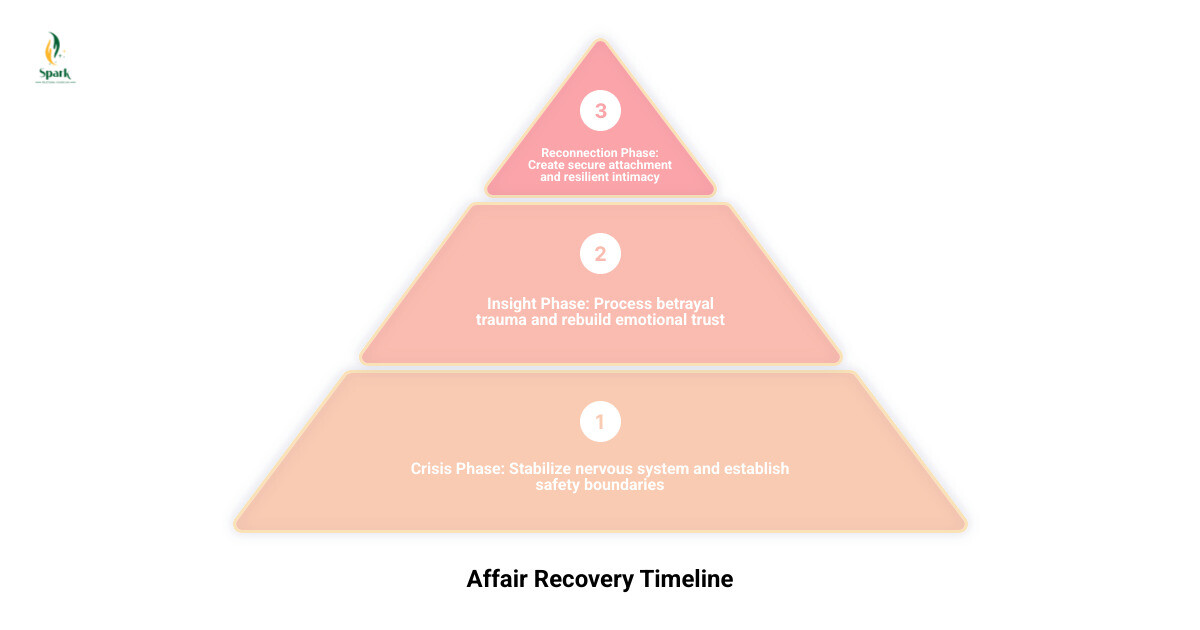
A common recovery arc looks like this:
Crisis phase: first 6 to 8 weeks
Shock, disclosure, stabilization, emotional volatility, urgent questions.Insight phase: roughly months 2 to 9
Understanding what happened, processing grief, beginning therapy, exploring relationship patterns without excusing the affair.Rebuilding phase: roughly months 9 to 36
Trust grows through consistency, repair attempts begin to land, emotional and physical intimacy slowly become more secure.
Many couples experience significant shifts around 18 to 24 months, though timelines vary. Recovery can take longer when there was long-term deception, repeated affairs, ongoing contact, or gaslighting.
The key is not speed. The key is direction.
If the couple is moving toward honesty, accountability, emotional presence, and secure connection, they are healing. If they are cycling through secrecy, blame, pressure, or avoidance, they likely need more support.
For a fuller map, see The Phases of Affair Recovery.
What is the difference between individual healing and relationship reconciliation?
This distinction is essential.
Individual healing is the personal recovery process. It belongs to each partner. The betrayed partner may need to process trauma, grief, anger, self-doubt, and identity rupture. The partner who cheated may need to understand their choices, shame, avoidance patterns, attachment wounds, and capacity for accountability.
Individual healing can happen whether the couple stays together or separates.
Relationship reconciliation is the shared process of rebuilding the partnership. It requires both people. One person cannot reconcile a relationship alone, no matter how emotionally evolved, well-read, hydrated, or committed they are.
Reconciliation requires:
- Mutual willingness
- Emotional safety
- Behavioral change
- Repair conversations
- Boundaries
- Accountability
- Patience
- Support
Sometimes the healthiest outcome is rebuilding together. Sometimes the healthiest outcome is separating with clarity and dignity. Therapy can help you listen for the difference without making fear the decision-maker.
If you are focusing on your own healing, start with How to Heal Myself from Infidelity.
Conclusion

So, how do couples recover from cheating?
They stabilize the crisis. They tell the truth carefully. They stop the ongoing harm. They make room for grief. They rebuild trust with behavior, not speeches. They learn to communicate without turning every conversation into a trial. They repair the attachment bond through emotional presence, transparency, and consistent care. They address the deeper patterns that made the relationship vulnerable, while still holding the cheating partner fully responsible for the choice to betray.
Most of all, they stop trying to resurrect the old relationship and begin co-creating something more honest.
Affair recovery is tender work. It asks both partners to become braver, softer, clearer, and more accountable than they may have been before. It is not easy. But with the right support, it can become a doorway into a relationship marked by deeper truth and more secure connection.
May Han and the clinical team at Spark Relational Counseling offer specialized, mindfulness-based relational therapy to help couples navigate betrayal trauma, process deep attachment injuries, and co-create a resilient, secure future together. We provide virtual counseling for individuals and couples in Oregon, Washington, and Illinois.
If you are ready for support, begin here: Affair Recovery Counseling: What Healing Really Requires After Betrayal.
