What Is Cross-Cultural Counseling?

Cross-cultural counseling is therapy that takes a client's cultural background seriously. A counselor asks how family values, language, identity, and life experiences shape the client's concerns, then works with the client to make care fit. The goal is not to guess what someone needs based on their culture. It is to listen, check assumptions, and build trust.
This matters when you are working through conflict with a partner, stress at work, or a pattern you want to change. Feeling understood can make it easier to talk openly about what is happening and what you want to do next.
I'm May Han, a licensed marriage and family therapist at Spark Relational Counseling with a background from Northwestern University and a strong interest in relationships and minority mental health. I bring mindfulness and emotionally focused techniques to my approach to cross-cultural counseling.
Foundations and Core Models of Cross-Cultural Counseling
Across the mental health field, culture is no longer treated as a peripheral footnote. Instead, multiculturalism stands recognized as a foundational "fourth force" in clinical psychology, alongside psychodynamic, behavioral, and humanistic traditions. Culture is not a static list of traditions or holidays; it is a dynamic, living information system that shapes how we experience emotional distress, communicate vulnerability, and conceptualize healing.
When mental health care is disconnected from cultural context, therapeutic misalignments occur. Standard modalities developed in specific historical contexts risk imposing assumptions that do not translate across different communities. Foundational texts such as Counseling the Culturally Diverse: Theory and Practice have emphasized that effective therapy requires understanding how structural dynamics, systemic privilege, and lived experiences shape our worldview.
Distinguishing Cross-Cultural Counseling from Multicultural Approaches
While the terms are often used interchangeably, understanding the distinction between cross-cultural and multicultural frameworks clarifies how therapy unfolds in practice. As explored in our guide to foundational cross-cultural therapy definitions, cross-cultural counseling historically focuses on bridging distinct cultural worlds—frequently across national, geographic, or linguistic boundaries—while multicultural counseling often addresses the rich diversity, intersectional identities, and systemic power dynamics within a specific society.
| Dimension | Cross-Cultural Counseling | Multicultural Counseling |
|---|---|---|
| Primary Scope | Comparative and transnational; interactions across distinct cultural or geographic systems | Intra-societal diversity; intersectionality within a shared national or regional framework |
| Core Focus | Bridging different worldviews, acculturation transitions, and migratory experiences | Systemic power imbalances, identity development, and historical inequities |
| Therapeutic Dynamic | Navigating universal human needs alongside culture-specific explanatory models | Examining overlapping social locations (race, gender, class, sexual orientation) |
| Clinical Goal | Adapting relational interventions to fit local and transnational contexts | Fostering self-actualization, empowerment, and culturally grounded equity |
Theoretical Frameworks: Emic, Etic, and the Process Model
Navigating cultural complexity requires clear theoretical models that balance universal human emotion with culturally specific expression:
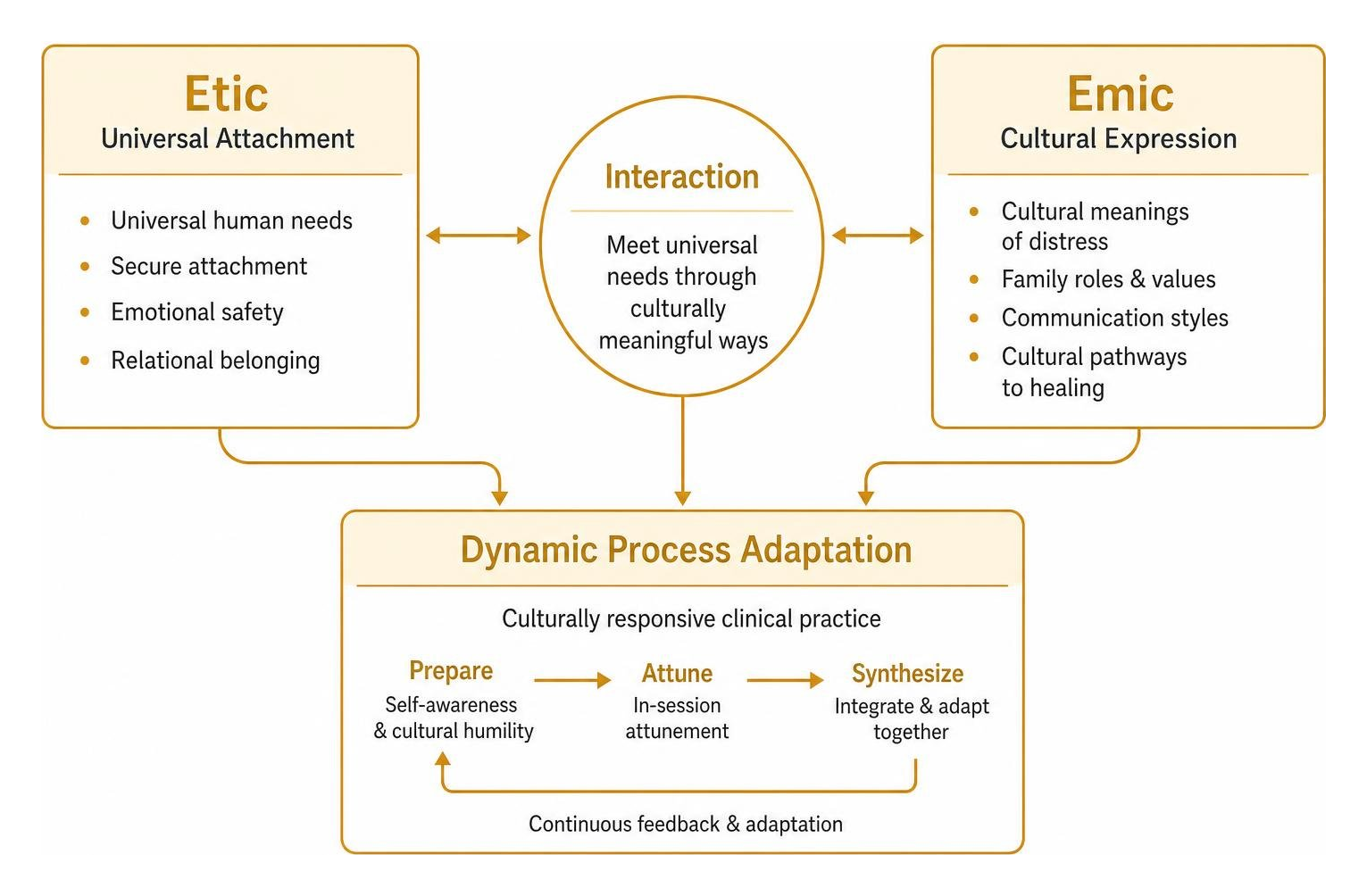
- The Emic-Etic Continuum: An etic perspective looks at universal human experiences—such as the fundamental need for secure attachment, emotional safety, and relational belonging. An emic perspective examines how distress, family roles, and emotional resolution are understood within a specific cultural community. Responsive therapy honors both, utilizing universal relational drives while speaking the client's cultural language.
- Autoplastic vs. Allocentric Adaptation: In cross-cultural dynamics, individuals navigate internal adjustments (autoplastic adaptation, where one shifts personal expectations to fit an environment) and outward adjustments (allocentric adaptation, where one seeks to reshape their environment or community to fit personal needs).
- The Process Model: Outlined in clinical scholarship like The Process Model of Multicultural Counseling Competence, cultural responsiveness is not a checklist. It is a dynamic, continuous operation across three distinct phases: preparation, in-session attunement, and treatment synthesis. Landmark reviews in Counseling Across Cultures confirm that incorporating deep-structure cultural values directly into the relational process yields the strongest therapeutic outcomes.
Key Competencies and Overcoming Barriers in Clinical Practice

Effective clinical work requires clinicians to cultivate continuous self-examination. Truly understanding what it means to be a culturally competent therapist moves beyond academic knowledge into emotional presence, humility, and the real-time awareness of relational power dynamics.
Developing Cultural Humility and Self-Awareness
Cultural humility is a lifelong commitment to self-reflection and learning rather than an endpoint of mastery. Clinicians must examine their own racial consciousness, social privilege, and unconscious filters. When clinicians explore the essential multicultural factors in counseling, they create space to recognize how implicit bias can cloud clinical intuition.
Practicing cultural humility in therapeutic work involves intentional habits:
- Tracking Internal Somatic Triggers: Noticing when physical tension or subtle defensiveness arises in session, using mindfulness to pause before reacting.
- Hypothesis Testing Over Assumption: Holding clinical interpretations lightly, constantly checking with the client rather than assuming shared meaning.
- De-centering the Dominant Narrative: Actively acknowledging that Western psychological norms are not the default standard of emotional health.
- Explicit Power Clarification: Naming the natural authority imbalance between therapist and client, inviting open dialogue about how differences in background impact safety.
Navigating Communication Styles, Stigma, and Bias
Navigating cultural differences requires attunement to diverse communication styles and community expectations. In many cultures, direct emotional confrontation feels disruptive to relational harmony. Understanding these nuanced dynamics is essential when bridging cultural gaps for Asian American clients or other communities where emotional expression is conveyed through somatic experiences, thoughtful pacing, or actions of care.
Clinical literature in the Cross-Cultural Counseling guide notes that systemic stigma and fear of judgment often deter individuals from seeking therapy. When microaggressions occur within clinical spaces, they can erode relational trust. Culturally attuned clinicians actively broach cultural differences early, creating a secure environment where clients can openly address misunderstandings without fear of rupturing the relationship.
Evidence-Based Interventions and the Therapeutic Relationship
Decades of research underscore the vital importance of culturally responsive care. Meta-analyses demonstrate that multicultural training for clinicians yields a substantial average effect size of 0.92. Furthermore, while the correlation between therapist multicultural competence and overall outcome is notable at 0.29, its correlation with in-session process measures reaches 0.75. Research highlighted in scholarly studies on culture in counseling affirms that when clinicians adapt their relational framework to align with a client's lived reality, treatment retention and emotional wellness improve significantly.
Implementing Culturally Adapted Interventions and Microinterventions
Adapting therapy goes beyond simple language translation. It involves incorporating a "culturally familiar myth"—a shared narrative framework that aligns with the client's spiritual, familial, and community worldview. Clinical studies have shown that integrating these deep-structure elements produces therapeutic benefits well beyond generic treatment protocols.
Rather than relying on rigid, manualized strategies, culturally responsive practitioners utilize modalities grounded in experiential depth, emotional safety, and neurobiological attunement:
- Emotionally Focused Therapy (EFT): Helps individuals and couples access underlying attachment vulnerabilities, reshaping negative relational cycles into secure, responsive bonds while honoring family obligations and collectivist loyalties.
- Accelerated Experiential Dynamic Psychotherapy (AEDP): Emphasizes "undoing aloneness" by processing vulnerable affect within a collaborative, emotionally safe dyad, allowing clients to heal intergenerational burdens without feeling culturally judged.
- Experiential Therapy & Brainspotting: Utilizes visual somatic processing and focused neuro-experiential access points to process somatic trauma and minority stress stored beneath conscious verbal expression.
- Mindfulness-Based Relational Therapy: Guides clients to mindfully notice emotional thresholds, de-escalate reactive neurological loops, and establish healthy relational boundaries that respect cultural roles.
Foundational frameworks documented in the International Handbook of Cross-Cultural Counseling and the principles of the cultural sensitivity approach demonstrate how blending experiential therapies with cultural responsiveness transforms therapeutic care into an empowering process.
Relational Dynamics and Alliance in Cross-Cultural Counseling

Imagine sitting in a therapy room, feeling a heavy weight in your chest while trying to explain the delicate balance between honoring your parents' traditional expectations and pursuing your individual aspirations. In a culturally unadapted space, that dynamic might be quickly labeled as "enmeshment." But with an attuned, culturally responsive therapist, that tension is recognized as an expression of profound familial loyalty, love, and cross-generational sacrifice.
When working with couples from different backgrounds, cultural awareness is essential for untangling relational misunderstandings. Discovering how cultural awareness strengthens relationships in therapy helps partners recognize that a behavior they perceive as emotional withdrawal may actually be a culturally ingrained strategy for preserving harmony. By recognizing the role of cultural awareness in understanding relationship dynamics, couples transform defensiveness into deep, mutual empathy.
Specialized Applications, Professional Ethics, and Future Directions
Culturally responsive practice is central to ethical therapy. Ethical codes across professional associations require clinicians to practice within the boundaries of their cultural competence, avoiding diagnostic bias and advocating against systemic disparities in care.
Sociological studies reveal that African Americans are significantly less likely than white Americans to seek mental health care, even when they recognize its value, largely due to historical mistrust and systemic bias. Similarly, low-income households face severe systemic barriers to care. Understanding the distinct multicultural counseling benefits for BIPOC individuals allows practitioners to design welcoming, culturally attuned environments that dismantle these barriers.
Understanding Mental Health Navigation: Systemic Realities
When seeking support, navigating healthcare systems involves important considerations. While utilizing in-network insurance benefits can offer immediate financial assistance, it also introduces systemic constraints that warrant careful evaluation:
- Mandatory Diagnoses: In-network insurance requires clinicians to assign a formal psychiatric diagnosis, which permanently enters your medical record and can have unintended implications for future life events, such as underwriting private disability or life insurance, security clearances, or international adoption processes.
- Confidentiality Limitations: Third-party payers retain the right to audit clinical records, compromising the absolute privacy of your vulnerable personal disclosures.
- Restricted Modalities: Managed care often restricts the duration and depth of treatment, limiting the ability to engage in nuanced, long-term experiential modalities like AEDP, Brainspotting, or Emotionally Focused Therapy.
Private-pay and culturally tailored practices provide an alternative where you and your therapist maintain total autonomy over the pacing, privacy, and depth of your healing journey.
International Settings, Member Care, and Educational Pathways
Cross-cultural counseling principles extend far beyond domestic practice:
- Member Care and Global Expatriates: Supporting aid workers, international business leaders, and missionaries requires targeted care frameworks to address acute culture shock, systemic grief, and reintegration challenges.
- Academic and Practicum Pathways: Advanced graduate degree programs across North America now emphasize intercultural communication, clinical trauma, and community-based experiential practicums.
- Global Synthesis: Systematic evaluations highlighted in the critical review of cross-cultural psychotherapy research show that integrating indigenous concepts into clinical care significantly enriches client outcomes worldwide.
Emerging Trends, Virtual Delivery, and Global Practice
As virtual mental health platforms expand across Oregon, Washington, and Illinois, therapy is more accessible than ever. Tele-mental health allows clients to connect with specialized clinicians who share or deeply understand their cultural background, even if they reside in different regions.
Looking forward, the integration of mindfulness-based relational approaches, neuro-experiential modalities, and social justice frameworks will continue to expand the horizons of culturally grounded mental health.
Frequently Asked Questions About Culturally Responsive Mental Health
What is the difference between emic and etic perspectives in therapy?
An etic approach examines universal aspects of human psychology—such as fundamental attachment drives, basic emotional processing, and nervous system regulation. An emic approach focuses on culture-specific understandings of distress, social roles, and healing traditions. Culturally responsive clinicians weave both perspectives together, ensuring that universal human needs are addressed in ways that honor each client's specific cultural context.
How do cultural factors impact the therapeutic alliance?
Culture directly shapes how trust is built, how authority is perceived, and how vulnerability is expressed. When a therapist demonstrates cultural humility, actively broaches identity differences, and validates the client's lived experiences, the therapeutic alliance deepens significantly. Research indicates that therapist multicultural competence correlates strongly with process measures at 0.75, demonstrating that cultural attunement is central to a strong therapeutic connection.
Why is cross-cultural counseling vital in modern mental health care?
Modern society is rich with intersecting cultural, racial, and international backgrounds. Traditional, unadapted Western counseling models can inadvertently misinterpret cultural values or pathologize healthy family dynamics. Cross-cultural counseling bridges these divides, reduces mental health disparities, and ensures that evidence-based interventions are tailored to provide resonant, lasting healing.
Conclusion
Embracing culturally responsive therapy is an ongoing journey of cultural humility, empathetic presence, and relational safety. When therapy honors every facet of who you are—your heritage, your family narrative, and your lived experiences—it creates the foundation for meaningful, lasting transformation.
At Spark Relational Counseling, May Han and our clinical team offer virtual individual and couples therapy across Oregon, Washington, and Illinois. Utilizing mindfulness-based relational therapy, Emotionally Focused Therapy (EFT), AEDP, and Brainspotting, our clinicians help you counter negative brain autopilots to cultivate lasting emotional peace and deeply connected, loving relationships.
If you are ready to experience therapy that honors your unique cultural narrative, explore our culturally sensitive individual counseling to begin your collaborative path toward growth and relational harmony.