
The Silent Epidemic: Why Do High Achievers Hide Their Depression?
The Internal Split: Why Do High Achievers Hide Depression Behind Success?

#
Why do high achievers hide depression is one of the most searched — and least openly discussed — questions in mental health today. The short answer: because everything around them confirms they should be fine.
Here is what the research actually shows:
| Reason High Achievers Hide Depression | What It Looks Like |
|---|---|
| Identity is tied to competence | Admitting struggle feels like admitting failure |
| Still functioning = must be fine | Continued performance convinces them they don't qualify for help |
| Fear of judgment and stigma | 33% of high achievers delay treatment due to stigma |
| Perfectionism as emotional camouflage | The drive to appear capable masks internal exhaustion |
| Productivity as emotional regulation | Staying busy keeps uncomfortable feelings at bay |
| Guilt about having "a good life" | External success invalidates their own suffering in their minds |
Picture this: a senior leader closes a deal, watches praise fill her inbox, then sits completely still in a parking garage — not from relief, but from an emptiness she cannot name. She fixes her expression, walks back in, and leads the afternoon meeting flawlessly. No one notices a thing.
That is not a rare story. It is a pattern.
High-functioning depression does not look like the clinical image most people carry. It does not look like staying in bed or missing deadlines. It looks like a packed calendar, a polished exterior, and a quiet inner life that feels increasingly hollow. The very traits that drive achievement — perfectionism, self-reliance, an iron work ethic — become the same traits that hide the pain.
This is what makes it so hard to catch, and so easy to dismiss.
I'm May Han, a Licensed Marriage and Family Therapist at Spark Relational Counseling, and I work closely with high-achieving adults navigating exactly this tension — the gap between outer success and inner suffering that sits at the heart of why high achievers hide depression. In the sections ahead, we'll move through the psychology, the hidden costs, and the paths toward genuine relief.
At the core of the high-achieving experience lies a profound psychological phenomenon known as the "internal split." This is the psychological dividing line between the highly competent, organized self presented to the world, and the weary, suffering self that remains locked away in the dark.
For many professionals in high-velocity hubs like Seattle, Bellevue, and Portland, this split is not a sudden development. It is a deeply ingrained survival mechanism. When we look at why high achievers experience depression, we often find that the very structures of modern success demand this division. The corporate boardroom, the tech sprint, and the partner-track law firm do not have spaces designed for vulnerability. Instead, they reward compartmentalization, speed, and unwavering logic.
This split often traces its roots back to childhood. Many top performers grew up under the weight of early "parentification" — a dynamic where a child is subtly or overtly required to act as the emotional caretaker, the perfect student, or the reliable problem-solver for their family. In these early environments, the child’s nervous system learns a powerful, albeit exhausting, lesson: my safety, love, and belonging are entirely contingent on my performance.
When childhood environments teach us that we are only as valuable as our last achievement, our brains hardwire this belief into what we call negative brain autopilots. These are automatic neural loops that continuously whisper that slowing down equals failure, and that showing any sign of weakness will result in a loss of connection or respect.
As adults, this manifests as a sophisticated form of emotional camouflage. As explored in clinical discussions on when competence masks high-functioning depression, exceptional ability can make chronic, low-grade suffering completely invisible to the outside world. Because the high-functioning part of the psyche remains incredibly efficient, it literally locks out the suffering part, leaving the individual to navigate their daily life like a beautifully engineered machine that is slowly running out of oil.
The Anatomy of Silent Suffering: How Hidden Distress Manifests
Because high achievers are masters of intellectualization and compartmentalization, their emotional distress rarely shows up as simple sadness. Instead, the body and the nervous system begin to carry the weight that the conscious mind refuses to acknowledge.
Somatic symptoms are often the first clear indicators that the "performance of wellness" is failing. When emotional pain is suppressed, it frequently translates into physical distress. High achievers are highly prone to chronic tension headaches, unexplained fatigue, and severe sleep disturbances.
In our clinical practice, we frequently observe a strong connection between chronic emotional suppression and gastrointestinal distress. Statistically, 58% of high achievers report IBS-like symptoms during high-pressure periods, highlighting the profound physical toll of hidden depression. When the mind refuses to rest, the gut and the nervous system scream on its behalf.
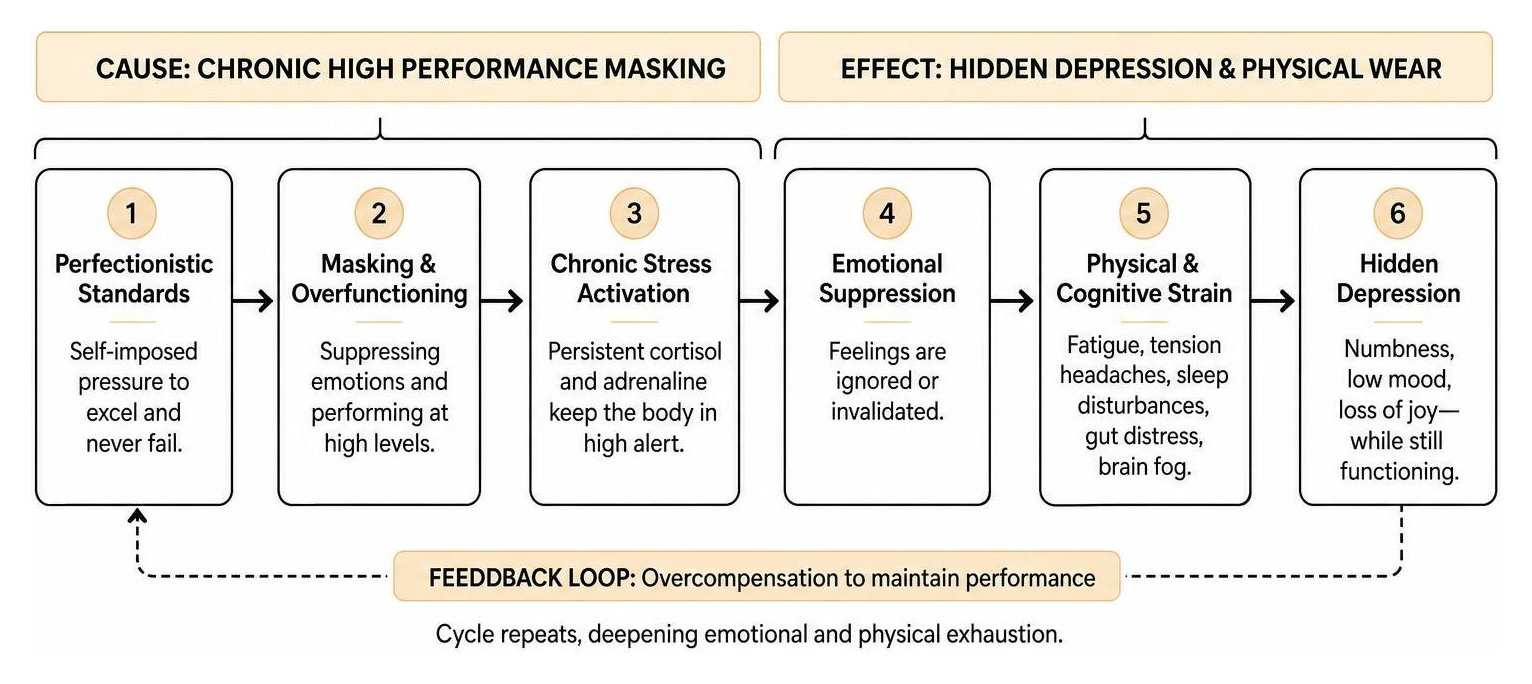
This physical wear-and-tear is accelerated by "temporal perfectionism" — the practice of setting incredibly rigid, self-imposed early deadlines to manage the underlying anxiety of not being "good enough." This constant state of hyper-vigilance keeps the body flooded with cortisol and adrenaline.
To make matters more complex, high achievers are the primary practitioners of presenteeism — the act of showing up to work and performing at capacity while psychologically completely unwell. Because they continue to hit targets and answer emails at midnight, they ignore the subtle warning signs. Yet, our current July 2026 clinical perspectives emphasize that there is a 50% comorbidity rate between depression and anxiety. This means the relentless drive of the high achiever is often fueled by a low-grade, constant state of panic. They are running on a treadmill that they are terrified to step off of, believing that the moment they stop, they will fall into an abyss of depression.
For a deeper look into these patterns, we discuss these dynamics extensively in our resource on why high achievers ignore mental health.
The Relational Cost of the Achiever's Mask
When you are constantly wearing a mask of perfect competence, your relationships inevitably pay the price. High achievers often find themselves trapped in transactional relationships, where they feel they must constantly provide, perform, or solve problems to be worthy of love. This creates a profound sense of emotional unavailability. When your partner asks how you are doing, the automatic response is a polished, "I'm fine, just busy."
Behind that "I'm fine" is a deep-seated fear that if you show your true, exhausted self, your partner will be disappointed, overwhelmed, or leave. This pattern often leads to a slow, painful erosion of intimacy, leaving both partners feeling lonely in the same room.
To help individuals and couples break this cycle, we utilize Emotionally Focused Therapy (EFT). Rather than simply analyzing communication patterns, EFT focuses on the deep, underlying attachment needs that drive our behavior. In therapy, we help the high-achieving partner move away from performance and toward genuine emotional transparency.
By safely exploring the fears of being "imperfect" or "too much," partners can learn to step out of the transactional loop and build relationships based on authentic connection rather than utility. If you find your achievements are driving a wedge between you and those you love, you can read more in our individual therapy for relationship issues.
Why Do High Achievers Hide Depression in Moments of Stillness?
If you want to know if a high achiever is struggling, do not look at them during their busiest week. Look at them on a Sunday afternoon, during a long flight, or on the second day of a beach vacation.
Moments of stillness are often the most terrifying times for a high-functioning individual. When the distraction of back-to-back meetings, project deadlines, and endless notifications finally fades, the internal noise becomes deafening. Without the shield of productivity, the underlying feelings of emptiness, sadness, and existential fatigue rise to the surface.
To avoid these uncomfortable feelings, high achievers engage in extreme overcompensation. They will clean the entire house, plan another business venture, or scroll through work emails on holiday — anything to avoid the quiet. This constant busyness is not just a work ethic; it is an active emotional regulation strategy.
In our work, we help clients recognize their emotional thresholds — the exact point where healthy drive crosses over into desperate avoidance. Learning to sit in stillness without needing to produce is one of the most challenging, yet deeply healing, steps a successful person can take. For practical steps on navigating these quiet moments, explore our guide on how achievers overcome hidden depression.
Dismantling the "Not Depressed Enough" Myth
One of the greatest barriers to healing for successful people is the belief that they are "not depressed enough" to deserve help. They look at clinical descriptions of depression — such as the inability to get out of bed, neglecting personal hygiene, or failing at work — and think, "Well, I ran five miles this morning, led a team of fifty, and made dinner. I can't possibly be depressed."
This is the central paradox of high-functioning suffering. Because their level of daily functioning remains incredibly high, they invalidate their own pain. This dynamic is thoroughly unpacked in our high-functioning depression guide.
This self-invalidation is closely linked to what clinicians refer to as "competency threat." Admitting to a mental health struggle feels like a direct threat to the high achiever’s entire identity. To them, saying "I need help" is equivalent to saying "I am broken."
Furthermore, they struggle with "time austerity" — a mindset common among lawyers, tech executives, and medical professionals, where every hour of the day is viewed through the lens of productivity or billing. They view taking an hour for therapy as "lost billable hours" or a sign of poor time management, rather than an essential investment in their long-term sustainability.
This is why, as explored in a poignant psychologist's perspective on high-functioning suffering, being "fine" is often the most dangerous state of all. When we perform wellness, we cut ourselves off from the natural support systems that keep us healthy.
This pressure is particularly intense for female high achievers, who are 20-30% more likely to score above the 90th percentile on socially prescribed perfectionism — the belief that others demand nothing short of absolute perfection from them at all times.
Why Do High Achievers Hide Depression and Avoid Seeking Help?
Even when high achievers recognize that something is deeply wrong, they face a unique set of barriers that prevent them from seeking clinical support. The primary obstacle is an extreme, almost pathological commitment to self-reliance. They are used to being the ones who have all the answers, who fix the problems, and who rescue others. The idea of leaning on someone else feels uncomfortable, even irresponsible.
There is also a profound fear of professional and social stigma. In competitive corporate environments from Seattle to Chicago, there is a lingering worry that admitting to depression or anxiety will stall career progression, damage professional credibility, or lead to being viewed as "unfit" for leadership.
To bypass these barriers, we must fundamentally reframe what therapy is. Mental health care for top performers is not about treating weakness; it is a sophisticated form of performance optimization and long-term sustainability. Just as an elite athlete utilizes physical therapists, coaches, and sports psychologists to keep their body in peak condition, a high-performing professional utilizes therapy to keep their mind and nervous system functioning at their highest level.
Vulnerability is not a loss of control; it is the ultimate expression of intelligence and self-awareness. For those ready to explore this shift, we offer tailored support detailed in our page on therapy for overachievers mental health.
Healing the Split: Experiential and Relational Paths to Lasting Peace
True recovery from high-functioning depression cannot be achieved by simply "thinking differently" or analyzing your problems logically. High achievers are already brilliant at over-thinking; they do not need more cognitive homework. Instead, lasting healing requires moving out of the analytical mind and into the body and the emotional self.
At Spark Relational Counseling, where our founder May Han and our clinical team specialize in high-achieving minds, we utilize deeply experiential, somatic, and relational modalities to help clients bridge the internal split. One of our primary frameworks is Accelerated Experiential Dynamic Psychotherapy (AEDP). Unlike traditional talk therapies that focus heavily on past history or cognitive restructuring, AEDP is designed to process deep emotional states in real-time, right in the therapy room. By focusing on the immediate, felt experience of safety and connection, AEDP allows the high achiever to safely let down their guard and process the heavy, locked-away emotions they have carried for years.
We also integrate Brainspotting, a powerful brain-body treatment that works by identifying, processing, and releasing core neurophysiological sources of emotional and physical pain. Brainspotting bypasses the analytical neocortex (the part of the brain high achievers use to rationalize their feelings) and directly accesses the subcortical brain, where trauma and chronic stress are held. This allows for deep somatic integration and rapid relief from chronic physical tension, anxiety, and exhaustion.

In addition to these clinical modalities, we provide practical high-functioning depression therapist tips to help clients build manageable boundaries in their daily lives. This includes the practice of "microdosing self-care" — taking small, non-negotiable 3-to-5-minute pauses throughout the day to step away from screens, breathe deeply, and check in with the body.
Through mindfulness-based relational therapy, we help you slow down your negative brain autopilots, allowing you to exist without constantly producing, and ultimately finding a sense of lasting peace that external achievements can never provide.
Frequently Asked Questions about High-Functioning Depression
What is high-functioning depression and how does it differ from typical depression?
High-functioning depression, clinically referred to as Persistent Depressive Disorder (or dysthymia), is a chronic, low-grade form of depression that lasts for two years or more. While typical depression often presents with visible functional impairment — such as an inability to work, maintain relationships, or handle daily tasks — high-functioning depression is characterized by emotional masking.
Individuals continue to meet all professional and social obligations flawlessly, appearing highly successful on the outside, while quietly battling a persistent feeling of emptiness, fatigue, and self-doubt on the inside.
How does perfectionism mask depression in high achievers?
Maladaptive perfectionism acts as a highly effective psychological camouflage. The relentless drive to meet impossibly high standards, the loud and critical inner voice, and the constant "performance of wellness" make it nearly impossible for others to see the underlying pain.
High achievers often use perfectionism to avoid the fear of failure or criticism, believing that if their output is flawless, they will remain safe from judgment. This constant striving masks the deep emotional depletion and exhaustion that characterize clinical depression.
Can therapy help high achievers without diminishing their drive or success?
Yes, absolutely. A common fear among top performers is that if they address their depression or anxiety, they will lose their "edge" or the drive that made them successful. In reality, therapy does not diminish your talent or ambition; it removes the toxic, fear-based fuel (like anxiety, guilt, and shame) and replaces it with sustainable, values-driven performance.
By learning to recognize your emotional thresholds and setting manageable boundaries through experiential therapy, you can achieve even greater, more lasting success without burning out or sacrificing your well-being.
Conclusion: Stepping Out of the Performance
The performance of faking happiness is an incredibly lonely path. It demands that you show up every day as a highly polished version of yourself, while leaving the parts of you that are tired, hurting, and human locked away in the dark. But you do not have to live behind the mask forever.
At Spark Relational Counseling, we believe that your worth is not a sum of your achievements, your billable hours, or your professional accolades. You deserve to feel well, not just perform well. Together with our clinical team, including our founder May Han, we work to help you dismantle the negative brain autopilots that keep you trapped in a cycle of endless doing.
Through our specialized virtual therapy services, we provide a discreet, intellectually engaging, and deeply compassionate space for high-performing adults across Oregon, Washington, and Illinois.
Whether you are seeking support for yourself or looking to heal the relational patterns that are straining your marriage, we are here to help you find your way back to genuine connection and lasting peace. If you are ready to take off the mask, we invite you to explore our specialized services in high-functioning depression or connect with our regional resources for high achiever mental health Oregon.
You have spent your entire life taking care of business, taking care of others, and taking care of the next milestone. It is time, finally, to take care of you.
