In Depth Guide to Finding Therapy in Portland, OR
Finding the Right Fit: A Starting Point for Portland OR Therapy

Portland OR therapy offers one of the most diverse and accessible mental health landscapes in the Pacific Northwest. If you're looking for a quick overview before diving deeper, here's what you need to know:
| Therapists available | 3,000+ in Portland |
| Average session cost | $174 |
| Low-cost options | Sliding scale fees, Oregon Health Plan (OHP), sessions under $50 |
| Top insurances accepted | Aetna (72%), BlueCross BlueShield (59%), Regence (57%) |
| Most common specialties | Anxiety (92%), Depression (84%), Trauma & PTSD (75%) |
| Session formats | 56% offer both in-person and online; 44% are online only |
| How to filter | By insurance, gender, ethnicity, specialty, cost, and location |
Maybe you've been carrying something for a long time — a low hum of anxiety, a recurring conflict with someone you love, or a quiet sense that you're running on autopilot. You know something needs to shift, but the thought of sorting through thousands of therapists in Portland feels like one more thing on an already full plate.
That feeling is more common than you'd think. And it's exactly where this guide begins.
I'm May Han, a Licensed Marriage and Family Therapist at Spark Relational Counseling, serving clients in Oregon, Washington, and Illinois. With a background from Northwestern University and specialized training in mindfulness and emotionally focused approaches, I've spent my career helping adults and couples in Portland OR therapy settings break through repeating patterns and build relationships that feel genuinely alive. In the sections ahead, I'll walk you through everything you need to find the right support — without the overwhelm.
Navigating the Landscape of Portland OR therapy
With over 3,000 mental health providers practicing in Portland, the local clinical community is exceptionally robust. The average clinician in the area brings 10 years of experience to their practice, representing a highly seasoned pool of professionals. However, navigating this vast landscape requires understanding where clinical priorities lie and how they match your personal needs.
Statistically, Portland’s clinical community is highly focused on the most pervasive mental health challenges of our time. An overwhelming 92% of local therapists prioritize treating anxiety, while 84% focus on depression, and 75% specialize in trauma and PTSD. Whether you are dealing with chronic stress or navigating the complex aftermath of difficult life events, you are surrounded by a network of clinicians equipped to support you. For a comprehensive look at starting this process, our resource, Therapy Portland Oregon: A Guide to Navigating and Finding Support, offers an excellent baseline.
The geographic distribution of therapy in the Portland metro area is also highly diverse. While neighborhoods like Southeast Portland and Northwest Portland host a high concentration of private practices, surrounding communities also feature excellent localized hubs. If you reside slightly outside the city center, you can find top-tier clinical care in areas like Lake Oswego, Happy Valley, or Tualatin, where specialized practitioners offer both in-person and virtual options to meet your needs.
For those seeking to address relational dynamics, navigating this landscape means looking for clinicians who understand that we do not heal in isolation. Our relationships have the power to cause immense pain, but they also serve as our greatest arenas for profound healing and growth.

Specialized Therapeutic Modalities: Moving Beyond Traditional Talk Therapy
Many individuals seek therapy hoping to talk their way out of painful feelings, only to find themselves running in intellectual circles. Traditional talk therapy operates primarily in the logical, analytical brain. While gaining intellectual insight is valuable, it rarely overrides the deep-seated reflex emotions and physiological survival states that take over when we are highly stressed.
To create lasting change, we must move beyond the logical mind and engage the nervous system. This is where specialized, experiential modalities excel:
- Emotionally Focused Therapy (EFT): EFT is a structured, highly validated approach that views relational distress through the lens of attachment. Instead of simply teaching communication tips, EFT helps you and your partner identify the underlying fears and unmet needs driving your repetitive cycles. By sharing these vulnerable layers, you construct a secure, resilient bond.
- Accelerated Experiential Dynamic Psychotherapy (AEDP): AEDP focuses on processing deep emotional states in the safety of the therapeutic relationship. It is an active, warm modality that aims to help you "undoneness" by processing difficult feelings together with your therapist, transforming pain into resilience in real-time.
- Experiential Therapy: This approach emphasizes live, in-the-moment experiencing over clinical abstraction. It encourages you to actively feel, express, and somaticize your emotional truths rather than merely talking about them.
- Brainspotting: Brainspotting is a powerful, neuro-experiential modality that uses your visual field to locate and process trauma, anxiety, and stress held deep within the subcortical brain. By bypassing the cognitive filters of the logical mind, Brainspotting accesses the brain's innate self-healing capacity.
These somatic and relational modalities are uniquely designed to dismantle "negative brain autopilots" — those deeply ingrained, default neural pathways that cause us to overthink, shut down, or push others away before we even realize we are doing it.
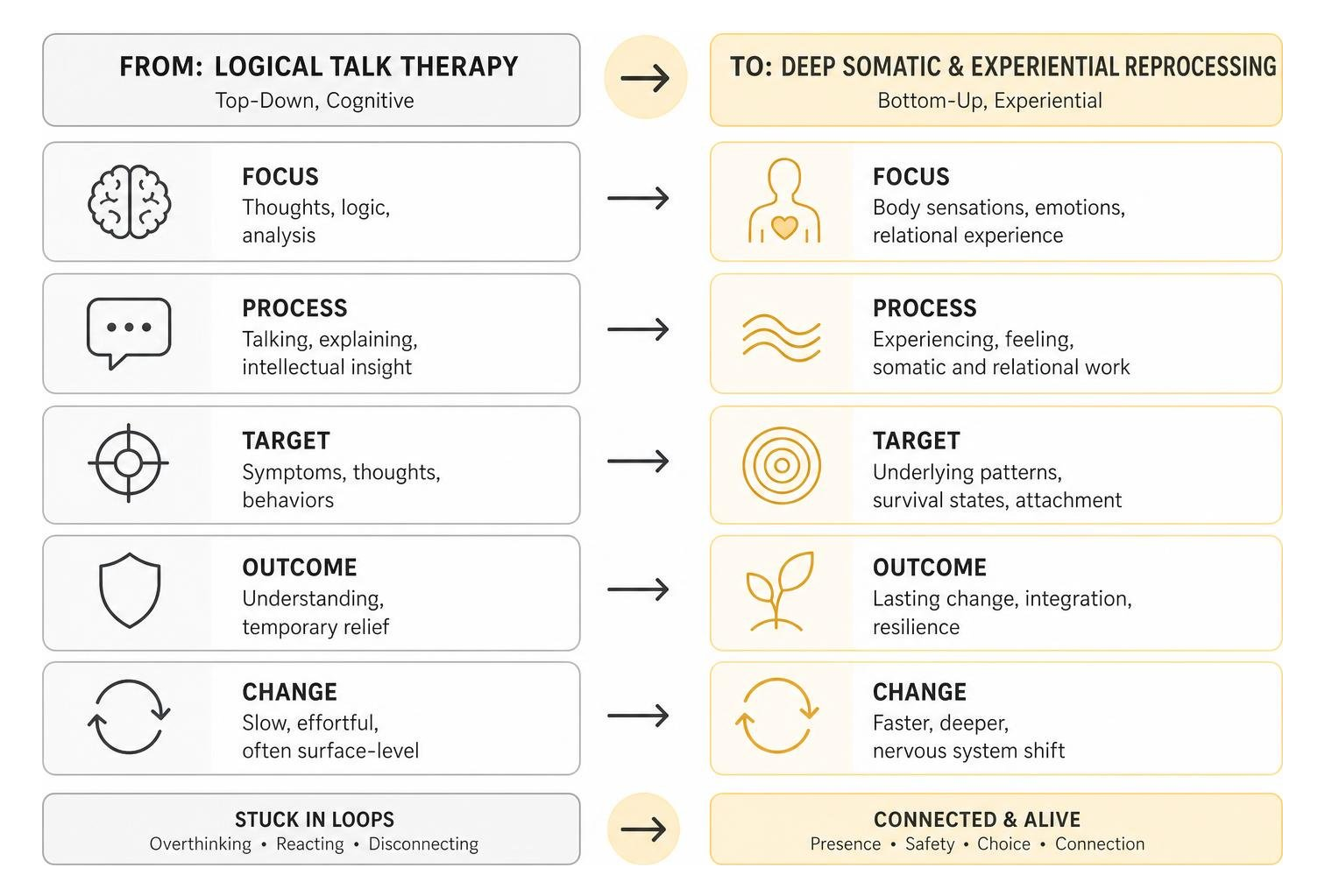
When we address these patterns, we pave the way for true healing. If you are seeking to repair a partnership, utilizing these modern frameworks can help you step out of defensive loops and return to a place of mutual safety. You can explore how these somatic patterns manifest in couples work through our guide on Relationship Therapy Portland Oregon, or dive into clinical timing with Marriage and Couples Counseling in Portland Oregon. For couples preparing to build a life together, our resource on Premarital Counseling Portland Oregon provides a solid foundation for preventing these autopilots from taking root.
Virtual vs. In-Person Care, Costs, and Insurance in Oregon

Choosing how to receive care is just as important as choosing the modality itself. In Portland, 56% of therapists utilize a hybrid model, seeing clients both in person and online, while 44% operate exclusively online.
Some worry that virtual therapy lacks the intimacy of an in-person office. However, experienced somatic and relational therapists are highly trained in "somatic tracking" through a screen. We carefully observe micro-expressions, shifts in posture, vocal tone, and breathing patterns, translating the deep relational work seamlessly into a digital space. This flexibility is highly beneficial for busy professionals and couples balancing hectic schedules across the region.
When it comes to financial planning, understanding your options is essential. The average cost of a private-pay therapy session in Portland is $174. To make care accessible, many therapists accept insurance or offer sliding scale fees based on income.
Insurance and State Coverage in Oregon
For those utilizing insurance, the most widely accepted plans in the Portland therapy market include:
- Aetna: Accepted by 72% of local therapists.
- BlueCross BlueShield: Accepted by 59% of local therapists.
- Regence: Accepted by 57% of local therapists.
For eligible low-income residents, the Oregon Health Plan (OHP) provides comprehensive mental health coverage. Many community clinics and specialized collectives prioritize OHP members, ensuring that high-quality, somatic, and trauma-informed care is accessible to those who need it most. If you are looking for virtual-first networks that help bridge these access gaps across the state, state directories and community health portals can assist in locating in-network clinicians.
To help you evaluate your financial and care options, consider the following breakdown:
| Care Path | Average Cost / Session | Pros | Key Considerations | |
|---|---|---|---|---|
| Private Pay | $150 - $220 | Maximum clinical freedom; no psychiatric diagnosis required; complete privacy. | Higher out-of-pocket cost; requires upfront payment. | |
| Commercial Insurance | Co-pay ($20 - $50) | Highly affordable; utilizes existing employer benefits. | Requires a clinical diagnosis; limited therapist availability. | |
| Oregon Health Plan (OHP) | $0 | Fully covered; excellent community-based somatic and crisis resources. | Longer waitlists; limited to OHP-contracted clinics. |
Navigating the No Surprises Act
If you choose to pay out-of-pocket or are uninsured, you are protected under the federal No Surprises Act. Your therapist is legally required to provide you with a Good Faith Estimate (GFE) outlining the expected costs of your treatment before you begin therapy. Be sure to keep a copy of this estimate; if your actual bills exceed the GFE by $400 or more, you have the legal right to dispute the charges.
For a deeper dive into managing virtual care across the state, explore our Online Therapy Oregon Guide 2026. If you are specifically interested in virtual relational work, check out our insights on Online Marriage Counseling in Oregon: Exploring Your Options and Oregon Virtual Couples Sessions.
Frequently Asked Questions About Mental Health Support
How do I find a specialized provider for Portland OR therapy?
Finding a therapist who aligns with your identity, lifestyle, and values is crucial for building a secure therapeutic relationship. In Portland, the therapist gender demographic breakdown sits at 74% female, 21% male, and 5% non-binary.
When searching for a provider, look beyond basic credentials to find someone who practices genuine cultural humility. Many Portland directories allow you to filter by highly specific criteria, including LGBTQ+-competent care, trans-affirming practices, body-positive/Health at Every Size (HAES) frameworks, and racial justice lenses. This is particularly vital for members of diaspora communities, third-culture kids (TCKs), and neurodivergent individuals who need a space where their lived experiences are deeply understood rather than pathologized.
If you are a high-achieving professional navigating workplace stress, or a woman seeking specialized support, you may find our resources on High Achiever Mental Health Oregon and Dating Therapy for Women Oregon highly relevant. If you are searching for directories outside of Oregon to support loved ones in other states, you can utilize regional search tools such as:
- Find Therapists and Psychologists in Seattle, WA
- Find Therapists and Psychologists in Illinois
- Find Therapists and Psychologists in Chicago, IL
- Find Therapists and Psychologists in Washington, DC
What is the average cost of Portland OR therapy sessions?
The average cost of a session in Portland is $174, typically ranging from $100 to $220 depending on the clinician’s experience, specialization, and location. If you are on a tight budget, look for therapists who offer sliding scale slots or search for low-cost community clinics that provide sessions under $50.
Additionally, if you have out-of-network benefits through your commercial insurance, you can pay your therapist directly and request a monthly document called a superbill. You can submit this superbill to your insurance company for partial out-of-network reimbursement, making premium, specialized care much more accessible.
How do I verify if an Oregon clinician is licensed?
To ensure you are receiving safe, ethical, and professional care, always verify your therapist’s licensing status. In Oregon, licensed mental health professionals are regulated by state boards. You can easily look up a clinician’s license number and check for any disciplinary actions through the Oregon Board of Licensed Professional Counselors and Therapists (OBLPCT) or the Oregon Board of Licensed Social Workers.
Verifying credentials ensures your practitioner has completed the rigorous supervised clinical hours, examinations, and ongoing continuing education required to practice safely in the state.
Conclusion
Finding the right support is a deeply personal journey, but you do not have to navigate it alone. Whether you are looking to heal old wounds, navigate a difficult life transition, or repair your most important relationships, the right therapeutic fit can help you step out of survival mode and back into your life.
At Spark Relational Counseling, founder May Han and her team of dedicated therapists offer virtual mindfulness-based relational therapy designed to help clients recognize emotional thresholds, set manageable boundaries, and counter negative brain autopilots for lasting peace and loving relationships. By blending clinical expertise with a warm, collaborative, and deeply compassionate approach, we help individuals and couples across Oregon, Washington, and Illinois build lives and partnerships that feel authentically connected.
If you are ready to take the next step in your healing journey, we invite you to explore our services and schedule a consultation through our Online Therapy in Oregon portal. Your path toward greater ease, intimacy, and clarity starts here.