
How to Use Visualization to Beat Burnout - Thoughts from a Mindfulness based therapist

When you are deeply burned out, your brain's alarm system stays stuck in the "on" position. Chronic stress alters the neural architecture of the brain, overactivating the amygdala while dampening executive functioning in the prefrontal cortex. Understanding how visualization techniques aid recovery begins with understanding neuroplasticity: the brain’s continuous ability to form new neural pathways and reorganize itself in response to experience.
Your brain is surprisingly non-literal. When you vividly imagine an experience, the brain activates many of the exact same neural networks as it would if the event were occurring in physical reality. Research highlights this phenomenon: a systematic review on motor imagery and brain plasticity analyzing 41 randomized controlled trials showed that mental rehearsal activates key regions including the primary motor cortex, premotor cortex, and cerebellum. This mental activation strengthens corticospinal excitability and triggers neuroplastic changes.
When you engage in structured imagery, you interrupt the neural loops driving chronic stress. Research demonstrates that episodic future thinking—a targeted form of visualization where you imagine positive future outcomes—directly lowers cortisol levels. Lowering cortisol shifts your physiology out of a sympathetic fight-or-flight state, creating space to restore your reserves. If you are unsure where your nervous system currently sits, learning how to track burnout symptoms offers a helpful starting baseline.
Mind-Body Synergy: How Visualization Techniques Aid Recovery at the Cellular Level
The connection between mind and body is not symbolic; it is rooted in psychoneuroimmunology, the study of how emotional and psychological states directly affect biological health. Burnout manifests as physical fatigue, gastrointestinal distress, elevated systemic inflammation, and muscle tension.
At the cellular level, visualization helps modulate the autonomic nervous system by tone-adjusting the vagus nerve. By pairing detailed sensory imagery with slow, abdominal breathing, you stimulate parasympathetic dominance. Clinical evidence on post-surgery imagery and tissue recovery demonstrates that imagery practice can alter physiological outcomes, reduce post-operative pain, and lower physical anxiety. Studies note that mental practice releases natural pain-modulating chemicals and dampens inflammatory pathways, accelerating physical restoration and tissue healing.

How Visualization Techniques Aid Recovery from Emotional Exhaustion
Burnout leaves individuals feeling hollowed out or emotionally flat. This defense mechanism occurs when the brain attempts to protect itself from overwhelming emotional demands. Knowing how to stop feeling emotionally numb involves gradually re-establishing contact with a safe internal environment.
Emotional exhaustion occurs when you repeatedly cross your emotional threshold without adequate downtime. Guided mental imagery provides an internal sanctuary—a mental refuge where your limbic system can settle without perceived threat. In experiential therapies, we rely on the "felt sense," a subtle internal awareness of physical sensations that signals safety to the mind. Visualizing a peaceful mental space acts as a bridge, allowing frozen emotional processing to resume gently.
4 Somatic and Experiential Visualization Practices for Mental Healing
To experience the restorative benefits of mental imagery, practices must extend beyond intellectualizing. Engaging somatic awareness, emotional resonance, and sensory details allows imagery to update automatic nervous system responses.

Safe Space Sanctuary Exercise
Creating an internal sanctuary gives your nervous system a predictable place to rest.
- Step 1: Find physical ease. Sit or lie down comfortably in a quiet room. Unclench your jaw, drop your shoulders away from your ears, and place a hand over your heart or abdomen.
- Step 2: Construct the environment. Imagine a location where you feel completely secure. This could be a sunlit clearing in an autumn forest, a secluded beach, or a quiet room wrapped in soft fabrics.
- Step 3: Layer sensory details. Notice what you see (soft light, natural colors), hear (gentle rustling, ocean waves), tactile feelings (warm ambient air, smooth stone), and smell (pine, salt breeze).
- Step 4: Establish containment. Envision a warm, golden barrier surrounding this space. It allows peaceful energy in while keeping external demands, emails, and obligations outside.
- Step 5: Rest. Remain in this internal sanctuary for 5 to 10 minutes, focusing on the calm physical sensations in your body.
Healing Light and Thermal Imagery
Thermal visualization helps relieve somatic tension, muscle tightness, and systemic burnout fatigue.
- Focus area: Bring your attention to the area of your body holding the most tension—often the chest, neck, or stomach.
- Visualizing temperature: Picture a warm, amber-tinted light hovering just above that area. Imagine this light carrying gentle, radiant heat.
- Somatic release: As you inhale, imagine drawing this warm light deep into the tight muscle tissue. As you exhale, picture the light dissolving rigid knots, spreading soothing warmth outward toward your extremities.
- Cellular restoration: Envision this amber light delivering oxygen and cellular energy to tired tissues, calming local nerve endings.
Future Self and Milestone Rehearsal
Burnout distorts your perception of the future, making upcoming challenges feel insurmountable. Episodic future thinking reverses this by mentally rehearsing successful, calm responses. Learning how to create a burnout prevention plan helps structure this imagery.
- Identify a pressure point: Choose an upcoming scenario that triggers dread (such as setting a boundary with a supervisor or presenting at a meeting).
- Rehearse composure: Rather than imagining ideal conditions, picture an obstacle occurring and visualize yourself navigating it with quiet composure.
- Sense the outcome: Picture yourself completing the task, stepping back, and feeling a deep sense of relief and quiet confidence in your body.
Emotion Release and Mental Rehearsal
Managing emotional impulses and overwhelming stress requires conscious emotional containment. Research on addiction recovery published in The Role of Visualization Techniques in Recovery highlights the practice of "playing the tape forward"—mentally rehearsing the full sequence of an action and its emotional aftermath to make thoughtful, healthy decisions.
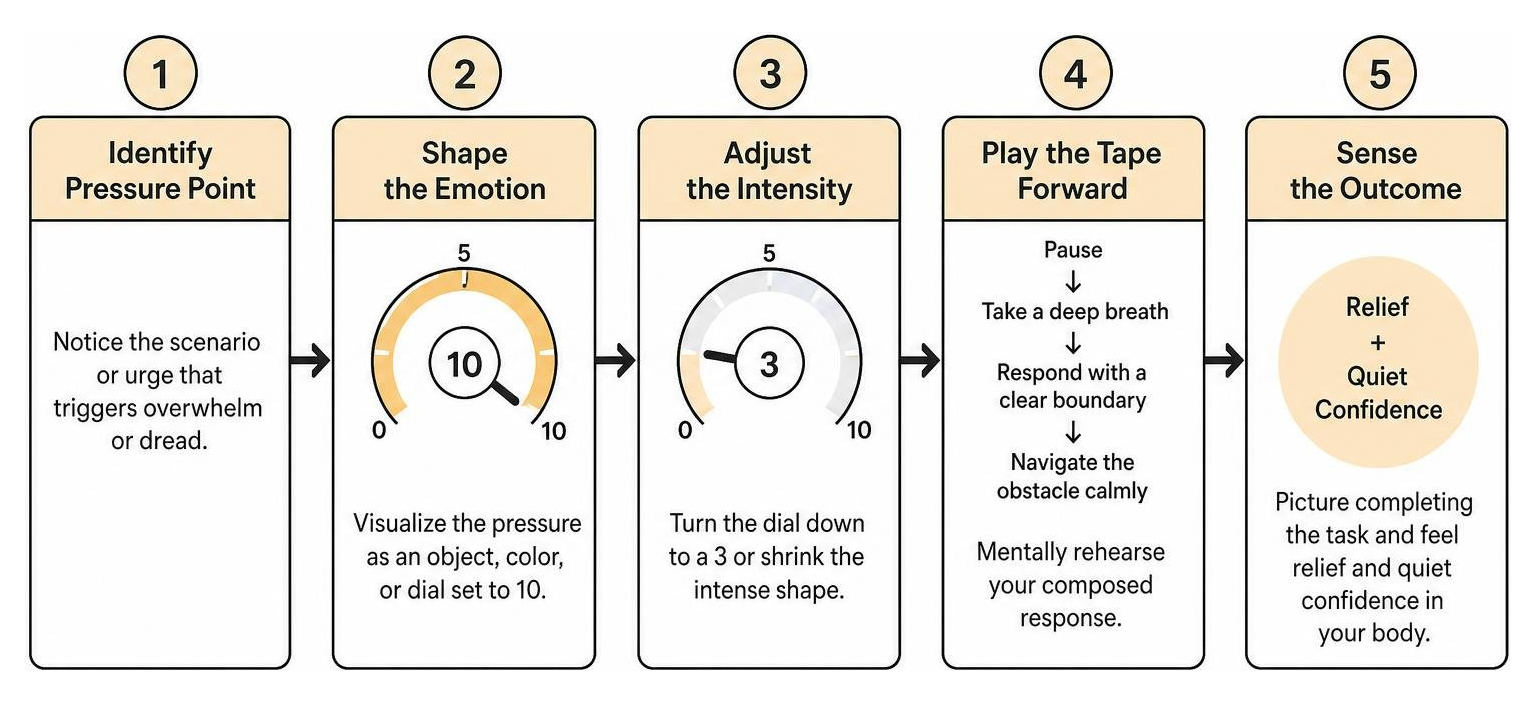
- Shape the emotion: If you feel overwhelmed, visualize that pressure as a physical object, color, or numerical dial set to 10.
- Adjust the intensity: Mentally turn the dial down to a 3, or picture the intense shape shrinking into a small, manageable pebble.
- Play the tape forward: Mentally step through responding to an overwhelming request by pausing, taking a deep breath, and calmly asserting a clear boundary.
How to Integrate Mental Imagery into Your Daily Recovery Routine
Consistency is key to forming new neural habits. Short, daily visualization practices are more effective for nervous system recalibration than occasional longer sessions.
Daily 10-Minute Rituals
At Spark Relational Counseling, May Han and our team recommend anchoring micro-sessions to existing daily habits—a concept known as habit stacking.
| Time of Day | Practice Focus | Duration | Goal |
|---|---|---|---|
| Morning | Future Self Alignment | 3–5 mins | Mentally rehearse calm energy and boundaries before opening devices |
| Midday | Thermal Tension Release | 2–3 mins | Softening physical contraction and resetting breath mid-shift |
| Evening | Sanctuary Containment | 5 mins | Releasing work stress and establishing restful boundaries for sleep |
A common query from high-achieving adults is: how long does it take to recover from burnout? Thoughts from a Seattle therapist emphasize that while full nervous system recalibration takes time, micro-interventions integrated into daily routines bring noticeable improvements in mood and energy within weeks.
Combining Imagery with Mindfulness and Experiential Therapy
Visualization is even more potent when paired with somatic mindfulness and experiential therapy frameworks like Emotion-Focused Therapy (EFT) and Accelerated Experiential Dynamic Psychotherapy (AEDP).
Rather than using mental rehearsal as a purely intellectual tool, experiential therapy encourages you to feel the emotional release in your body as you visualize setting a boundary or accessing safe support. Exploring the best therapy for burnout: effective strategies to recover and thrive reveals that combining experiential therapies with daily mental imagery accelerates recovery by rewriting stuck emotional patterns.
Overcoming Obstacles in Visualization and Emotional Grounding
Mental visualization does not always come easily, especially when your brain is depleted. Below are common obstacles encountered during practice, along with somatic adjustments:
| Challenge | Root Cause | Somatic & Practical Solution |
|---|---|---|
| Aphantasia (Inability to see vivid pictures) | Neurological variation in visual imagery generation | Shift to kinesthetic imagery—focus on physical sensations (warmth, weight, muscle release) or auditory cues (calm rhythms). |
| Intrusive Thoughts | Hyper-vigilant nervous system attempting protection | Acknowledge thoughts without judgment. Visualize them as leaves floating down a quiet stream, returning focus gently to your breath. |
| Sensory Numbness | Dissociation resulting from chronic emotional fatigue | Use physical somatic anchors—hold a warm mug, touch smooth stone, or feel your feet firmly planted on the floor before starting. |
| Restlessness / Anxiety | Sudden drop in adrenaline causing nervous system panic | Begin with brief movement (gentle stretching or walking) before practicing 60-second micro-visualizations. |
If emotional hyper-vigilance makes inward focus challenging, working with a trained professional can provide a structured, safe environment. Learning how to start therapy can help you explore personalized support tailored to your unique nervous system needs.
Frequently Asked Questions About Burnout and Mental Imagery
How long does it take for mental visualization to show results in burnout recovery?
While immediate physiological shifts—such as reduced heart rate and muscle softening—occur during a single 10-minute practice, neuroplastic rewiring requires consistency. Most individuals report noticeable reductions in day-to-day anxiety and emotional reactivity after practicing daily for 3 to 4 weeks.
What if I have trouble visually imagining scenes during guided exercises?
Vivid mental pictures are not required for these techniques to work. Kinesthetic imagery (focusing on physical feelings of warmth, softness, or weight) and auditory imagery (focusing on sound rhythms or internal tone) engage similar neurobiological pathways. Focus on what you feel physically and emotionally rather than what you see.
Can visualization techniques replace professional therapy for severe burnout?
Visualization is a powerful self-care and recovery tool, but it complements rather than replaces professional clinical support. Deep, chronic burnout often involves underlying relational patterns, unresolved trauma, or systemic life pressures that benefit from experiential therapies like EFT or AEDP under professional guidance.
Reclaiming Peace: Next Steps for Lasting Healing
Burnout can make you feel as though your vitality is permanently depleted, but your brain and body retain an extraordinary capacity to heal. By understanding how visualization techniques aid recovery, you gain a practical, scientifically grounded method to lower stress hormones, restore emotional regulation, and step out of constant survival mode.
At Spark Relational Counseling, May Han and our clinical team provide virtual individual and couples counseling built on mindfulness-based relational therapy, EFT, and AEDP across Oregon, Washington, and Illinois. We help high-performing professionals, entrepreneurs, and adults counter negative brain autopilots, heal emotional exhaustion, and build resilient, loving relationships.
If you are ready to move beyond exhaustion and rebuild an authentic, sustainable life, learn more about our Individual Therapy for Burnout and High-Functioning Professionals or reach out to schedule a consultation today.