What Is Burnout and How Can Therapy Help You Recover?

When Exhaustion Becomes Something Deeper: A Guide to Therapy for Burnout
Therapy for burnout is one of the most effective ways to recover from the kind of deep, chronic exhaustion that rest alone cannot fix. Here is a quick overview of what works:
| What you need | What it does |
|---|---|
| Experiential therapy (EFT, AEDP) | Reconnects you to your emotional experience and resets nervous system patterns |
| Brainspotting | Accesses and releases trauma stored in the body beneath conscious awareness |
| Mindfulness-based approaches | Restores access to genuine rest and helps you recognize your emotional thresholds |
| Boundary-setting and relational work | Addresses the patterns of over-responsibility and perfectionism that fuel burnout |
| Organizational and lifestyle changes | Reduces the external pressures that keep the nervous system in threat mode |
You have hit every deadline this week. Your inbox is under control. From the outside, everything looks fine. But somewhere between the fourth Zoom call and the moment you sat down to eat dinner and felt nothing, a quiet question surfaced: How long have I been running on empty?
That feeling is not weakness. It is not simply stress. Research shows that chronic burnout is a physiological state — one where your autonomic nervous system becomes locked in a near-constant threat response, gradually making genuine rest feel out of reach. The body does not forget how to relax all at once. It happens slowly, over months or even years, until one day you realize you cannot remember the last time you felt truly okay.
This guide is here to help you understand what is happening, and what evidence-based therapy can do to support real recovery.
I am May Han, a Licensed Marriage and Family Therapist at Spark Relational Counseling, and I specialize in using mindfulness and emotionally focused approaches to help high-achieving individuals and couples navigate exactly this kind of depletion. Supporting clients through therapy for burnout — especially those who have spent years pushing through while quietly unraveling — is central to the work I do every day. In the sections ahead, we will walk through the signs, the science, and the specific therapeutic approaches that can help you move from surviving back to actually living.
Understanding Burnout: More Than Just Everyday Stress
When we experience stress, our body mobilizes. Our heart rate rises, cortisol surges, and we focus to meet a challenge. Once the challenge passes, our parasympathetic nervous system is supposed to bring us back down to a state of calm.
But what happens when the challenge never ends?
In high-pressure environments across Seattle, WA, Portland, OR, and Chicago, IL, many professionals live in a state of chronic, unyielding pressure. When stress is sustained over months or years, the autonomic nervous system gets locked in chronic threat mode. The brain begins to interpret every email, meeting, and domestic task as an active danger. Over time, the nervous system loses its flexibility. The restorative, parasympathetic "rest-and-digest" state becomes functionally inaccessible. This deep physiological dysregulation is what we call burnout.
It is easy to mistake this state for everyday fatigue, but the signs of burnout symptoms run much deeper. You might notice physical signs like persistent jaw tension, disrupted sleep, or digestive issues long before you consciously realize you are struggling. Left unaddressed, this chronic state can easily mimic or transition into clinical mood struggles. Understanding the crossover between these experiences is essential, as detailed in our high functioning depression guide.
Distinguishing Functional Burnout from Clinical Collapse
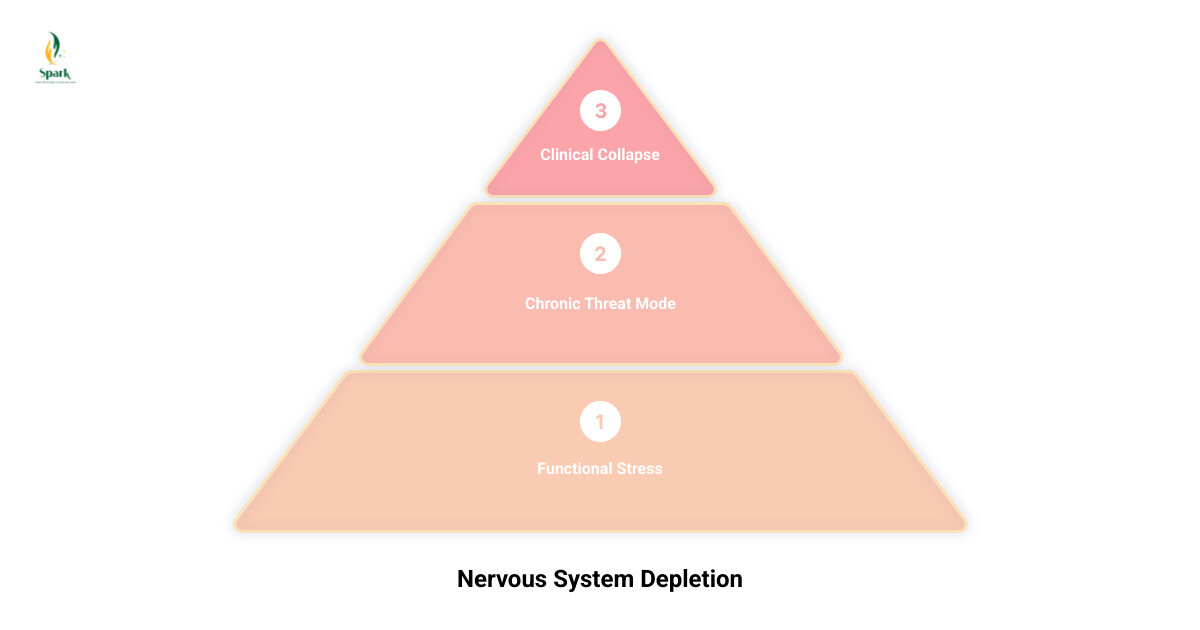
To understand where you are on this spectrum, it helps to distinguish between functional burnout and clinical collapse.
- Functional Burnout: In this stage, you are struggling deeply, yet you are still pushing through. You make every meeting in Redmond, WA or Bellevue, WA, manage your household, and maintain a quiet, albeit mechanical, performance. Your nervous system is depleted, and your sleep may have lost its natural depth, but your sheer willpower keeps you moving.
- Clinical Collapse: This occurs when the body's adaptive mechanisms fail entirely. Your nervous system forces a stop. Suddenly, you might find yourself unable to look at your laptop screen, experiencing profound brain fog, or feeling a complete physical inability to get out of bed.

This progression is deeply tied to how chronic stress impacts the brain. Prolonged exposure to high cortisol levels can actually impair the prefrontal cortex—the area responsible for planning, working memory, and emotional regulation. When this happens, even simple decisions feel monumental. Learning how to track burnout symptoms can help you read your body's early physiological warning signs before your nervous system makes the decision to shut down for you.
The Core Dimensions and Symptoms of Burnout
The academic consensus defines burnout through three primary dimensions:
- Emotional Exhaustion: A profound sense of physical and emotional depletion. You feel as though you have nothing left to give on an emotional level.
- Depersonalization (Cynicism): An emotional detachment from your work, your clients, or even your loved ones. You might find yourself feeling uncharacteristically cynical, cold, or disconnected.
- Reduced Personal Accomplishment: A persistent feeling of ineffectiveness. No matter how much you achieve, you feel as though your work lacks value and that you are underperforming.
Because we do not live in a vacuum, these symptoms inevitably spill over into our personal lives. When you are emotionally depleted, you have fewer internal resources to bring to your relationships. You might find yourself pulling away from your partner, reacting with irritability to minor issues, or feeling entirely numb during shared moments.
Recognizing these relational patterns is a crucial step in recovery. We often explore these dynamics in depth, helping individuals understand how their internal state influences their home life. For a closer look at these patterns, you can read about recognizing burnout in relationships and explore how this chronic depletion impacts couples in our guide on how burnout impacts couples.
How High Achievers and Professionals Mask Exhaustion
High achievers, perfectionists, and tech professionals in hubs like Seattle, WA and Bellevue, WA are incredibly skilled at masking. Built on a foundation of over-responsibility, many professionals carry a belief that they must never let anyone down.
In our practice, we frequently see clients who use their competence as a shield. They double-book their calendars, volunteer for extra projects, and maintain an immaculate external image while quietly crumbling inside. This masking is often driven by a fear that showing vulnerability or slowing down will expose them as incompetent. This complex intersection of identity and pressure is a key reason why high achievers ignore mental health, often waiting until they are on the verge of clinical collapse before seeking professional support.
Evidence-Based Therapy for Burnout: Beyond the Standard Coping Skills
When you are deeply burned out, standard self-care advice—like taking a bath or downloading a meditation app—can feel like just another task on an already overwhelming to-do list. When the nervous system is locked in threat mode, cognitive strategies alone are rarely enough.
This is where specialized therapy for burnout becomes essential. According to a comprehensive review of clinical outcomes, individual-focused therapeutic interventions can significantly reduce emotional exhaustion and help restore a sense of professional and personal accomplishment. You can review the clinical data in Psychotherapeutic burnout interventions—an umbrella review.
At Spark Relational Counseling, we move beyond basic coping skills by utilizing experiential and somatic therapies. Rather than simply talking about your stress, we work directly with the body and the nervous system to process and release the tension that keeps you stuck.
Experiential and Relational Approaches in Therapy for Burnout
Two of the primary modalities we use are Emotionally Focused Therapy (EFT) and Accelerated Experiential Dynamic Psychotherapy (AEDP).
EFT is designed to help you safely access, understand, and organize your emotional experiences. When applied to burnout, EFT helps us look beneath the surface-level frustration or numbness to find the core feelings of fear, loneliness, or overwhelming pressure. We work to identify your "negative brain autopilots"—those automatic, deeply ingrained habits of over-working, people-pleasing, or self-criticism that drive you past your limits.
Through AEDP, we focus on processing these difficult emotions in the safety of the therapeutic relationship. We pay close attention to your immediate, somatic experience. By helping you recognize your emotional thresholds in real-time, we guide you to gently step back before your nervous system crosses into a threat response. This experiential approach is widely considered the best therapy for burnout because it rewires your physiological response to stress rather than just teaching you to manage it intellectually.
Brainspotting and Mindfulness: Accessing the Rest-State Imprint in Therapy for Burnout
To help your body remember what true relaxation feels like, we also integrate Brainspotting and somatic mindfulness.
- Brainspotting: Developed as a neurobiological tool, Brainspotting uses your visual field to locate "spots" where your brain holds trauma or chronic stress. By focusing on these specific points, we can access the deeper subcortical brain, allowing your nervous system to process and release the survival energy that keeps you in chronic threat mode.
- Mindfulness: We use mindfulness not as a relaxation trick, but as a precise tool for somatic tracking. We help you pay attention to the subtle physical shifts—a tightening in the chest, a change in breathing, or a sudden wave of fatigue—that signal your body is reaching its capacity.
Through these practices, we work to re-establish what is known as the rest-state imprint. This is your body's innate memory of genuine safety and deep, restorative rest. When you can access this state consistently, you can begin finding balance in work and life, even while navigating a demanding career in Seattle, WA or Portland, OR.
The 3 R’s Framework: Recognize, Reverse, and Build Resilience
A structured way to conceptualize your recovery is through the clinical framework of the 3 R’s:
- Recognize: Developing the somatic awareness to identify the warning signs of stress before they turn into full exhaustion.
- Reverse: Actively undoing the damage by seeking professional support, reducing your load, and regulating your nervous system.
- Resilience: Building long-term physical and emotional boundaries to protect your energy and prevent future episodes.
When you have zero energy, the thought of building a complex recovery routine can feel impossible. This is why we advocate for starting with a "minimum viable recovery routine." As highlighted in Marty Wolner's insightful piece on building routines with depleted energy, recovery does not require a massive lifestyle overhaul. Instead, it relies on tiny, neurologically accessible habits that bypass the depleted prefrontal cortex and build automaticity in the basal ganglia. You can read more about this gentle approach in How to Build a Burnout Recovery Routine When You Have No Energy to Build Anything.
Setting Manageable Boundaries and Reclaiming Energy
A critical part of reversing burnout is learning how to set clean, functional boundaries.
For many high-achieving professionals, setting boundaries triggers intense anxiety. We help you explore the emotional roots of this anxiety while implementing practical, somatic strategies. This might include understanding your cortisol awakening response—the natural peak in cortisol that occurs shortly after waking—and protecting that window by keeping your phone in another room. We also practice "habit stacking," such as linking a simple boundary (like closing your laptop at a set time) with a physical transition (like taking five deep, grounding breaths).
For those navigating high-pressure environments, you can find specific, actionable strategies in our guide on managing workplace anxiety and setting boundaries.
The Timeline of Burnout Recovery and What to Expect
Recovery is a gradual, non-linear process. While everyone's journey is unique, clinical experience and research suggest a general timeline:
- First 6 to 8 Weeks: With consistent, focused therapy and supportive lifestyle shifts, most individuals begin to notice a lift in acute symptoms. Sleep quality often begins to improve, and the constant feeling of dread starts to soften.
- 3 to 6 Months: This is the window where deeper behavioral and relational patterns are restructured. We work to dismantle the perfectionism and over-responsibility that fuel chronic stress, allowing the nervous system to firmly re-establish its capacity for rest.
- Beyond 6 Months: Long-term resilience is integrated. You learn to monitor your physiological markers—such as tracking your Heart Rate Variability (HRV) or recognizing subtle shifts in your daily energy—to maintain your well-being.
For a detailed look at how tracking physiological data and sequential recovery protocols can support your somatic healing, you can explore The Recovery Stack for Burnout.
The Role of Workplace Factors and Organizational Support
While individual therapy is incredibly powerful, we must also acknowledge that burnout is often an occupational phenomenon. It is a predictable response to an environment where job demands consistently outweigh job resources.
Research shows that while individual therapy significantly reduces emotional exhaustion, organizational-level interventions—such as managing workloads, fostering peer support, and improving workplace flexibility—are critical for long-term prevention. You can read a systematic review of these findings in Effectiveness of Organizational Interventions to Reduce Burnout in the Workplace.
In our work together, we help you evaluate these external factors objectively. We support you in identifying what you can control, what requires a firm boundary, and when it might be time to transition to an environment that respects your humanity.
Frequently Asked Questions About Burnout Recovery
How long does it take to recover from burnout with therapy?
For immediate relief and practical coping tools, a short-term course of 8 to 12 sessions can be highly effective. However, if you are looking to address deep-seated patterns of perfectionism, trauma, or chronic nervous system dysregulation, a longer-term approach of 3 to 6+ months is typically recommended to ensure lasting change.
What is the difference between burnout and clinical depression?
While they share overlapping symptoms like fatigue and low motivation, burnout is primarily situational and closely tied to chronic stress (often work-related). If you change your environment or take a prolonged break, burnout symptoms will typically begin to lift. Clinical depression, however, is a persistent mood state that is not necessarily tied to a specific environment and often requires specialized clinical care to address neurochemical and psychological patterns.
Can couples therapy help when both partners are burned out?
Absolutely. When both partners are running on empty, a relationship can easily become a source of mutual depletion rather than support. In these cases, we use Emotionally Focused Therapy (EFT) to help couples step out of reactive, defensive cycles and build a shared sanctuary of rest. You can learn more about how we support couples through this process in our guide on couples therapy burnout recovery.
Conclusion

Recovering from burnout is not about learning to run faster or carry more. It is about remembering how to slow down, listen to your body, and reclaim your life.
At Spark Relational Counseling, May Han and our dedicated team work together to help you counter the negative brain autopilots that keep you locked in chronic depletion. We provide virtual individual and couples counseling across Oregon, Washington, and Illinois—including communities in Portland, OR, Seattle, WA, and Chicago, IL—offering a warm, clinical, and deeply supportive space to guide your recovery.
If you are ready to step out of the endless storm of exhaustion and begin re-establishing your nervous system's natural capacity for rest and connection, we invite you to take the first step. To learn more about how we address these deep-seated emotional and physical patterns, explore our specialized support for high functioning depression and reach out to schedule a consultation with us today.