
Why Do Perfectionists Get Depressed: The Core Psychological Breakdown

To truly understand why relentless high standards crumble into chronic emotional exhaustion, we have to look beneath the surface of ambition. In clinical psychology, perfectionism is not merely an obsessive eye for detail; it is a transdiagnostic vulnerability factor that predisposes individuals to, and actively maintains, serious mood and anxiety struggles.
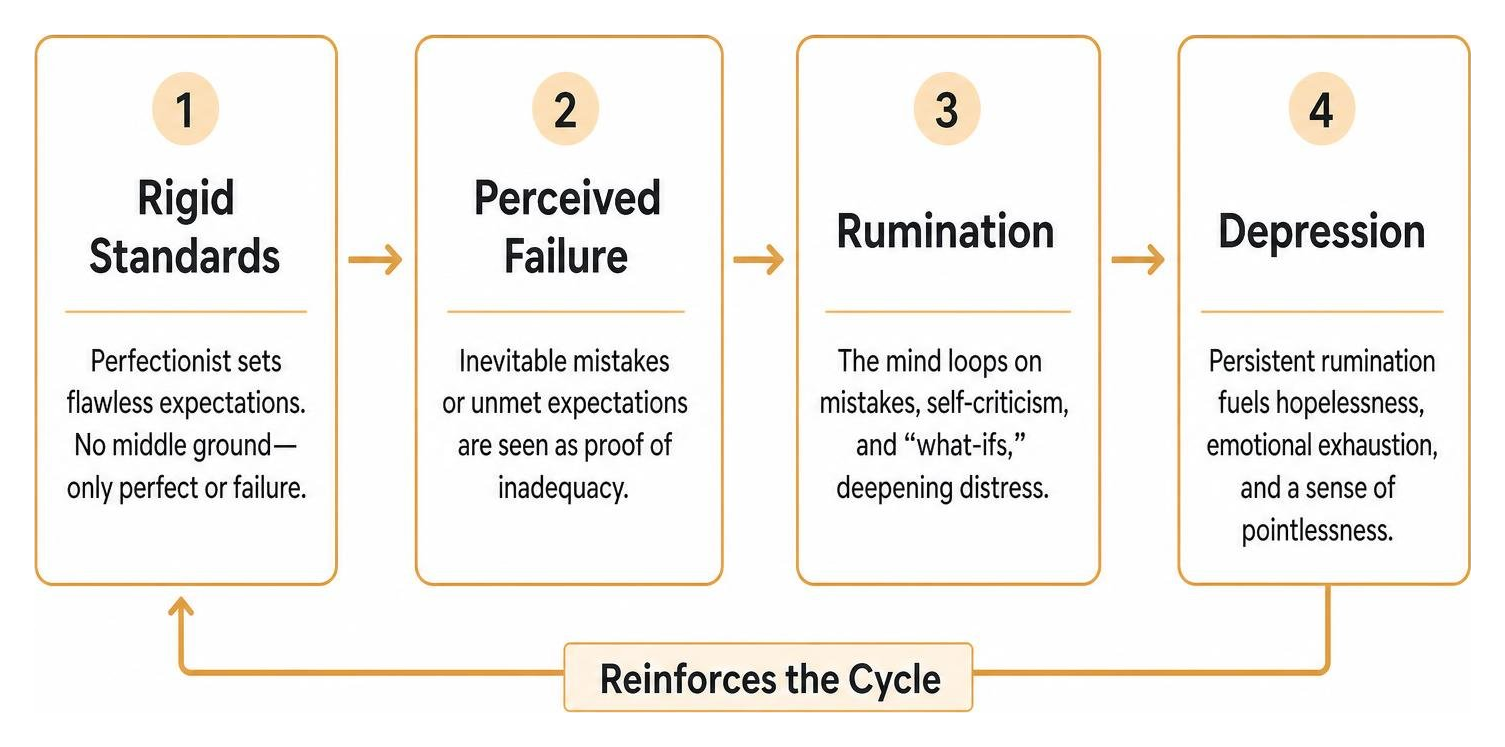
When perfectionists pursue flawless outcomes, their internal cognitive architecture operates on profound cognitive rigidity. Life is filtered through binary, black-and-white thinking: an outcome is either an unmitigated triumph or an absolute, humiliating catastrophe. There is no compassionate middle ground. When an inevitable human error occurs, or when circumstances refuse to bend to their will, this rigid lens collapses. Rather than viewing a mistake as situational data, the individual internalizes it as evidence of profound inadequacy, plummeting into an existential, emotional void where everything feels pointless.
A landmark longitudinal study on perfectionism as a transdiagnostic process tracking young adults over 12 months demonstrated that while setting high personal goals does not inherently trigger mood disorders, maladaptive perfectionistic concerns—such as intense fear of mistakes and relentless self-disparagement—consistently predict future depressive episodes in a reciprocal, deteriorating loop. Understanding what is dysthymia in high achievers helps clarify why this low-grade, persistent despair lingers behind impressive resumes and impeccable presentations.
| Dimension | Healthy Striving | Pathological Perfectionism |
|---|---|---|
| Underlying Motivation | Joy of growth, curiosity, authentic values | Fear of failure, shame avoidance, seeking safety |
| Self-Worth Foundation | Inherent, stable, decoupled from outcomes | Contingent entirely on performance and external validation |
| Response to Mistakes | Curiosity, adaptive problem-solving, self-soothing | Harsh self-censure, catastrophizing, emotional despair |
| Interpersonal Stance | Open to vulnerability, authentic connection | Masking flaws, fear of judgment, defensive isolation |
| Psychological Flexibility | High; adapts gracefully when plans shift | Low; rigid all-or-nothing expectations |
Childhood Attachment and the Fear of Defectiveness: Why Do Perfectionists Get Depressed
The roots of perfectionism rarely begin in boardrooms or university lecture halls; they are forged in our earliest attachment environments. When children grow up in homes where love, attunement, or safety feels conditional—dependent on exceptional grades, emotional composure, or athletic triumphs—they make an unconscious survival negotiation. They internalize the belief: "If I am flawless, I will be protected. If I never make a mistake, I cannot be rejected or abandoned."
As these children grow into adulthood, this survival strategy crystallizes into an abusive, punitive inner critic. When life triggers distress, perfectionists suffer from profound self-soothing deficits. Instead of meeting difficulty with warmth, their nervous system activates a scalding internal monologue, treating everyday human limitations as dangerous defects. As clinical literature explores perfectionism's role in depressive cycles, we see that this internal hostility directly drains vitality. Exploring why high achievers experience depression reveals how early attachment injuries transform excellence into an exhausting, lifelong shield against chronic shame.
The Perfectionism Social Disconnection Model: Why Do Perfectionists Get Depressed in Isolation
One of the most robust frameworks explaining perfectionistic despair is the Perfectionism Social Disconnection Model (PSDM). Perfectionists mistakenly believe that appearing flawless will guarantee belonging and admiration. Ironically, this pursuit builds a psychological fortress that locks genuine intimacy out.
Perfectionists routinely engage in three damaging interpersonal behaviors:
- Perfectionistic self-promotion: Constantly projecting an image of effortless success.
- Non-display of imperfection: Refusing to let others witness struggle, fatigue, or uncertainty.
- Non-disclosure of imperfection: Actively withholding personal difficulties, emotional pain, or errors from loved ones.
By concealing their authentic experiences, perfectionists create severe subjective and objective alienation. They interpret neutral reactions as impending rejection, and their guardedness prevents others from truly knowing them. Over time, this breeds profound interpersonal hopelessness—the conviction that if people saw the "real" them, they would turn away. As research highlights the evidence on the depressive void in perfectionism, this lack of genuine relational nourishment directly fuels depressive withdrawal. Learning how achievers overcome hidden depression involves dismantling this curated armor to risk real, healing connection.
The High-Performance Trap: Perfectionistic Vulnerability in Athletes and Elite Achievers
In competitive arenas, perfectionistic traits are frequently romanticized as the hallmark of dedication. However, when an individual's entire identity becomes fused with performance metrics, they enter a state of acute psychological vulnerability. In high-stakes athletic and professional domains, contingent self-worth turns every game, review, or project into an existential referendum on personal value.
A comprehensive systematic review of high-performance athletes revealed striking insights:
- The prevalence of depressive symptomatology in high-level competitive athletes ranges between 20% and 26%, with general anxiety and depressive distress reaching up to 34%.
- Athletes in individual disciplines present significantly greater perfectionism and depressive symptoms compared to players in team sports, who benefit from collective buffering and shared responsibility.
- Female athletes consistently report higher rates of depressive symptomatology under perfectionistic pressure compared to their male counterparts.
- Longitudinal data among professionals indicates that perfectionists striving under unrealistic standards are actually less productive over time, generating fewer innovative publications and experiencing higher rates of career-ending burnout.
When an injury, benching, or unexpected loss occurs, perfectionists experience total identity disruption. Because their coping mechanisms rely exclusively on external execution, the loss of performance leaves them defenseless against self-condemnation. Clinical research on perfectionism and depression in partial hospitalization confirms that rigid perfectionism severely hinders acute psychiatric recovery, illustrating why high achievers ignore mental health until systemic exhaustion forces an operational halt.
How to Break the Perfectionism-Depression Loop: Practical Recovery Strategies
Recovering from perfectionistic depression does not mean abandoning competence or ambition; it means untying your fundamental worth from flawless output. To rewire the nervous system's automatic threat responses, we combine somatic mindfulness with deep relational repatterning.

1. Mindful Boundary Setting and Threshold Recognition
Use mindfulness to tune into subtle somatic cues—jaw clenching, shallow breathing, sudden irritability—that signal your nervous system is entering perfectionistic panic. By noticing these emotional thresholds in real time, you can set manageable boundaries before exhaustion sets in, stepping away from tasks when they are complete rather than agonizing over impossible refinement.
2. Progressive Behavioral Experiments in Imperfection
Challenge rigid cognitive rules through controlled, low-stakes exposures to imperfection. These behavioral experiments allow your nervous system to register that minor flaws do not lead to catastrophe or relational abandonment:
- Send an internal email without rereading it four times. Observe your anxious predictions beforehand, and note the actual outcome afterward.
- Intentionally leave a minor typo in a non-critical draft. Notice that the conversation continues and your professional standing remains intact.
- Arrive three minutes late or leave dishes in the sink overnight. Practice sitting with the discomfort of unfinished business without scrambling to fix it.
- Express a tentative, unpolished opinion in a meeting. Allow yourself to participate without preparing an airtight defense.
3. Somatic and Relational Psychotherapies
Deep-seated perfectionism rarely yields to purely surface-level self-talk because harsh self-criticism is an ingrained somatic defense against vulnerability. Therapeutic modalities that engage emotions and relational dynamics directly provide lasting relief:
- Emotion-Focused Therapy (EFT): Helps identify the primary attachment panics and unmet emotional needs concealed behind demanding standards.
- Accelerated Experiential Dynamic Psychotherapy (AEDP): Focuses on processing deep emotional pain in the safe, attuned presence of a therapist, replacing shame with self-compassion.
- Brainspotting and Experiential Therapies: Target where trauma and hyper-vigilant tension are held in the subcortical brain and body, releasing negative autopilot loops.
Integrating practical high-functioning depression therapist tips can help you gradually replace internal hostility with gentle, steady self-attunement.
Frequently Asked Questions About Perfectionism and Depression
What is the difference between healthy striving and pathological perfectionism?
Healthy striving is driven by intrinsic curiosity, values, and the enjoyment of learning. It is flexible; when a setback happens, self-worth remains intact, and the person can adapt their goals. Pathological perfectionism, by contrast, is an anxiety-driven defense against shame. Self-worth is completely contingent on flawless performance, mistakes trigger brutal self-criticism, and the fear of failure creates chronic distress.
Why do perfectionists frequently hide their depressive symptoms?
Perfectionists often practice strict symptom concealment because they view emotional struggle as an intolerable flaw or sign of weakness. Driven by internalized stigma and the fear that exposing vulnerability will invite rejection, they maintain a composed exterior. Reviewing what are signs of high-functioning depression illustrates how individuals can experience profound internal despair while continuing to excel in outward responsibilities.
Why is standard behavioral coaching sometimes insufficient for deep perfectionistic depression?
Harsh self-criticism is not an isolated cognitive glitch; it is a relational defense mechanism rooted in early attachment patterns. Simply trying to rationally dispute perfectionistic thoughts often fails because the deeper emotional system still feels fundamentally unsafe without the shield of perfection. Lasting healing requires relational, somatic, and experiential therapies—such as EFT and AEDP—that repair the individual's core relationship with themselves.
Conclusion: Healing the Relationship with Yourself
Perfectionism is a profound, protective attempt to secure safety, connection, and worth in an unpredictable world. Yet, when perfection becomes the prerequisite for self-acceptance, it inevitably extracts a heavy emotional toll. Escaping this cycle does not require you to lower your capabilities; it invites you to dismantle the impossible demand that you must be superhuman to be loved.
True psychological resilience begins with cultivating an inner environment of self-compassion, learning to quiet negative brain autopilots, and allowing yourself to be genuinely seen in your humanity. When navigating mental health support, many clients consider using health insurance. While in-network benefits can offer short-term financial savings, using insurance requires an official psychiatric diagnosis that becomes part of your permanent medical record. This can carry unexpected privacy constraints and potential long-term complications for future life events, such as securing private disability or life insurance policies, specific career security clearances, or international adoption processes. Investing in private, specialized therapy ensures your records remain completely confidential.
Led by founder May Han, Spark Relational Counseling provides specialized virtual individual and couples therapy across Oregon, Washington, and Illinois, serving clients in communities like Portland, Seattle, Chicago, Lake Oswego, Bellevue, and beyond. Through mindfulness-based relational therapy, Emotion-Focused Therapy (EFT), and brainspotting, our clinicians help you dissolve self-critical defenses and restore genuine inner peace. If you are ready to put down the crushing weight of perfection, explore our dedicated high-functioning depression support to begin your journey toward authentic, lasting relief.
