
The Portland Guide to ADHD Therapy and Neurodivergent Support
Finding the Right ADHD Therapist in Portland, Oregon

If you are looking for an adhd therapist portland oregon, here is a quick overview of your options:
| What You Need | Where to Start |
|---|---|
| Therapy + assessment | Look for licensed therapists or psychologists who offer comprehensive ADHD evaluations and neurodiversity-affirming care |
| Medication management | Seek a psychiatrist or psychiatric mental health nurse practitioner (PMHNP) in Portland — only they can prescribe |
| Couples or relational support | A therapist trained in relational and experiential approaches can help when ADHD affects your relationship |
| Insurance coverage | Some Portland providers accept commercial insurance, which can lower upfront costs. Before using benefits, ask about tradeoffs such as diagnosis requirements, session limits, prior authorization, and what personal health information may be shared with your insurer. |
| Telehealth | Several Portland-area ADHD therapists offer virtual sessions across Oregon |
| Directory search | Over 500 ADHD therapists are listed in Oregon on Psychology Today, with many concentrated in the Portland metro area |
Picture this: it is 8 a.m. on a Tuesday. Your inbox is full, your coffee is getting cold, and you have already lost track of what you sat down to do. From the outside, your life looks pulled together. On the inside, it feels like thirty browser tabs are open at once — and none of them will close.
That experience is familiar to many adults living with ADHD in Portland. And it is more common than most people realize. ADHD affects roughly 4% of adults worldwide, yet many reach their 30s or 40s without ever receiving an accurate diagnosis. For high-achieving adults especially, the signs are easy to miss or dismiss — until the weight of managing everything alone becomes too heavy to carry.
The good news is that support exists, and it is closer than you might think. I am May Han, a Licensed Marriage and Family Therapist at Spark Relational Counseling in West Portland, and I specialize in helping adults break through the exhausting cycles that keep them stuck — including the relational and emotional toll that unaddressed ADHD so often brings. As someone who has worked with many clients navigating neurodivergence alongside relationship challenges, I understand how deeply these two areas of life are connected.
Understanding ADHD and the Neurodivergent Mind in 2026
To understand Attention Deficit Hyperactivity Disorder (ADHD) in 2026 is to look beyond outdated stereotypes of hyperactive school children. Today, we recognize ADHD as a complex, lifelong neurodevelopmental difference. It is not a character flaw, a lack of willpower, or a sign of laziness. Instead, it is a unique way the brain processes information, regulates attention, and filters sensory input.
While children with ADHD often exhibit visible restlessness or outward impulsivity, adult ADHD tends to present internally. In adults, hyperactivity frequently morphs into a persistent, internal sense of anxiety or mental restlessness. You might find yourself constantly planning, overthinking, or feeling an undercurrent of urgency that never truly goes away.
For many adults in Portland, this internal storm is heavily masked. Masking is the subconscious process of hiding neurodivergent traits to fit into a neurotypical world. You might get to meetings early, obsessively check your calendar, or work late into the night just to keep up with daily demands. But masking comes at a massive cost: profound, chronic exhaustion.
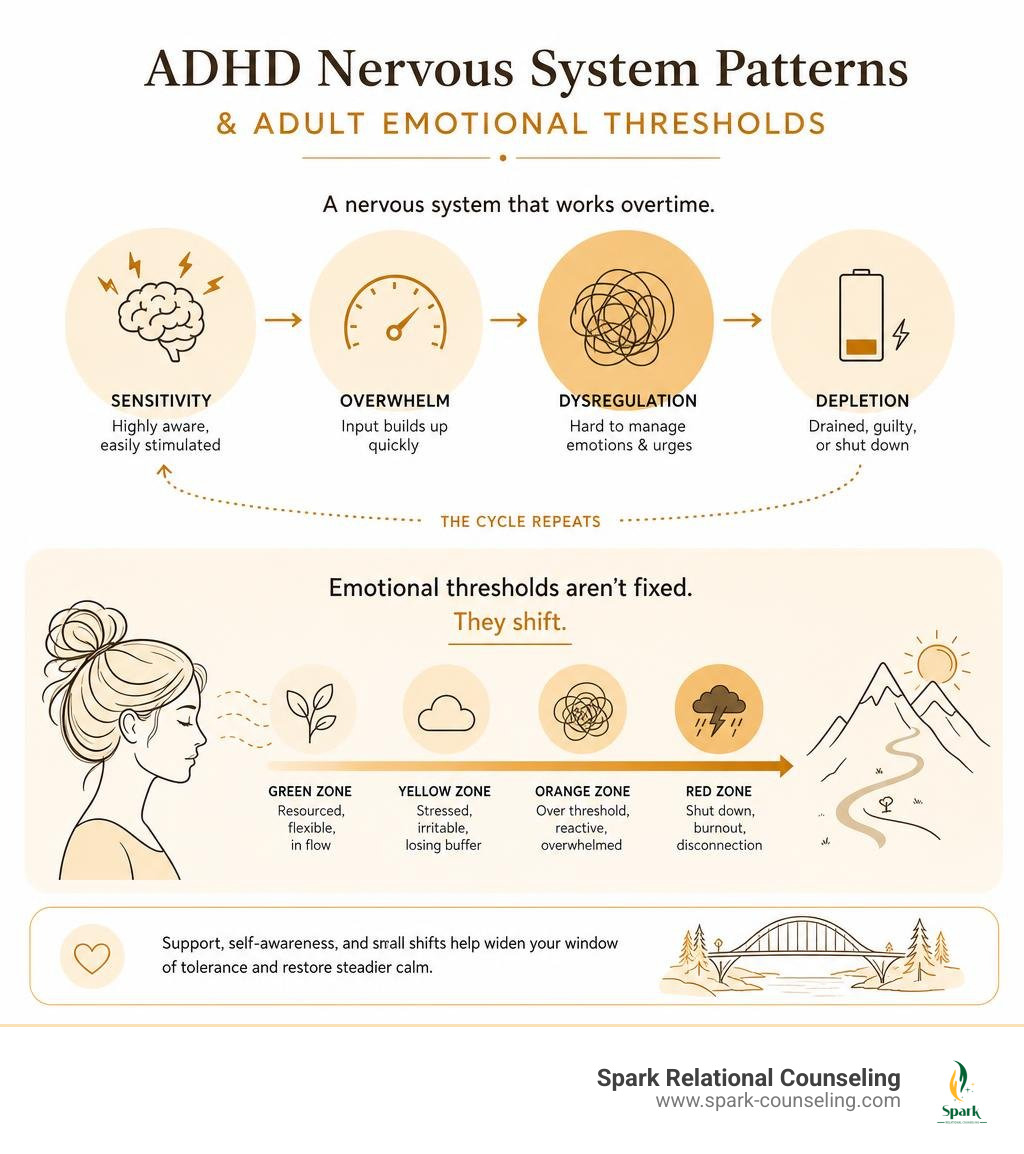
When your nervous system is constantly running on high alert to compensate for executive functioning differences, you eventually hit a wall of sensory overwhelm. A crowded coffee shop in Southeast Portland, a cluttered kitchen, or a sudden change in plans can send your system into a state of freeze or irritability. This delicate balance between overstimulation and understimulation is why so many adults seek out Anxiety treatment Portland before realizing that the root cause of their chronic overwhelm is actually an ADHD nervous system crying out for specialized care.
Why Work with a Specialized ADHD Therapist in Portland Oregon?
When you are navigating a fast-moving mind, traditional, generalist therapy can sometimes feel like trying to fit a square peg into a round hole. You might have tried strategies that work for neurotypical brains, only to feel like a failure when they do not stick. This is why working with a specialized adhd therapist portland oregon is so transformative.
A specialized therapist offers neurodiversity-affirming care. This framework views ADHD not as a deficit that needs to be "fixed," but as a natural variation in human biology. Rather than forcing you to conform to systems that do not work for your brain, an affirming therapist helps you understand your unique emotional thresholds. We work together to explore how your nervous system responds to stress, transition, and connection, building a deep sense of self-compassion along the way.
Unmanaged ADHD also has a profound relational impact. It can lead to patterns of miscommunication, forgotten agreements, and emotional dysregulation that strain even the most loving partnerships. By seeking specialized support, you can address these dynamics at their source.
If you are ready to explore your options, you can browse local practitioners using the Psychology Today Portland ADHD Directory to find a provider who resonates with you. Integrating specialized ADHD care with dedicated Relationship therapy Portland Oregon allows you to heal both your relationship with yourself and your connection with those you love.
Experiential and Somatic Approaches to ADHD Support
At Spark Relational Counseling, we believe that true healing goes beyond just talking about your problems. Under stress, the logical brain often goes offline, leaving our somatic, reflexive responses in charge. This is why we focus on experiential and somatic approaches that help you access and repattern the nervous system directly.
May Han and the team at Spark Relational Counseling utilize powerful, deep-reaching modalities to support neurodivergent individuals in Portland. By integrating Brainspotting, Emotionally Focused Therapy (EFT), and Accelerated Experiential Dynamic Psychotherapy (AEDP), we help you move past intellectual understanding and into embodied change.
- Brainspotting: This somatic modality uses your visual field to locate "spots" in the brain where trauma, anxiety, and neurodivergent stress are held. By focusing on these precise points, Brainspotting bypasses the analytical mind, allowing your nervous system to process and release deep-seated tension, shame, and sensory overload.
- Emotionally Focused Therapy (EFT): EFT helps us identify the emotional thresholds that trigger protective, defensive behaviors. Instead of pathologizing your reactions, we explore the underlying emotional needs driving them, helping you feel safer and more grounded.
- AEDP: This gentle, relational approach focuses on processing difficult emotions in the safety of a connected therapeutic relationship. It emphasizes undoing your loneliness, helping you feel deeply met and understood as you navigate your ADHD journey.
Through somatic awareness, you learn to read the subtle signals your body sends before you hit a state of burnout or sensory overwhelm, allowing you to set gentle, proactive boundaries.

Finding an ADHD Therapist in Portland Oregon for Couples
When one or both partners have ADHD, relationships can fall into repetitive, exhausting cycles. We call these "relational autopilots." For example, one partner might feel overwhelmed by executive functioning tasks, leading to procrastination. The other partner, feeling anxious, might step into a caretaking or managing role. Over time, this dynamic breeds resentment, eroding intimacy and leaving both partners feeling lonely.
By focusing on EFT and somatic tracking, we help couples identify these automatic patterns without blame or shame. We work together to recognize the emotional thresholds that trigger these defensive loops. When you understand that the cycle itself is the enemy — not your partner — you can learn to communicate your needs from a place of vulnerability and connection.
If you are ready to reshape how you and your partner navigate neurodivergence together, exploring Couples therapy Portland Oregon is a beautiful place to start. For a deeper look at what this process looks like, our guide on Therapy for relationship issues in Portland OR offers compassionate insights to help you take the first step toward lasting relational peace.
What to Expect from an ADHD Therapist in Portland Oregon
Starting therapy can feel intimidating, especially when your executive functioning is already stretched thin. When you begin working with an ADHD specialist in Portland, the process is collaborative, respectful, and paced entirely to your comfort level.
Your journey typically begins with a comprehensive, narrative assessment. Rather than relying solely on dry, clinical checklists, we take the time to hear your story. We look at how your symptoms have shown up throughout your life, how you have masked them, and where your unique strengths lie. From there, we engage in collaborative goal-setting, designing a therapeutic path that honors your natural energy rhythms.
To help you understand how this approach differs from traditional therapy, here is a comparison:
| Traditional Therapy | Experiential Relational Therapy (Spark Relational) |
|---|---|
| Focuses primarily on symptom reduction and behavioral compliance. | Focuses on somatic awareness, emotional regulation, and self-acceptance. |
| Teaches standardized organizational tools and rigid daily structures. | Explores your natural energy rhythms to build custom, sustainable systems. |
| Often addresses ADHD in isolation from relational dynamics. | Integrates relational impact, helping you heal connections and communication. |
| Relies on cognitive restructuring (changing thoughts to change feelings). | Bypasses the analytical mind using somatic tracking, EFT, and Brainspotting. |
Navigating Daily Life and Executive Functioning in Portland
Living in Portland offers a beautiful, vibrant backdrop, but navigating daily life with high-functioning ADHD can still feel like an uphill climb. High-functioning ADHD is a term often used when someone appears incredibly successful on the outside — perhaps running a local business, managing projects, or raising a family — while feeling an internal storm of chaos, self-doubt, and exhaustion.
This constant pressure to perform frequently leads to a state of deep burnout. When you use urgency and anxiety as your primary fuel to get things done, your nervous system eventually runs dry. This chronic depletion can easily transition into High-functioning depression, where you continue to go through the motions of your day but feel entirely disconnected from joy or satisfaction.
Healing begins with learning how to set compassionate, realistic boundaries around your time and energy. It means recognizing when your system is reaching its threshold and allowing yourself to pause before you hit empty. This is particularly vital for local creators, builders, and professionals who navigate the unique pressures of self-employment; our specialized Therapy for entrepreneurs is designed to help you balance your creative drive with sustainable, nervous-system-friendly business practices.

Frequently Asked Questions about ADHD Therapy
How is ADHD diagnosed in adults?
Adult ADHD diagnosis is a collaborative, narrative process. While clinical questionnaires are helpful tools, a comprehensive evaluation relies heavily on an in-depth clinical interview and a detailed review of your developmental history. We look at how executive functioning challenges have shown up across different areas of your life — from childhood report cards to current workplace and relationship dynamics — to build a clear, validating picture of your unique brain.
Can therapy help with ADHD without medication?
Absolutely. While psychiatric medication can be an incredibly supportive tool for correcting chemical imbalances, it is not the only path. Somatic strategies, emotional regulation skills, and mindfulness practices are highly effective for managing ADHD. Therapy helps you build customized executive functioning systems, process the emotional shame of late-stage diagnosis, and learn how to work with your brain's natural chemistry rather than fighting against it.
How does neurodivergence affect relationships?
Neurodivergence naturally shapes how we communicate, process sensory information, and express emotion. In relationships, differences in attention and executive functioning can create automatic, painful relational autopilots. Without a shared understanding of these differences, partners can easily misinterpret ADHD symptoms as a lack of care or respect. Therapy provides the tools to bridge this gap, helping couples build mutual understanding and deeper intimacy.
Conclusion: Embarking on Your Healing Journey
Your neurodivergence is not a defect to be cured; it is a vital, creative, and unique part of who you are. You deserve to live a life that feels authentic, grounded, and connected, without the constant pressure of masking or the exhausting weight of chronic burnout.
At Spark Relational Counseling, May Han and our compassionate team are here to walk beside you. Through mindfulness-based relational therapy, we help you step out of painful automatic patterns and into a life of lasting peace and loving relationships. Whether you are looking to explore your own patterns or want to strengthen your partnership, we are ready to support you.
If you are ready to take the next step toward healing, we invite you to learn more about our virtual and in-person options for Online therapy in Oregon. To explore how relational work can transform your personal growth, visit our complete guide to Individual therapy for relationship issues and begin your journey toward a more aligned, compassionate life today.