Love in the Time of Burnout: Why You Need a Relational Therapis
When Burnout Starts to Affect Your Love Life

A relational therapist for burnout helps you address the stress draining your energy and the distance it may create with your partner. Burnout can show up at home as shorter patience, less interest in intimacy, emotional withdrawal, or conflict that seems to start over small things. It does not mean your relationship is broken. It often means your nervous system has been carrying too much for too long.
| What burnout can change | How relational therapy can help |
|---|---|
| Emotional energy | Creates space to name exhaustion without blaming yourself or your partner. |
| Communication | Helps couples slow down reactive patterns and hear the need beneath the conflict. |
| Connection and intimacy | Supports safer, more honest moments of closeness while stress is high. |
Research on psychotherapists suggests that deeper, higher-quality therapeutic relationships are linked with lower burnout and stronger psychological well-being. While that research examined practitioners rather than couples, its core insight matters here: meaningful connection can be protective when stress makes people feel alone.
I am May Han, a Licensed Marriage and Family Therapist at Spark Relational Counseling, and I work as a relational therapist for burnout with individuals and couples caught between high demands and repeating relationship patterns. From mindfulness and emotionally focused approaches, I help clients build clearer communication, steadier connection, and more room to feel like themselves again.
How Burnout Erodes Romantic Relationships
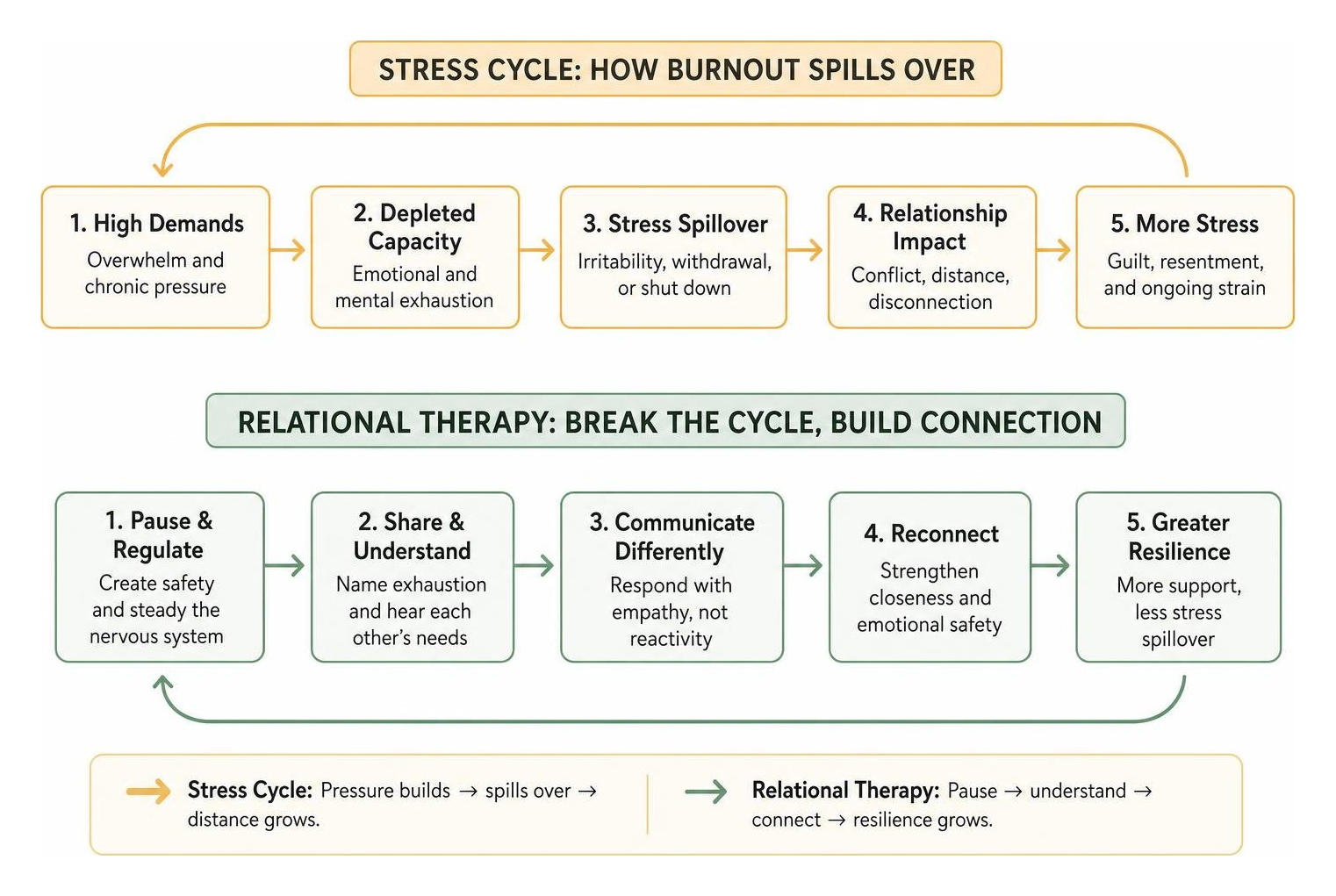
When high-pressure demands consume your energy, your romantic relationship often becomes the place where stress quietly overflows. Imagine coming home after an exhausting ten-hour workday, carrying mental fatigue from endless decision-making. Your partner gently asks what you would like for dinner, and instead of answering warmly, you snap or retreat into total silence. This is not a failure of love—it is stress spillover.
When chronic pressure saturates your nervous system, your capacity for emotional resonance plummets. You might notice that How Burnout Impacts Couples unfolds in predictable patterns: conversations turn transactional, affection feels like another task on an endless checklist, and small misunderstandings spiral into defensive arguments. By Recognizing Early Burnout Signs, partners can stop viewing emotional distance as a lack of affection and begin understanding it as a physiological cry for relief.
The Cycle of Emotional Exhaustion and Depersonalization
Burnout operates through distinct psychological mechanisms that directly undermine intimacy. The primary driver is emotional exhaustion—a state where your psychological reserves are completely drained. When exhausted, your nervous system seeks self-preservation, which often manifests as depersonalization. In clinical terms, depersonalization involves developing a cynical, detached, or numb attitude toward work and, eventually, toward loved ones.
In intimate partnerships, depersonalization looks like emotional isolation and reduced empathy. When your partner shares their day, you might struggle to genuinely care or respond with attunement. This detachment is not malicious; it is an involuntary emotional buffer. However, the non-burntout partner frequently experiences this detachment as rejection, leading to a vicious cycle of loneliness, partner detachment, and heightened relationship tension.
How to Spot the Early Signs of Stress in Your Partnership
Recognizing burnout early prevents long-term relational erosion. Here are key indicators that chronic stress is impacting your partnership:
- Emotional Withdrawal: Moving away from shared conversations, physical touch, or eye contact to conserve remaining energy.
- Irritability and Short Temper: Reacting disproportionately to minor domestic frustrations or everyday logistical questions.
- Loss of Relational Joy: Feeling as though time spent together feels like an obligation rather than a source of comfort and rejuvenation.
- Passion and Intimacy Fatigue: Experiencing a marked drop in sexual desire or affection due to physical and mental depletion.
- Cynical Communication: Defaulting to sarcasm, eye-rolling, or passive-aggressive remarks during conflict resolution.
Learning How to Track Burnout Symptoms allows couples to catch these indicators before emotional distance turns into deep resentment.
Why You Need a Relational Therapist for Burnout
Traditional individual approaches to stress often center exclusively on time management, productivity hacks, or isolated self-care routines like taking a bubble bath. While helpful, these strategies fail to address the social and emotional climate of your life. At Spark Relational Counseling, founder May Han and our clinical team work as a dedicated relational therapist for burnout resource, examining stress through the lens of relational safety and human connection.

Rather than treating you as an isolated individual, relational therapy addresses the interpersonal dynamics that either exacerbate or soothe stress. By establishing deep relational presence and safety, we create a sanctuary where both partners can step off the hamster wheel of achievement and reconnect with their authentic emotional selves. Exploring The Best Therapy for Burnout reveals that true healing happens in connection, not isolation.
Core Benefits of Seeing a Relational Therapist for Burnout
Working with a relational therapist for burnout offers specialized modalities tailored to restoring emotional capacity. We utilize experiential therapies, Emotionally Focused Therapy (EFT), Accelerated Experiential Dynamic Psychotherapy (AEDP), and Brainspotting to access deeper somatic and emotional processing.
Through Couples Therapy Burnout Recovery, couples experience several transformative benefits:
- Therapeutic Attunement: Experiencing deep, non-judgmental presence from a clinician helps lower nervous system hyperarousal.
- Somatic Co-Regulation: Learning how to use your partner's calm presence to settle your own racing thoughts and biological stress responses.
- Emotional Threshold Recognition: Utilizing mindfulness techniques to help clients recognize emotional thresholds and set manageable boundaries before reaching total overload.
- Attachment Repair: Healing old wounds that cause partners to turn away from each other during periods of acute vulnerability.
Working with a Relational Therapist for Burnout to Rebuild Trust
When burnout persists over months or years, trust can erode—not necessarily because of infidelity, but because partners stop trusting that they will be met with care, presence, or support. Rebuilding this trust requires cultivating shared vulnerability in a secure environment.
In session, a relational therapist for burnout guides you past surface-level complaints ("You never help with dishes") to the underlying attachment needs ("I feel completely alone under this heavy weight, and I miss you"). By cultivating mutual empathy and co-regulation, partners move from adversarial interactions back into a supportive team. To understand how structured clinical care supports this transition, explore our comprehensive guide on Therapy for Burnout.
When considering professional therapy, many clients ask about using health insurance benefits. While insurance can offer short-term in-network financial convenience, it is vital to understand its limitations. Insurance companies mandate a formal psychiatric diagnosis on your permanent medical record, which can carry long-term privacy concerns and potentially impact future life choices such as obtaining private disability insurance, life insurance, adoption approvals, or specialized security employment clearance. Additionally, insurance carriers often restrict the session count and dictate treatment goals. Investing privately in relational therapy protects your clinical privacy and allows your care to be dictated solely by your personal relationship goals.
The Science of Relational Depth and Burnout Prevention
The transformative power of relational therapy is backed by substantial empirical research. While burnout literature historically focused on individual coping mechanisms or workplace environmental factors, structural clinical research emphasizes the protective power of relational dynamics.
A landmark study investigating structural equation modeling in psychotherapists (examining a sample of 101 humanistic-experiential practitioners aged 29 to 86 years) revealed that relational depth and therapeutic relationship quality correlate negatively with professional burnout. Relational depth—defined as state of profound, authentic contact and mutual emotional presence—acts as a primary structural mechanism that buffers against exhaustion and depersonalization while boosting psychological well-being. Individuals seeking local specialized care can learn more by viewing Therapists in Portland That Specialize in Relational Therapy.
Mediating Factors: Relationship Quality and Psychological Well-Being
The research demonstrates that relational depth does not directly reduce stress in a vacuum; rather, it works through key mediating factors. Relational depth directly enhances the quality of the interpersonal bond, which subsequently serves as the primary predictor of reduced burnout and heightened psychological well-being.
When partners or clients experience authentic relational depth, their sense of isolation dissolves. High relationship quality creates a buffer that transforms how external stressors are perceived and digested.
Dimensions Affected: Emotional Exhaustion vs. Depersonalization
Relational depth interacts differently with specific dimensions of burnout. Understanding these distinction helps clarify why relational interventions are so effective:
| Burnout Dimension | Primary Symptom | Relational Depth Impact | Therapeutic Mechanism |
|---|---|---|---|
| Emotional Exhaustion | Severe energy depletion, chronic fatigue, emotional helplessness. | Provides direct co-regulation and emotional relief, reducing the burden of solitude. | EFT and AEDP allow gentle processing of grief, fear, and fatigue without judgment. |
| Depersonalization / Cynicism | Callousness, emotional detachment, viewing others as demands or burdens. | Re-humanizes interactions, restoring empathy and interpersonal warmth. | Mindfulness and experiential tracking reconnect clients with visceral warmth and affection. |
Clinical Training and Supervision Implications
The research underscores that relational depth is not an innate trait, but a clinical capacity that can be cultivated. For therapists and clients alike, fostering deep presence requires intentional practice, mindful self-awareness, and clear boundaries. Integrating Burnout Prevention Daily Habits into daily life helps stabilize the nervous system so that deep relational connection remains accessible even during demanding work weeks.
Practical Strategies to Save Your Relationship from Stress
Restoring your partnership while navigating high workplace demands requires actionable daily interventions. A relational therapist for burnout helps translate clinical insights into practical routines that safeguard your emotional home.

Setting Boundaries to Protect Intimacy
Boundaries are not walls designed to keep people out; they are clear guidelines designed to keep connection safe. When high achievers fail to set firm boundaries around work, professional stress inevitably devours intimate time.
- Define a Transition Ritual: Create a clear threshold between work time and personal time. Whether changing clothes immediately after getting home or taking five minutes of quiet breathwork in your car, signal to your nervous system that the work day has ended.
- Establish Tech-Free Intimacy Zones: Keep laptops and work phones out of the bedroom. Agree on a digital curfew after which work emails are not checked.
- Practice Explicit Energy Communication: Instead of letting exhaustion turn into sudden irritation, communicate your capacity early. Saying, "I love you and want to connect, but my brain is at 5% capacity right now—can we sit quietly together for 20 minutes first?" sets a manageable boundary with warmth.
For professionals running businesses, review our targeted guidance on Finding a Work Life Balance Essential Tips for Entrepreneurs and explore Therapy for Entrepreneurs or specialized care for high performers at High Achiever Mental Health Oregon.
Cultivating Daily Habits for Stress Recovery
Small, consistent micro-moments of connection protect against emotional depersonalization far better than grand, infrequent vacations.
- The 6-Minute Mindful Reconnection: Spend six uninterrupted minutes holding hands or sitting closely without screens, simply sharing three slow co-regulating breaths.
- Daily Gratitude Express: State one specific thing you appreciated about your partner today, shifting attention away from problem-solving and back toward warm acknowledgement.
- Somatic Brainspotting Check-In: Notice where stress settles in your physical body (e.g., tight chest, clenched jaw) and share that somatic awareness with your partner without needing them to "fix" it.
- Collaborative Burnout Plan: Use our structured resources on How to Create Burnout Prevention Plan to align on household logistics, meal responsibilities, and rest schedules during peak work seasons.
Frequently Asked Questions About Burnout and Relational Therapy
How does burnout specifically damage romantic relationships?
Burnout drains the emotional reserves required for empathy, patience, and active listening. As emotional exhaustion sets in, partners often experience depersonalization, which causes them to pull away, act cynically, or view intimate requests as overwhelming chores. This emotional distance frequently leads to misunderstandings, decreased sexual intimacy, and repeating cycles of conflict.
Can relational therapy help both individual burnout and relationship strain?
Yes. Because human beings are inherently social and relational creatures, individual stress and relationship dynamics are deeply interconnected. Relational therapy using Emotionally Focused Therapy (EFT), AEDP, and Brainspotting addresses both nervous system dysregulation and relationship communication. Healing the relational environment gives both individuals a supportive base to recover from individual exhaustion.
What is the difference between general counseling and relational therapy for burnout?
While traditional individual counseling often focuses on personal cognitive strategies or time management, a relational therapist for burnout focuses on the quality of the interpersonal bond, emotional attunement, and attachment security. Relational therapy views connection as the primary engine for healing, emphasizing deep relational presence, emotional safety, and somatic co-regulation.
Conclusion
Burnout does not have to be the end of intimacy or ease in your relationship. When stress threatens to push you and your partner apart, working with a relational therapist for burnout offers a compassionate, evidence-based pathway back to grounded connection and mutual support. By prioritizing relational depth, emotional attunement, and healthy boundaries, you can transform your partnership into a peaceful sanctuary from life's heavy demands.
At Spark Relational Counseling, founder May Han and our team provide specialized virtual individual and couples therapy across Oregon, Washington, and Illinois—including clients in Portland, Seattle, Chicago, Tualatin, Lake Oswego, Happy Valley, West Linn, Sammamish, Redmond, Bellevue, Spokane, Eugene, Ballard, and Northwest Portland. If you are ready to move past negative autopilot cycles and rebuild lasting warmth in your life, explore our guide on Individual Therapy for Relationship Issues or reach out today to connect with our team.