Conflict Resolution and Problem Solving: The Ultimate Guide to Workplace Peace
Why Conflict Resolution and Problem Solving Matter

Conflict resolution and problem solving help people move from blame, tension, or silence toward a clear shared path forward. The goal is not to avoid every disagreement. It is to understand what is underneath it, protect the relationship, and make a workable decision.
| Focus | Quick answer |
|---|---|
| What causes conflict? | Unclear roles, unmet needs, poor communication, different values, unfairness concerns, and old hurts can all create friction. |
| What helps resolve it? | Pause, listen closely, name the real issue, speak from your own experience, and look for options that respect both people. |
| When is outside help useful? | A neutral therapist, mediator, or other qualified third party can help when conversations repeat, emotions run high, or power feels uneven. |
Conflict is often less about the topic on the surface than the meaning beneath it. A disagreement about money, workload, or plans may also involve trust, feeling unseen, or fear that one person's needs do not matter. When those deeper concerns are missed, the same argument can return in a new form.
I am May Han, a Licensed Marriage and Family Therapist at Spark Relational Counseling. My work in conflict resolution and problem solving draws on mindfulness and emotionally focused approaches to help individuals and couples step out of painful autopilot patterns and build more connected conversations.
Understanding Conflict Dynamics: Root Causes and Distinctions
When conflict erupts in a professional team or an intimate partnership, our neural pathways frequently view the situation as an immediate threat. This physiological reaction can trigger involuntary defensive behaviors: shutting down, raising our voice, or launching an immediate counterattack. To move past these reactive loops, we must understand the core psychological drivers behind disputes. Most friction stems not from inherent malice, but from misperceptions, unexpressed attachment needs, historical grievances, and structural barriers.
Conflict operates on multiple levels simultaneously. On the surface, two people may argue over a project deadline or household responsibilities. Below that surface lie deeper layers of identity, status, and emotional safety. When someone feels that their underlying competence, value, or belonging is challenged, a simple administrative task turns into an existential struggle. Learning How to Resolve Conflict requires looking beneath surface arguments to address these root vulnerabilities.
Organizational and Relational Conflict Triggers
In workplace settings across Oregon, Washington, and Illinois, organizational disputes often boil down to systemic ambiguities. When team members do not have clear boundaries around their individual responsibilities, friction becomes inevitable. Key organizational triggers include:
- Role ambiguity and confusing operational expectations that leave individuals competing for authority.
- Misaligned policy interpretations and competing departmental priorities.
- Self-serving fairness biases, where each party genuinely believes their contribution is superior and deserves greater resource allocation.
- Communication gaps that allow unchecked assumptions to fester into entrenched resentment.
In personal relationships, similar triggers manifest as unspoken assumptions about care, labor distribution, and emotional reciprocity. When we neglect to name our specific expectations, we default to internal narratives that frame the other person as uncooperative or uncaring. As noted in research on Applying a Problem-Solving Approach to Conflict, jumping directly to solutions before clarifying underlying scope and personal interests creates brittle agreements that fail under stress.
Distinguishing Productive Friction from Destructive Disputes
Not all conflict is harmful. In fact, total silence within a team or relationship rarely signals genuine harmony—more often, it indicates apathy or deep psychological unsafe conditions. Organisational researcher Adam Grant noted that a complete lack of conflict typically means people no longer care enough to speak up or share their true perspectives.
To evaluate whether friction is helping or hurting, leaders and partners can compare the core characteristics of healthy versus unhealthy engagement:
| Dimension | Productive Friction | Destructive Dispute |
|---|---|---|
| Primary Focus | Task-oriented problems, ideas, and shared goals | Personal traits, character flaws, and past faults |
| Emotional Tone | Curious, engaged, and psychologically safe | Defensive, contemptuous, hostiles, or withdrawn |
| Communication | Open dialogue, direct feedback, and active listening | Gossip, 'parking lot' meetings, and passive resistance |
| Outcome Goal | Win-win expansion of value and mutual understanding | Zero-sum domination, personal vindication, or forced compliance |
Productive friction stimulates innovation, uncovers hidden risks, and deepens trust once resolved. Destructive disputes, by contrast, erode psychological safety, trigger emotional burn-out, and impair long-term relational security.
Essential Frameworks for Conflict Resolution and Problem Solving
Resolving complex, recurring disputes requires moving beyond spontaneous reactions toward structured frameworks. Without a reliable methodology, individuals revert to familiar defensive patterns when emotional stress escalates.
The PDCA Cycle and Collaborative Problem Solving
One structured approach to navigating friction is combining systematic continuous improvement with collaborative relational models. The Plan-Do-Check-Act (PDCA) framework offers an iterative process for testing solutions:
- Plan: Identify the underlying issue, map out stakeholder interests, and establish clear criteria for what success looks like.
- Do: Implement a small, time-bound pilot agreement or behavioral shift rather than demanding permanent transformation immediately.
- Check: Review the outcomes objectively. Gather feedback on whether the emotional and operational needs of all parties were met.
- Act: Standardize the successful changes or adjust the strategy if friction persists.
In organizational contexts, this pairs with evidence-based models like Harvard's Collaborative Problem Solving (CPS). CPS highlights that employees and partners do well when they can. When someone struggles to meet an expectation, it is usually due to a skill gap or an unaddressed constraint rather than poor intent.
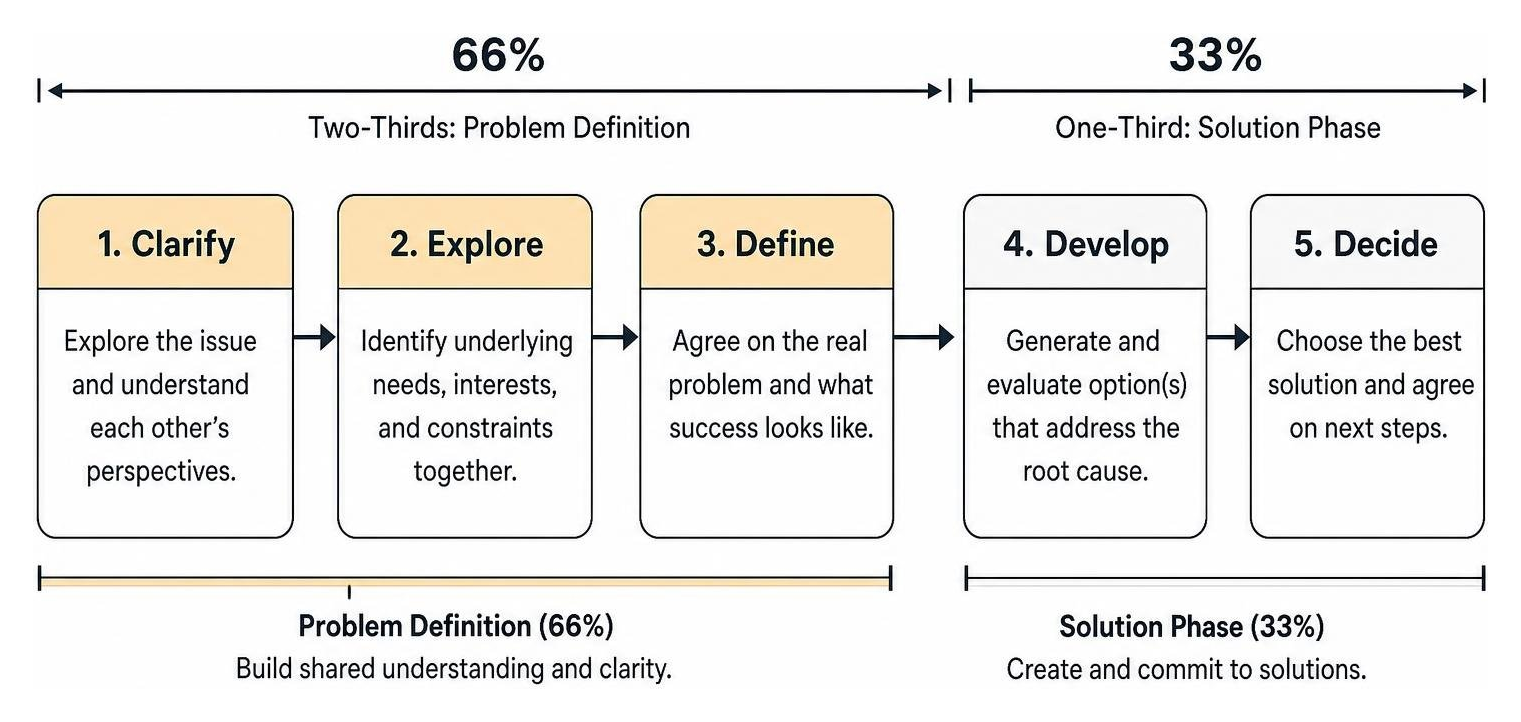
A critical principle of CPS is the allocation of time: roughly two-thirds (66%) of the time spent on conflict resolution and problem solving should be dedicated to mutual problem definition and empathetic exploration (Phase 1). Only one-third (33%) should be spent negotiating solutions (Phase 2). Research reveals that making a neutral, curious observation followed by silent listening clarifies the issue so thoroughly that fully 50% of perceived workplace conflicts turn out to be simple misunderstandings requiring no formal negotiation at all. As detailed in practical guides on How Can Problem-Solving Techniques Be Applied To Conflict Resolution?, identifying shared interests over rigid positions transforms adversarial standoffs into joint troubleshooting.
The Propeller Framework: Balancing Identity, Engagement, and Governance
For systemic or deeply entrenched disputes, macro-level frameworks shed light on why simple communication fixes sometimes fail. Harvard's national conflict research introduces THE PROPELLER framework, which demonstrates that resolving complex human friction requires simultaneous thrust across three interdependent domains:
- Identity & Meaning: Rebuilding basic human trust, acknowledging historical grievances, and addressing deeply held beliefs about self-worth and fairness.
- Collaboration & Engagement: Fostering inclusive dialogue, joint problem identification, and multi-stakeholder participation.
- Governance & Procedures: Establishing transparent ground rules, enforceable boundaries, clear policies, and formal accountability.

Historical research on global conflict emphasizes how difficult lasting peace truly is: out of roughly 350 global armed conflicts analyzed between 1946 and 2018, only 51 resulted in durable peace agreements, and merely six met the full criteria for resolving protracted ethno-national disputes. Long-standing conflicts—such as the 27-year Angolan civil war that caused over 800,000 casualties—demonstrate what happens when governance collapses and identity threats remain unaddressed. While day-to-day organizational or marital conflicts operate on a different scale, the psychological mechanics remain identical: if you update the rules (Governance) without addressing hurt feelings and identity threats (Identity), the conflict will resurface.
Core Interpersonal Skills for De-Escalation and Mediation
Applying structured frameworks requires grounded interpersonal skills. When high-tension disagreements arise, logic alone cannot restore connection; we must also regulate the nervous system to enable effective problem solving.

Integrating Emotional Intelligence into Conflict Resolution and Problem Solving
Emotional intelligence (EQ) is the foundational engine of conflict resolution and problem solving. EQ consists of four distinct capabilities: self-awareness, emotional self-regulation, social empathy, and relational management.
When our nervous system senses criticism, it enters a state of physiological arousal—heart rate rises, breathing becomes shallow, and executive functioning dims. Practicing mindfulness allows us to recognize this emotional threshold before we react impulsively. Simple somatic adjustments, such as controlled diaphragmatic breathing, restore physiological calm and bring executive reasoning back online.
Self-awareness also requires recognizing our own cognitive biases during heated discussions. These include:
- Overconfidence Bias: Overestimating the likelihood that an objective third party would side completely with our position.
- Self-Serving Fairness: Defining what is "fair" purely in ways that benefit our own immediate interests or workload.
- Escalation of Commitment: Continuing to defend a failing argument or stance simply because we have already invested significant energy into it.
Shifting from accusatory "you" language to clear "I" statements reduces defensiveness. Instead of saying, "You are completely ignoring our project priorities," an emotionally intelligent reframe sounds like: "I feel overwhelmed when deadlines shift unexpectedly, because I worry about maintaining our quality standards." To explore how communication skills can be refined in professional or personal life, read our article on Can a Therapist Help With Communication?.
De-Escalation Strategies for High-Tension Disputes
When managing an actively escalating argument, immediate de-escalation takes priority over long-term problem solving. You cannot negotiate a rational solution while either person is emotionally dysregulated.
Key de-escalation steps include:
- Pause and Offer a Cooling-Off Period: Explicitly request a brief break to allow nervous systems to settle, reassuring the other person that you will return to complete the conversation.
- Establish Micro-Agreements: Find immediate small areas of consensus, even if it is simply agreeing on the schedule for the conversation or acknowledging a shared goal ("We both want this project to succeed").
- Validate Emotional Experiences: Validate the other person's feelings without necessarily agreeing with their interpretation of the facts ("I can see how frustrating this timeline delay has been for you").
- Maintain Non-Defensive Body Language: Keep posture open, maintain soft eye contact, slow your speech cadence, and avoid crossing arms or raising your voice.
For deeper insights into breaking reactive communication loops, explore our guide on How to Break the Argument Cycle With the Help of Couples Therapy.
Building Cultures and Systems That Prevent Unnecessary Conflict
While having effective de-escalation tools is vital, the most resilient teams and relationships build environments that prevent unnecessary friction from occurring in the first place.
Proactive conflict prevention relies on continuous maintenance. When expectations are explicitly defined and psychological safety is established, minor misunderstandings are caught and cleared before turning into entrenched disputes.
Practical Tools for Everyday Conflict Resolution and Problem Solving
To systematically analyze and resolve everyday friction, individuals and team leaders can utilize visual diagnostic tools like the Conflict Tree:
- Roots (Causes): Deep structural issues, structural inequities, misaligned values, unstated assumptions, or unresolved historical grievances.
- Trunk (Core Problem): The central, observable issue at hand (e.g., a missed deadline, an unbudgeted expense, or a boundary violation).
- Branches (Effects): The outward symptoms and downstream fallout (e.g., missed targets, resentment, low morale, emotional withdrawal, or gossip).
By mapping out disputes with the Conflict Tree, parties avoid spending all their energy hacking away at the surface branches (symptoms) while leaving the subterranean roots (causes) intact.
Another vital practice is distinguishing between Positions and Interests. A position is a rigid, non-negotiable demand ("I demand this specific desk by the window" or "We must use my exact process"). An interest is the underlying emotional or operational need behind that demand ("I need quiet light to focus on my writing without eye strain"). As explained in research by the Harvard Law School What is Conflict Resolution, and How Does It Work?, focusing discussions strictly on underlying interests opens up creative, win-win problem-solving options that rigid positional standoffs block.
Understanding these dynamics is central to healthy relationships; learn more in our detailed article on What is Conflict Resolution in Relationships & How Couples Therapy Can Help.
Neutral Facilitation and When to Engage Third-Party Mediators
Even with strong skills, certain conflicts reach an impasse where internal resolution becomes unlikely. In these moments, bringing in an objective third party is essential.
Leaders and facilitators attempting to manage disputes within their own teams must maintain complete neutrality. This requires:
- Refraining from taking sides or offering immediate judgments.
- Asking clarifying, open-ended questions rather than guiding statements.
- Restating each person's perspective using empathetic language until both parties confirm they feel fully understood.
- Ensuring equal speaking time and checking for subtle power asymmetries.
When internal neutral facilitation fails, external mediation or arbitration becomes necessary. Understanding the distinction between these external processes is vital:
- Mediation: A neutral mediator facilitates dialogue to help disputing parties reach a voluntary, mutually acceptable agreement. The parties retain full control over the final outcome.
- Arbitration: An arbitrator acts as an informal judge, hearing evidence and arguments from both sides before issuing a binding decision. Disputants forfeit control over the outcome to the arbitrator.
Third-party intervention is particularly urgent when there are significant power imbalances, when emotional safety has been compromised, or when the parties have reached a complete deadlock despite repeated good-faith attempts. Resources on workplace mediation models are outlined in Collaborative Problem Solving.
Frequently Asked Questions about Conflict Resolution and Problem Solving
What are the main causes of conflict in teams and relationships?
The most common causes include unclear roles and expectations, poor communication, unaddressed emotional needs, misperceptions, competing goals, and self-serving fairness biases. At a deeper level, disputes are frequently driven by threats to personal identity, feeling undervalued, or an underlying lack of trust.
How can leaders maintain neutrality while mediating workplace disputes?
Leaders maintain neutrality by focusing entirely on facilitating the resolution process rather than dictating the specific outcome. They should practice reflective listening, equalize airtime between participants, validate emotions without validating false facts, avoid offering unsolicited personal opinions, and ensure both parties collaboratively define the final action steps.
When should a mediator or arbitrator be brought in to resolve a disagreement?
An external neutral professional should be engaged when internal discussions repeatedly result in hostile deadlocks, when deep power asymmetries prevent fair negotiation, when trust has completely broken down, or when the dispute carries high legal, financial, or emotional risks that endanger the organization or relationship.
Conclusion
Mastering conflict resolution and problem solving is an ongoing journey of self-awareness, emotional attunement, and structured communication. Disagreements are an inevitable part of human connection. When approached with curiosity and clear problem-solving frameworks, friction becomes a catalyst for deeper understanding, systemic improvement, and resilient trust.

At Spark Relational Counseling, we help individuals and couples across Oregon, Washington, and Illinois navigate painful relational cycles and cultivate lasting emotional peace. Serving communities from Portland, Seattle, and Chicago to Lake Oswego, Bellevue, and Spokane, our practice specializes in experiential, mindfulness-based relational approaches—including Emotionally Focused Therapy (EFT), Accelerated Experiential Dynamic Psychotherapy (AEDP), Experiential therapy, and Brainspotting—that interrupt negative brain autopilots and create genuine healing.
When considering therapeutic support for relational conflict, many individuals explore using their health insurance benefits. While we acknowledge the financial convenience of in-network coverage, it is important to understand the significant constraints associated with utilizing insurance for relational counseling. Insurance carriers require a formal mental health diagnosis for an individual, which becomes part of your permanent medical record. This diagnosis can raise serious privacy concerns and potentially create hurdles for future life choices, such as acquiring life insurance, pursuing adoption, or securing employment. At Spark Relational Counseling, we prioritize your long-term privacy and personal freedom, offering transparent private-pay options that keep your care completely confidential and tailored strictly to your relational goals.
If you are ready to break free from repetitive arguments and build strong communication skills, we invite you to reach out today. Explore our comprehensive services on Individual Therapy for Relationship Issues, discover our specialized approach to Marriage Counseling, or learn how we support individuals navigating deep emotional fatigue through care for High-Functioning Depression. Together, we can transform friction into a foundation for lasting connection.