
Virtual Individual Anxiety Counseling: What to Expect and How It Works

Virtual individual anxiety counseling is a confidential, technology-assisted mental health service that connects you directly with a licensed clinician. Through HIPAA-compliant video platforms, teletherapy brings professional clinical care straight to your private space. Rather than navigating traffic or sitting in a busy waiting room, you meet with your therapist in an environment where you already feel secure.
When you begin Anxiety Treatment through telehealth, the core clinical process mirrors high-quality in-person therapy. You and your therapist work together to understand the root drivers of your anxiety, map out physical and emotional triggers, and re-pattern automatic nervous system responses. Using secure video technology, your therapist observes subtle shifts in expression, vocal tone, and breathing patterns, ensuring that the therapeutic relationship remains deeply grounded and attuning.
Formats of Virtual Individual Anxiety Counseling
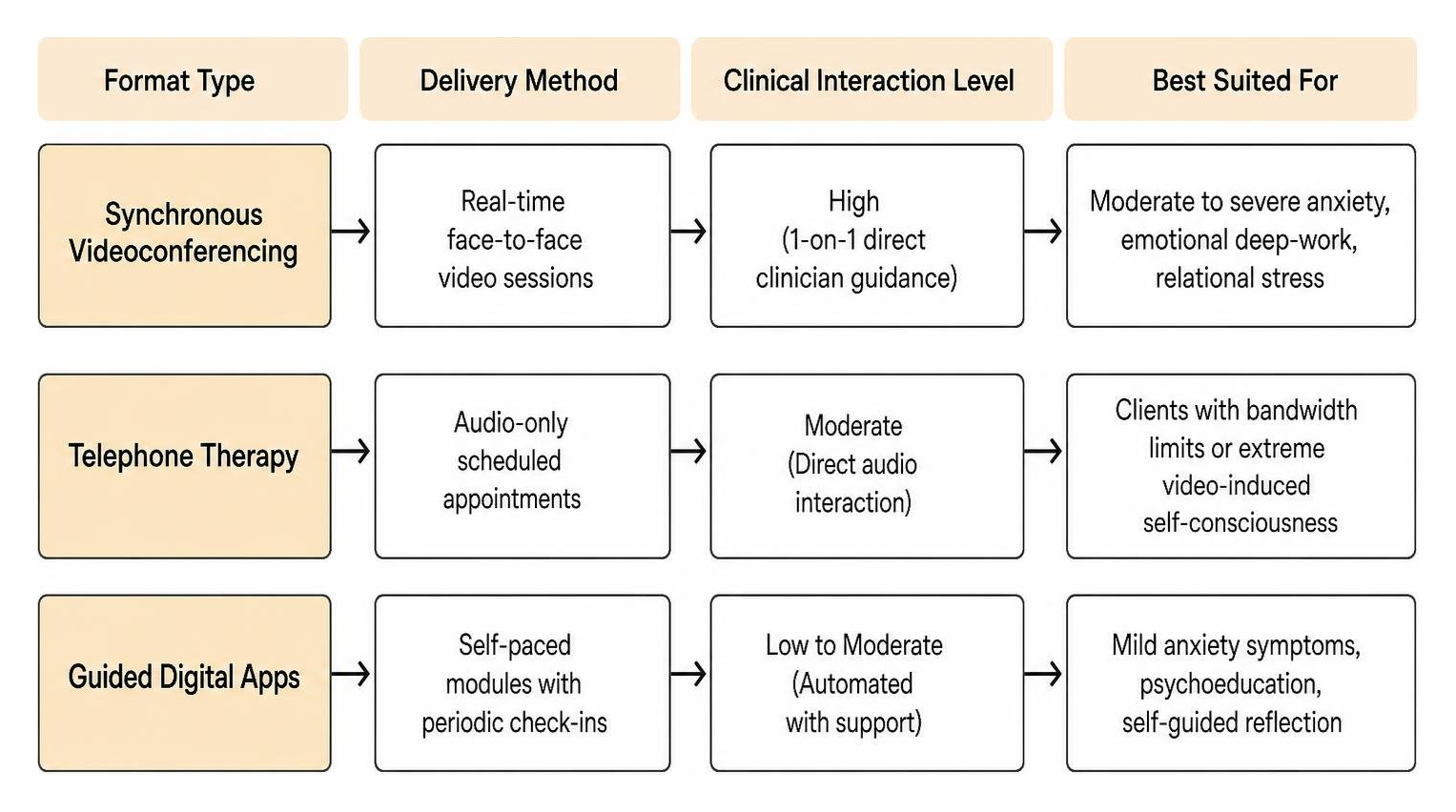
While live videoconferencing represents the clinical gold standard for virtual individual therapy, digital mental health care spans several formats depending on your needs and level of care required:
| Format Type | Delivery Method | Clinical Interaction Level | Best Suited For |
|---|---|---|---|
| Synchronous Videoconferencing | Real-time face-to-face video sessions | High (1-on-1 direct clinician guidance) | Moderate to severe anxiety, emotional deep-work, relational stress |
| Telephone Therapy | Audio-only scheduled appointments | Moderate (Direct audio interaction) | Clients with bandwidth limits or extreme video-induced self-consciousness |
| Guided Digital Apps | Self-paced modules with periodic check-ins | Low to Moderate (Automated with support) | Mild anxiety symptoms, psychoeducation, self-guided reflection |
Structure and Duration of a Virtual Individual Anxiety Counseling Program
A typical virtual therapy journey is structured to offer both immediate stabilization and long-term emotional transformation. Sessions are generally scheduled weekly for 50 minutes.
During the initial assessment phase, we explore your unique emotional landscape, current coping strategies, and relational history. As therapy progresses, we move beyond surface-level symptom management into experiential processing and Emotionally Focused Therapy (EFT) techniques. Between sessions, you may engage in guided mindfulness exercises, body-awareness tracking, or reflective journaling to integrate therapeutic insights into your daily routine. Most structured virtual care plans run between 8 and 20 weeks, though many clients choose ongoing care to support continued emotional resilience.
Types and Clinical Efficacy of Virtual Anxiety Therapy
A common question people ask is whether remote care truly matches the clinical depth of sitting in the same room with a counselor. Robust scientific research confirms that virtual therapy is as effective as in-person care for managing anxiety disorders.
In clinical trials evaluating video-delivered counseling for social anxiety disorder, participants demonstrated remarkable clinical improvements. A landmark study published in a major psychiatric journal revealed a videoconferencing trial for social anxiety disorder achieved a 57% diagnostic remission rate immediately following treatment, which climbed to 68% at a 3-month follow-up. Within-group effect sizes were large (Cohen’s d = 0.95), showing that video platforms provide full therapeutic potency.
In our practice, we focus on depth-oriented, relational, and somatic frameworks such as Emotionally Focused Therapy (EFT), Accelerated Experiential Dynamic Psychotherapy (AEDP), Brainspotting, and mindfulness-based practices. Instead of merely managing thoughts, these modalities allow us to track emotional thresholds, explore underlying attachment fears, and gently help you step out of defensive autopilots. For a comprehensive overview of treatment modalities, explore our Anxiety Disorders Treatment Complete Guide.
Clinical Value of Therapist-Led Videoconferencing
While self-guided apps offer accessible psychoeducation, live therapist-led videoconferencing creates the relational safety necessary for deep healing. Research published in the Journal of Medical Internet Research - Safety and Efficacy of Modular Digital Psychotherapy for Social Anxiety: Randomized Controlled Trial notes that while automated tools significantly reduce Social Phobia Inventory (SPIN) scores (achieving mean score drops of -12.89 points), high-intensity synchronous video therapy yields even higher overall completion rates (nearly 90%) and lower drop-out rates.
The presence of a live, attuned clinician allows for real-time co-regulation. When anxiety spikes during a session, we guide you through somatic grounding, helping your nervous system return to a safe baseline in the moment.
Key Benefits for Social Anxiety and Overcoming Care Barriers
Despite anxiety disorders affecting approximately 40 million American adults, statistics reveal that only 23% of individuals with lifetime social anxiety disorder ever receive specialized psychological treatment. The very nature of anxiety creates significant barriers to getting help—fear of driving, panic in public places, agoraphobia, or intense dread of social evaluation can make traveling to an office feel overwhelming.

Virtual care breaks down these obstacles by allowing you to receive care within your safe environment:
- Eliminating Travel Anxiety: You eliminate stress related to traffic, parking, public transit, or unfamiliar environments.
- Overcoming Social Avoidance: For those with severe social anxiety, meeting a therapist on a screen provides a manageable emotional step into therapeutic connection.
- Expanded Geographic Access: You can work with specialized therapists anywhere in your state, regardless of whether you live in urban centers like Seattle, Chicago, or Portland, or in rural areas.
- Cultural and Relational Alignment: Finding a specialized clinician who understands your identity is easier when geographic limitations are removed. Learn more about our approach to Culturally Sensitive Individual Counseling and explore tailored options for Online Therapy in Washington.
Safety, Risk Factors, and Emergency Safety Protocols
Virtual therapy is remarkably safe. Extensive clinical trials demonstrate that adverse events in remote mental health care occur at rates comparable to waitlist control groups (around 13% to 16%), confirming that virtual platforms pose no inherently elevated risk for out-patients.

However, clinical safety requires established protocols. Prior to beginning care, your clinician establishes clear safety measures:
- Location Verification: Confirming your physical location address at the start of every session.
- Local Emergency Contacts: Keeping local crisis team contact details on file for your specific municipality.
- Backup Communication: Establishing secondary phone contacts in case internet connectivity drops.
If a client experiences an acute mental health crisis or severe distress, teletherapy platforms integrate immediate crisis response plans, connecting the individual to local emergency services or specialized crisis lines. Learn more about our safety standards on our Online Therapy Services page.
Insurance Coverage, Costs, and How to Choose a Therapist
Understanding the financial and privacy landscape of therapy is an important step in your wellness journey.
Many health plans do offer in-network telehealth benefits, which can reduce immediate out-of-pocket costs through fixed co-pays. While using insurance benefits can make therapy accessible, it is equally important to understand the inherent constraints that come with billing insurance:
- Mandatory Diagnostic Record: Insurance companies require a formal psychiatric diagnosis (such as Generalized Anxiety Disorder or Major Depressive Disorder) on your permanent medical record to justify reimbursement.
- Privacy Limitations: Insurers retain the right to audit clinical notes, session lengths, and treatment plans, compromising absolute confidentiality.
- Long-term Consequences: A formal mental health diagnosis on your medical record can occasionally impact future personal choices, including underwriting for private life or disability insurance, security clearances, adoption applications, or specific employment screenings.
For these reasons, many clients choose private-pay virtual therapy to ensure complete privacy, control over their records, and therapy unconstrained by insurance-mandated session limits.
When choosing a virtual provider, verify that the therapist holds active state licensure where you physically reside. At Spark Relational Counseling, led by founder May Han, our licensed clinicians provide care across Oregon, Washington, and Illinois (including clients in Seattle, Portland, Chicago, Bellevue, Spokane, Eugene, and surrounding communities).
Frequently Asked Questions About Telehealth Anxiety Care
Does virtual individual anxiety counseling include medication management?
While licensed talk therapists (LMFTs, LCSWs, LPCs) specialize in psychotherapeutic approaches like EFT and mindfulness rather than prescribing medication, telehealth psychiatric medical providers can evaluate and prescribe anxiety medications online when appropriate. Therapy and medication management can seamlessly operate as complementary elements of a complete care plan.
Is virtual therapy safe during a mental health crisis?
Virtual therapy is highly effective for mild, moderate, and severe anxiety. However, during an acute psychiatric emergency—such as active suicidal intent or severe self-harm—outpatient virtual therapy may need to be supplemented by immediate local crisis response teams, emergency rooms, or specialized inpatient care to ensure physical safety.
How long does it take to see results from virtual anxiety counseling?
Many clients report feeling an initial sense of relief within 3 to 5 sessions simply by having a dedicated, supportive space to express their burdens. Lasting structural changes in nervous system regulation and relational patterns typically unfold over 8 to 16 weeks of consistent weekly counseling.
Conclusion
Anxiety can make your world feel increasingly small, pushing you into isolation and exhaustion. Virtual individual anxiety counseling bridges the gap between where you are today and the emotional freedom you deserve, offering grounded, evidence-based care directly in the comfort of your home.
Whether you are navigating chronic worry, social apprehension, panic, or relational strain, centered mindfulness and emotionally focused approaches can help you step off emotional autopilots and step into lasting peace.
If you are ready to begin your journey toward emotional balance in Oregon, Washington, or Illinois, explore our dedicated Anxiety Treatment options. You can also read more about deep healing through our guides on individual therapy for relationship issues or understanding high-functioning depression. We are here to support your path back to connection and calm.