
The Psychology of Human Connection and Attachment Theory
Define Attachment Theory: A Quick Guide to Human Connection

To define attachment theory, it is a psychological framework that explains how people form emotional bonds with caregivers and other close people, especially when they need comfort, safety, or support. Developed by British psychiatrist John Bowlby and expanded through Mary Ainsworth's research, it suggests that these early bonds help shape how we handle trust, closeness, stress, and relationships over time.
| Key idea | What it means |
|---|---|
| Attachment | A lasting emotional bond that helps a child seek safety and comfort from a trusted caregiver. |
| Secure base | A reliable relationship that gives someone confidence to explore, grow, and return for support when life feels hard. |
| Internal working models | Learned expectations about whether other people will be available and whether we are worthy of care. |
| Adult relationships | Romantic partners can become sources of comfort, safety, and support in ways that echo early attachment bonds. |
Attachment theory is not a verdict on your childhood or a permanent label for your relationships. It is a useful map. It can help explain why one person seeks reassurance during conflict while another pulls away, and why the same patterns can feel so hard to change on autopilot.
I am May Han, a Licensed Marriage and Family Therapist at Spark Relational Counseling who works with individuals and couples on relationship patterns, communication, and emotional connection. In helping clients define attachment theory in practical terms, I use mindfulness-informed and emotionally focused approaches to connect insight with the real moments that shape a relationship.
What Is the Biological Blueprint? How Psychologists Define Attachment Theory
At its fundamental core, human connection is not merely a social convenience; it is a biological imperative wired directly into our nervous system. When developmental psychologists and neurobiologists define attachment theory, they describe an evolved behavioral system designed to protect vulnerable offspring from danger by maintaining physical and emotional proximity to a primary caregiver.
In early human history, an infant who wandered too far from the protective sphere of their adult caretakers faced immediate evolutionary risks. Proximity seeking became an essential survival mechanism. When a baby senses threat, coldness, fatigue, or distress, their internal attachment system activates automatically. Crying, clinging, reaching, or smiling are primary attachment behaviors—innate signals meant to draw the caregiver back into comforting proximity.
When the caregiver responds with warmth, attunement, and consistency, the infant experiences a profound physiological state known as "felt security." This state calms the sympathetic nervous system, lowers cortisol levels, and fosters emotional regulation. Through thousands of daily micro-interactions, the child's brain learns that distress can be co-regulated and transformed into safety. Research published in Contributions of attachment theory highlights how these neurobiological feedback loops lay the foundation for resilience and emotional capacity throughout our entire lives.
Historical Origins: How John Bowlby and Mary Ainsworth Define Attachment Theory
To fully grasp how we define attachment theory today, we must journey back to the mid-20th century. British psychoanalyst John Bowlby formulated the theoretical foundation of attachment while observing emotionally troubled children at the London Child Guidance Clinic during the 1930s and 1940s.
At the time, dominant psychoanalytic and behaviorist paradigms promoted "cupboard love theory"—the belief that infants only bond with mothers because caregivers fulfill basic physical needs like hunger and warmth. Bowlby rejected this reductionist view. Drawing upon evolutionary biology, ethology, control systems theory, and mammalian studies—such as Harry Harlow’s famous experiments showing infant rhesus monkeys preferring soft terry-cloth surrogate mothers over wire mothers that provided milk—Bowlby recognized that touch, nurturance, and emotional safety were human needs independent of feeding.
In the 1950s and 1970s, American developmental psychologist Mary Ainsworth transformed Bowlby's theoretical framework into an empirical science. Her field research observing mother-infant pairs in Uganda and Baltimore demonstrated that sensitive caregiving—responding quickly and appropriately to an infant's cues—was the key determinant of secure bonding. Detailed accounts found in the Contributions of Attachment Theory and Research illustrate how Bowlby's grand synthesis and Ainsworth's rigorous observational methods created a groundbreaking paradigm for developmental psychology.
Key Concepts: Secure Base, Safe Haven, and Internal Working Models
Three foundational concepts anchor the way clinical practitioners and researchers define attachment theory:
- The Secure Base: A primary caregiver acts as a launchpad. When children feel secure in their parent's availability, they possess the emotional confidence required to venture out, play, learn, and explore their environment.
- The Safe Haven: When the external world becomes overwhelming, frightening, or painful, the caregiver serves as a protective harbor where the child can return to receive comfort, recalibrate their nervous system, and restore felt security.
- Internal Working Models: Through early interactions, infants construct implicit cognitive representations—or relational scripts—about themselves and others. These working models answer two foundational subconscious questions: "Am I worthy of love and care?" and "Are others reliable and safe when I am in distress?"
These cognitive representations operate within hierarchical associative memory networks. Rather than staying static, they become the implicit template or "brain autopilot" guiding how we expect people to react during moments of vulnerability in adulthood.
The Developmental Stages and the 'Strange Situation' Paradigm
An infant does not develop a selective attachment overnight. Developmental research tracks a distinct progression across four early stages:
- Pre-attachment Stage (Birth to 6 Weeks): Infants exhibit indiscriminate proximity behaviors like crying, smiling, or grasping to attract any nearby caregiver without a strong preference for specific individuals.
- Attachment in the Making (6 Weeks to 7 Months): Babies begin distinguishing familiar caregivers from strangers, responding more warmly to primary figures, though separation distress remains minimal.
- Clear-Cut Attachment (7 Months to 2 Years): Strong, specific attachments crystallize. Infants display pronounced separation anxiety when caregivers depart and stranger anxiety when unfamiliar adults approach. The caregiver is explicitly used as a secure base.
- Goal-Corrected Partnership (2 Years and Beyond): As cognitive and language capacities mature, children begin understanding their caregiver's goals, schedules, and feelings, negotiating proximity through collaborative communication.

How Early Experiments Help Define Attachment Theory in Childhood
To measure individual differences in how infants utilize their attachment figures, Mary Ainsworth designed a standardized laboratory observation known as the Strange Situation Procedure. Designed for infants aged 12 to 18 months, this 21-minute laboratory paradigm evaluates how a toddler balances exploratory drives against attachment needs during mild, controlled stress.
The procedure moves through eight brief episodes involving a parent, an infant, and a friendly stranger:
- Mother and baby enter an unfamiliar playroom.
- Baby explores toys while mother sits quietly.
- A stranger enters, speaks with mother, and approaches baby.
- Mother leaves room discreetly; stranger stays with baby (First Separation).
- Mother returns, greets and comforts baby, stranger leaves (First Reunion).
- Mother leaves baby completely alone in room (Second Separation).
- Stranger returns and offers comfort to baby.
- Mother returns, comforts baby, and stranger quietly leaves (Second Reunion).
Researchers focus primarily on the infant's behavioral organization during the reunion episodes. How quickly can the child accept comfort? Does the child draw close, or do they express anger or detachment? An extensive Attachment theory research overview shows that caregiver sensitive responsiveness—the ability to accurately read infant signals and offer timely comfort—directly determines the child's classification.
The Four Primary Infant Attachment Styles
Observations from the Strange Situation paradigm revealed distinct behavioral clusters. Mary Ainsworth initially identified three major styles, while Mary Main and Judith Solomon later identified a fourth category in 1986 to account for disorganized patterns.
| Attachment Style | Prevalence | Separation Behavior | Reunion Behavior | Underlying Caregiving Style |
|---|---|---|---|---|
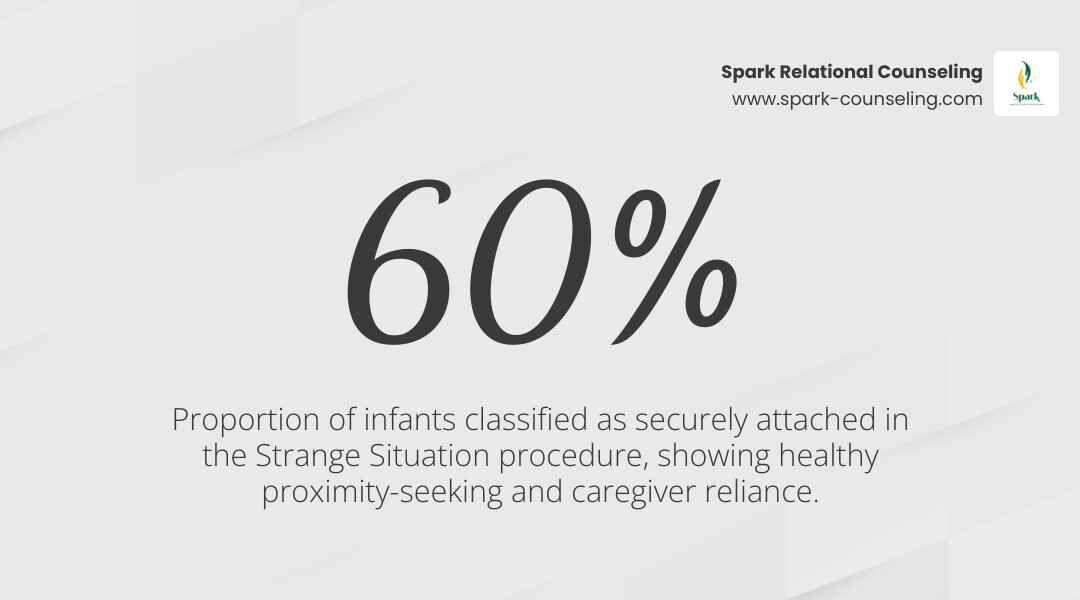
| Secure | ~60% | Visibly distressed when caregiver leaves; limits exploration. | Actively seeks physical contact; easily comforted and resumes play. | Consistently responsive, warm, attuned, and emotionally available. |
| Anxious-Ambivalent (Resistant) | ~10–20% | Intensely distressed; hyper-focused on caregiver throughout. | Seeks proximity but expresses anger, kicking, or pushback; hard to soothe. | Inconsistent or unpredictable caregiving; warm at times, overwhelmed at others. |
| Avoidant | ~20% | Shows little outward distress; focuses on toys. | Actively avoids or ignores caregiver upon return; turns away physically. | Consistently rejecting, cold, dismissive, or over-controlling during distress. |
| Disorganized-Disoriented | ~5–10% | Displays confused, freezing, or contradictory approach-avoidance actions. | Approaches caregiver while looking away, collapsing, or exhibiting fear. | Caregiver is a source of fear or unresolved trauma (fright without solution). |
The Four Main Adult Attachment Styles in Relationships
In 1987, psychologists Cindy Hazan and Phillip Shaver realized that the emotional dynamics linking infants to caregivers operate similarly in adult romantic partnerships. Adults seek physical proximity to partners, turn to them as a safe haven during emotional strain, rely on them as a secure base to achieve personal goals, and experience protest when intimacy feels threatened. Exploring the connection between the 4 attachment styles in relationships offers profound clarity into how these childhood templates manifest in modern adult partnerships.
Secure Attachment: Trust and Interdependence
Adults with a secure attachment style hold internal working models that view themselves as worthy of affection and view others as fundamentally reliable and well-intentioned. Population studies suggest that approximately 60% of adults classify themselves as secure, with broader survey metrics indicating up to 81.8% overall security across varied non-clinical cohorts.
In everyday relationships, securely attached adults communicate needs transparently, share vulnerabilities without terror, and set clear, healthy boundaries. During disagreement, they regulate their emotional thresholds effectively, avoiding extreme withdrawal or hostility. Discovering more about understanding secure attachment style and trust clarifies how secure partners build lasting interdependence without losing their individual identity.
Anxious-Preoccupied Attachment: Fear of Abandonment
Adults with an anxious-preoccupied attachment style (accounting for roughly 20% of adults) operate with a high drive for emotional closeness combined with an underlying fear of rejection or abandonment. They rely heavily on external reassurance to regulate their internal sense of safety.
When an anxious partner perceives emotional distance—such as a delayed text message or a subtle shift in tone—their brain interprets it as an existential relational threat. This triggers hyperactivating strategies:
- Repeatedly checking in or demanding immediate validation.
- Hyper-vigilance toward micro-shifts in a partner's facial expressions or moods.
- Expressing intense emotional distress to compel closeness.
A deep dive into understanding anxious attachment signs and triggers reveals how these hyperactivating strategies often stem from early environments where caregiver attention was intermittent or unpredictable.

Dismissive-Avoidant Attachment: Compulsive Self-Reliance
Representing approximately 20% of the adult population, dismissive-avoidant individuals navigate relational anxiety by maintaining emotional self-reliance and minimizing the importance of intimacy. Because their early attachment bids were frequently rejected or ignored, their nervous system learned that depending on others is unsafe.
When relational tension arises, avoidant adults utilize deactivating strategies:
- Suppressing emotional needs and pulling away physically or emotionally.
- Focusing obsessively on work, solitary hobbies, or independence.
- Dismissing a partner's distress as "overly dramatic" or "irrational."
Physiological experiments reveal a striking insight: while dismissive adults may appear completely calm and indifferent on the surface during conflict, their heart rate and skin conductance levels reflect high internal physiological arousal. Reading about avoidant attachment style signs and patterns explains how this apparent indifference is actually a sophisticated defensive shell built to keep anxiety at bay.
Fearful-Avoidant (Disorganized) Attachment: Relational Trauma and Conflict
Fearful-avoidant attachment—often referred to as disorganized attachment in adults—combines high attachment anxiety with high attachment avoidance. Individuals with this style deeply desire affection and deep connection, yet intimacy triggers intense feelings of danger and fear.
This creates a painful internal dilemma: the very thing I crave is the thing that frightens me most. In couples, this often generates an erratic approach-avoidance pattern where an individual draws a partner in close, panics, pushes them away, and then fears losing them. Our comprehensive fearful avoidant attachment overview explains how this complex dynamic usually forms when early caregivers were chaotic, scary, or lived with unresolved relational trauma.
From Infancy to Adulthood: Stability, Change, and Adult Romantic Bonds
To bridge childhood assessments with adult relational patterns, modern social psychologists conceptualize attachment not as rigid diagnostic boxes, but along two continuous dimensions: attachment-related anxiety (fear of rejection/abandonment) and attachment-related avoidance (fear of dependency/intimacy).
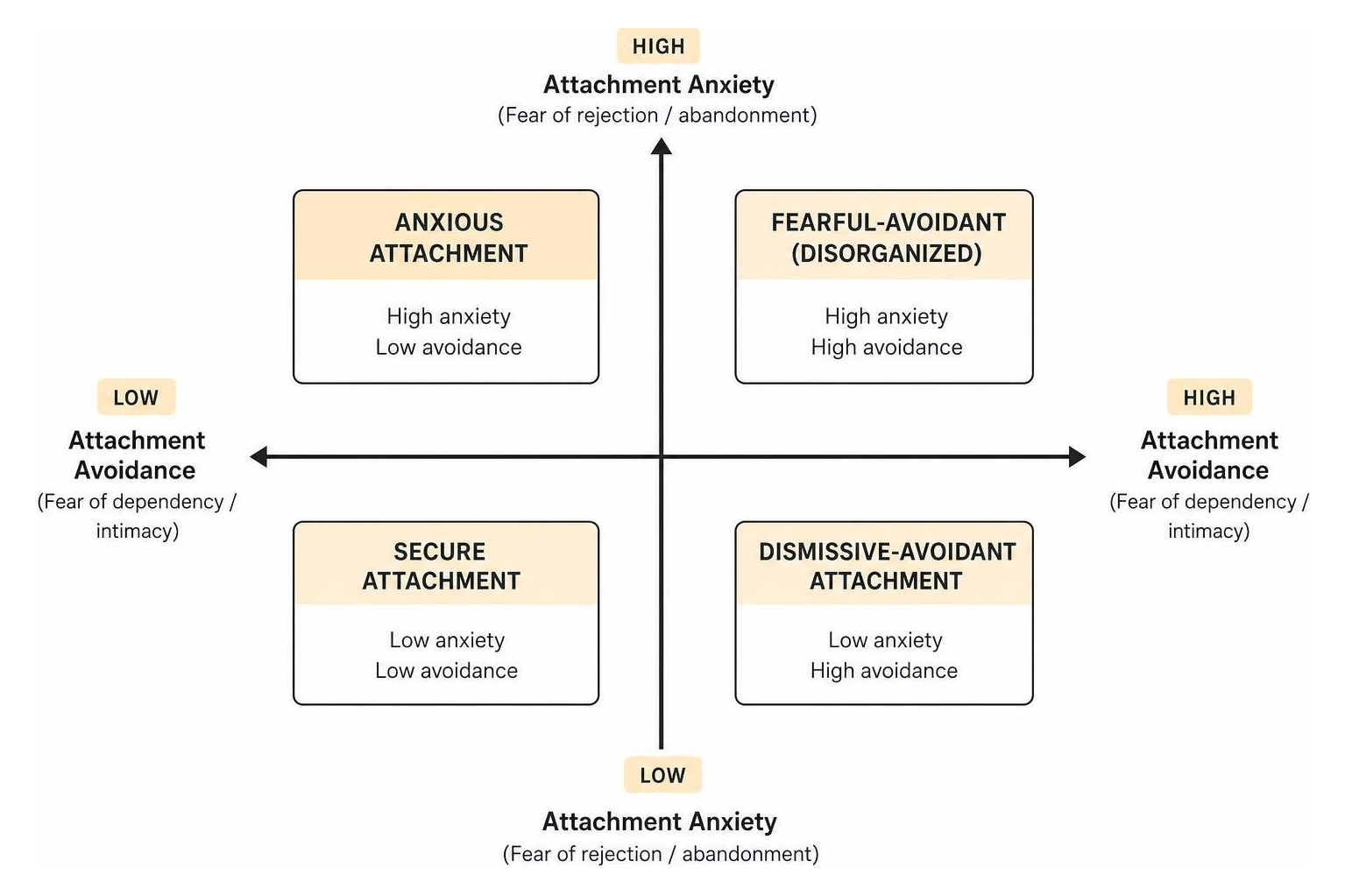
A quick look at A Brief Overview of Adult Attachment Theory and Research confirms that evaluating partners along these continuous axes provides far greater nuance than forcing complex human behavior into rigid labels.
The Attachment Behavioral System in Adult Intimacy
When we enter a romantic partnership, our biological attachment behavioral system integrates with our adult caregiving and sexual systems. Partners become primary attachment figures who fulfill mutual safe haven and secure base functions.
When a partner feels threatened, tired, or distressed, their attachment system fires instantly. If the couple experiences an anxious-avoidant dynamic—often termed the demand-withdraw cycle—one partner's hyperactivating bid for connection activates the other partner's deactivating impulse to pull away. Exploring our avoidant anxious attachment guide offers compassionate clarity on how couples can map these automatic cycles without shaming either person's protective tendencies.
In our clinical work with clients across Oregon, Washington, and Illinois, we often see how couples end up feeling stuck in these cycles. When evaluating therapy options, clients sometimes ask about using health insurance benefits. While insurance can offer helpful in-network financial support for therapy, we always believe in fully informing our clients about its operational constraints.
To reimburse care, insurance companies require a formal psychiatric diagnosis on your permanent medical record, which can compromise personal privacy. Additionally, having a documented mental health diagnosis can sometimes carry unforeseen negative impacts for future personal choices—such as high-value life insurance underwriting, private disability coverage, formal adoption proceedings, employment opportunities, or specific high-level security clearances. We prioritize giving our clients the knowledge needed to make empowered choices about their healthcare privacy.
Can Attachment Styles Change Over Time? Earned Security
A common question people ask when learning how practitioners define attachment theory is whether early childhood bonding locks them into a fixed lifelong destiny. Longitudinal studies tracking individuals from infancy into adulthood show moderate stability correlations ranging between .17 and .39. A 20-year longitudinal study found a correlation of .17 between Strange Situation security at age 1 and adult romantic security at age 21.
This modest correlation proves that early attachment experiences shape us, but they do not seal our fate. Attachment security is remarkably fluid. Through neuroplasticity, self-reflection, and supportive experiences, individuals can achieve what psychologists term Earned Security.
We can rewrite implicit working models by moving beyond automatic brain autopilots. In therapeutic frameworks such as Emotionally Focused Therapy (EFT), Accelerated Experiential Dynamic Psychotherapy (AEDP), Experiential therapy, and Brainspotting, individuals and couples experience real-time relational attunement. Practicing gentle mindfulness helps partners track physiological stress, identify emotional thresholds, and communicate needs calmly before feeling overwhelmed. Groundbreaking clinical insights detailed in The Science and Clinical Practice of Attachment Theory highlight how experiencing safe, emotionally attuned relationships in adulthood actually re-patterns our underlying nervous system.
Scientific Critiques, Cultural Limitations, and Modern Perspectives
While attachment theory provides an invaluable framework, modern developmental psychology highlights several historical limitations and cultural biases in early 20th-century research:
- Western Individualist Bias: Original paradigms categorized high infant stranger anxiety as insecure behavior. However, in collectivist cultures where extended families practice shared child-rearing, or in societies where community caretaking is the norm, child responses naturally differ without indicating relational pathology.
- The Flaw of Monotropy: John Bowlby initially asserted that infants require a singular primary maternal figure (monotropy). Modern ethology and anthropology demonstrate that human children evolved in hunter-gatherer societies utilizing cooperative breeding, forming healthy attachment hierarchies with fathers, grandparents, siblings, and community members.
- Socio-Environmental Confounding: Critics point out that early Strange Situation assessments often reflect current environmental stability and family stress levels rather than fixed infant traits. When family stress decreases, infant attachment security frequently shifts upward.
- Genetic and Temperamental Influences: Early models overemphasized maternal caregiving while downplaying intrinsic genetic factors, such as infant neurobiological temperament, sensory sensitivity, and autonomic nervous system reactivity.
Acknowledging these nuances allows clinicians to view attachment through a broader, more inclusive, and culturally humble lens.
Frequently Asked Questions About Attachment Theory
What is the core concept of attachment theory?
The core concept is that human beings possess an innate biological drive to seek closeness with protective caregivers to ensure survival, manage distress, and construct internal working models that guide safety and trust in lifelong relationships.
Can your attachment style change in adulthood?
Yes. Attachment styles exist along a fluid continuum. Through self-awareness, transformative relationship experiences, mindfulness practices, and relational therapy like EFT or AEDP, adults can shift from insecure patterns to earned secure attachment.
What causes a disorganized attachment style?
Disorganized attachment typically develops when a child's primary caregiver is simultaneously a source of fear and a source of safety. This creates an unresolvable biological paradox (approach-avoidance threat response) usually rooted in trauma, severe neglect, or frightening caregiver behavior.
Conclusion
Understanding how psychologists define attachment theory gives us a compassionate lens for viewing human vulnerability, emotional conflict, and our universal longing for connection. Rather than assigning blame or labeling yourself or your partner, attachment theory offers a practical road map for recognizing automatic habits and creating meaningful emotional safety.
When we pause to observe our relational reactions using simple mindfulness, we can identify when our nervous system feels overwhelmed. Recognizing these thresholds allows us to step out of reactive cycles and cultivate genuine, open communication.
At Spark Relational Counseling, May Han and our clinical team specialize in helping individuals and couples break free from negative brain autopilots to restore warmth, emotional safety, and lasting connection. Through virtual therapy sessions available across Oregon, Washington, and Illinois—including communities in Portland, Seattle, Chicago, Bellevue, and Lake Oswego—our clinicians blend mindfulness with Emotionally Focused Therapy (EFT) and experiential approaches. Explore our guide on attachment styles and connection in relationship counseling to take your next step toward building a deeper, secure connection.