How to Master Conflict Resolution Steps, Even if You're a Beginner
Conflict Resolution Starts With Slowing Down and Getting Curious

Conflict resolution is the skill of handling a disagreement without attacking, shutting down, or trying to win at any cost. Start by pausing long enough to settle your body, name the issue without blame, listen for the other person's real concern, and agree on one clear next step.
A useful script is: "When this happened, I felt ____. I need ____. Can you help me understand what this was like for you?" This keeps the focus on impact, needs, and shared problem-solving.
Conflict is not proof that a relationship or team is failing. Often, it points to an unmet need, unclear expectation, competing priority, or feeling of disrespect. When people address it early and with care, conflict can build trust, improve decisions, and interrupt the same exhausting argument cycle.
I am May Han, a Licensed Marriage and Family Therapist at Spark Relational Counseling. I help individuals and couples use mindfulness and emotionally focused techniques to build conflict resolution skills, step out of reactive patterns, and create more connected relationships.
Psychological Traps and Foundational Conflict Resolution Methods

Disagreements rarely turn destructive because of the topic itself. Instead, they spiral when we get caught in defensive instincts and lose sight of our shared goals. The legal system illustrates how naturally human beings seek alternatives to full-scale battle: only 5% of all cases filed in court go to trial, while the rest are settled through negotiation, mediation, or other dispute resolution methods.
When tension emerges at work or at home, understanding how our minds escalate tension helps us choose a calmer path. Research from the 5 Conflict Resolution Strategies That Actually Work - PON - Program on Negotiation at Harvard Law School shows that shifting from persuasion to open curiosity preserves connection and reveals creative, lasting solutions.
Cognitive and Emotional Traps That Escalate Tension
When a conversation feels high-stakes, our nervous system instinctively seeks self-protection. This instinct triggers common psychological biases that trap us in unhelpful dynamics:
- Self-Serving Fairness: We naturally view fairness through our own subjective lens, assuming our perspective is objective while treating the other person's view as biased.
- Overconfidence Bias: Believing our interpretation of the situation is the only accurate one makes us dismiss alternative explanations before exploring them.
- Escalation of Commitment: As we pour time and emotional energy into defending a specific stance, we become determined to win the point, even when doing so damages the bond.
- Reactive Devaluation: We instinctively reject a constructive suggestion simply because it was proposed by the person we are frustrated with.
- Conflict Avoidance: Sidestepping difficult discussions out of discomfort allows resentment to quietly build underneath the surface.
Recognizing these mental habits allows you to pause and discover how to break the argument cycle before defensive autopilot takes over.
Dispute Resolution Spectrum: From Informal Dialogue to Legal Action
Disputes exist across a continuum, ranging from private discussions to formal adjudications. Choosing the right method depends on your relationship, the complexity of the issue, and the level of decision-making control you wish to keep.
| Method | Facilitator | Control Over Outcome | Process Privacy | Binding Nature |
|---|---|---|---|---|
| Negotiation | None (Direct dialogue) | Complete (Mutual consent) | Completely private | Only if mutually signed |
| Mediation | Neutral third-party mediator | High (Parties craft agreement) | Confidential | When terms are formalized |
| Arbitration | Neutral arbitrator | Low (Arbitrator decides) | Generally private | Typically legally binding |
| Litigation | Judge and/or Jury | None (Court imposes verdict) | Public record | Legally binding |
As outlined in the Guidance for effective mediation provided by the United Nations, maintaining voluntary engagement, impartiality, and mutual consent generates durable agreements that respect dignity on both sides.
Navigating Conflict Styles Across Relationships and Cultures
Every individual brings a unique personal history, attachment baseline, and cultural background to a disagreement. The dual-concern model explains how our behaviors balance two primary forces: assertiveness (advocating for our own needs) and cooperativeness (caring for the other person's needs).
Understanding these underlying dynamics is essential to healthy conflict resolution, ensuring we do not misinterpret someone else's stress response as personal malice.
The 5 Thomas-Kilmann Conflict Handling Modes
The Thomas-Kilmann framework identifies five distinct conflict modes. Each style serves a specific purpose depending on the circumstance:
- Competing (High Assertiveness, Low Cooperativeness): Essential during genuine safety emergencies or when critical boundaries require immediate, decisive protection.
- Accommodating (Low Assertiveness, High Cooperativeness): Helpful when the issue matters significantly more to the other person or when preserving emotional goodwill takes priority.
- Avoiding (Low Assertiveness, Low Cooperativeness): Useful as a temporary cooling-off step when emotions run high, allowing both parties to return once grounded.
- Compromising (Moderate Assertiveness, Moderate Cooperativeness): Effective for temporary, middle-ground settlements when time constraints prevent a deeper exploration.
- Collaborating (High Assertiveness, High Cooperativeness): The gold standard for intimate partnerships and close teams, where parties integrate their deeper needs to build win-win outcomes.
Learning when and how to shift across these modes offers practical insight into how to resolve conflict without defaulting to rigid, reactive habits.
Intercultural Dimensions and Power Dynamics
Cultural backgrounds shape how directly or indirectly people communicate during stress:
- Low-Context Communication: Relies on direct, explicit wording where words carry the primary message.
- High-Context Communication: Values subtle cues, shared context, tone, and nonverbal signals to preserve harmony.
- Face-Saving and Collectivism: In many collectivist cultures, protecting an individual's public dignity and social harmony is vital to resolving tension.
- Navigating Power Imbalances: Disagreements across organizational hierarchies or institutional ranks can make junior individuals feel unsafe speaking candidly. Recognizing structural power gaps ensures open dialogues occur without fear of retaliation.
Practical Conflict Resolution Framework for Any Disagreement

Resolving a painful disagreement does not require complex theories. It requires a structured, repeatable sequence that helps your nervous system feel secure while exploring mutual solutions (Lewis et al., 2025). Learning how to stop fighting and repair a relationship begins with breaking the process down into two manageable phases.
Phase 1: Emotional De-Escalation and Preparation
Before addressing the logistical details of a problem, both individuals must feel internally grounded:
- Somatic Self-Regulation: When heart rates rise and voices tense, your body enters a threat state. Take slow, deliberate breaths, soften your shoulders, and feel the ground beneath your feet to bring your nervous system back into balance.
- The Mindful Pause: If emotional intensity escalates past your threshold, request a short, agreed-upon pause (such as twenty minutes) to regroup rather than impulsively reacting.
- Diagnose the Root Driver: Determine whether the conflict stems from a task mismatch (the what), a procedural disagreement (the how), an authority dispute (who decides), or an unmet relational need (feeling unseen or undervalued).
Phase 2: Collaborative Problem-Solving and Implementation
Once emotional safety is restored, shift the conversation toward tangible problem-solving:
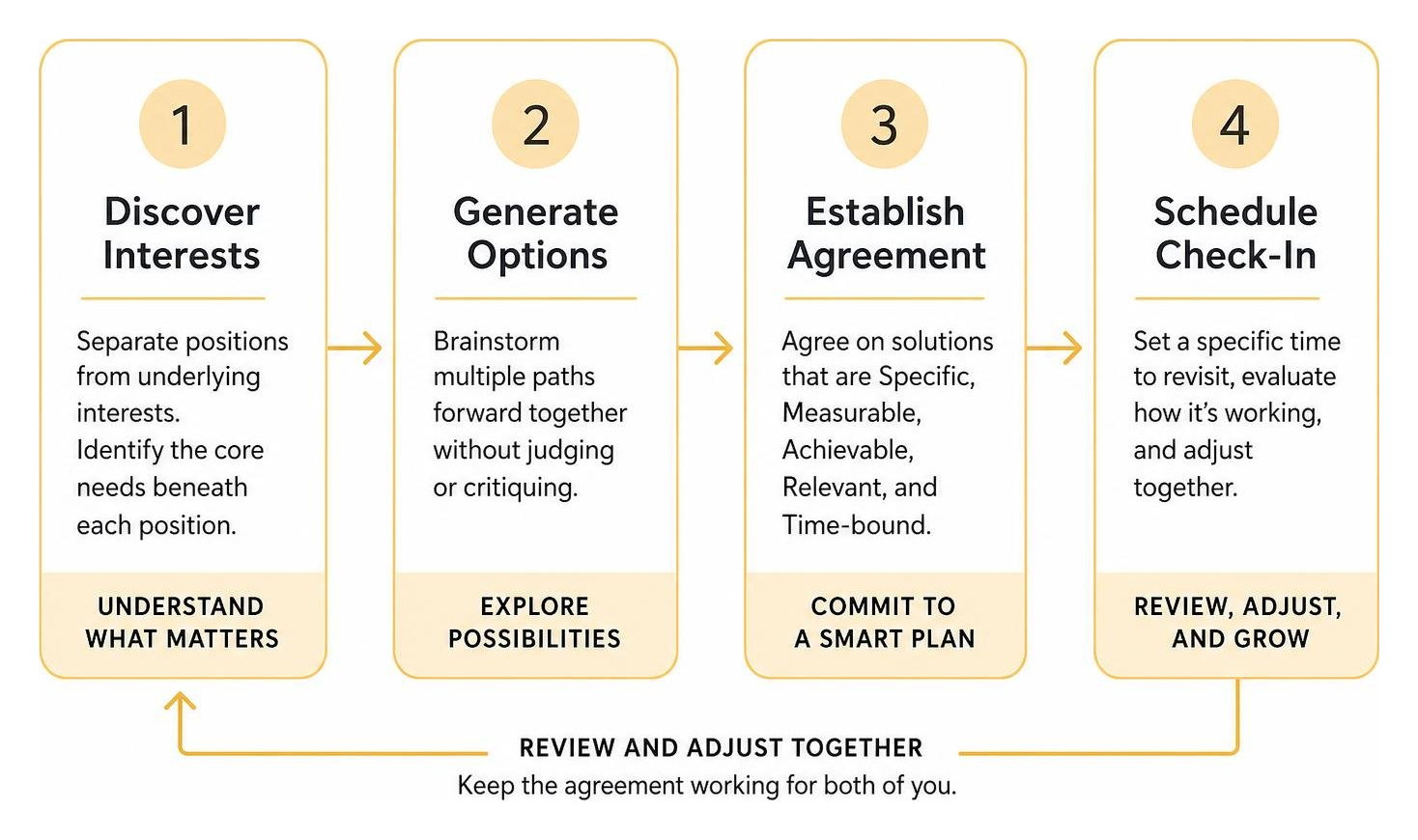
- Separate Positions from Underlying Interests: A position is a rigid demand ("You must clean the office every Tuesday"), whereas an interest is the core need underneath ("I need our shared workspace to feel calm and organized so I can focus").
- Generate Options Together: Brainstorm multiple paths forward without immediately judging or critiquing them.
- Establish SMART Agreements: Agree on solutions that are Specific, Measurable, Achievable, Relevant, and Time-bound.
- Schedule an Accountability Check-In: Set a specific time to revisit the agreement, evaluate how it is working, and adjust together with warmth and flexibility.
Mastering the Core Habits of Long-Term Peace

Sustainable relational health is sustained through daily micro-habits of connection and attunement. Using our relationship communication guide, you can transform everyday friction into deeper mutual understanding.
Key Skills for Conflict Resolution Success
Integrating these relational habits into your daily life creates an environment where repair happens smoothly:
- Active, Reflective Listening: Summarize what you heard before sharing your perspective. Try saying: "What I'm hearing is that you felt overwhelmed when the plan changed suddenly. Did I capture that accurately?"
- Clear "I" Statements: State your internal experience rather than diagnosing the other person's faults. Frame your thoughts around impact: "I felt anxious when the project timeline was moved up without a check-in."
- Playful De-Escalation: Gentle, shared humor can relieve bodily tension and remind both parties of their shared affection.
- Nonverbal Attunement: Maintain an open posture, a calm vocal tone, and unhurried eye contact to convey psychological safety.
- Sincere, Accountable Apologies: Validate the emotional impact of your actions without defensive justifications, taking full ownership of your role in the dynamic.
High-Impact Professional and Personal Applications
Conflict skills provide measurable value across diverse professional fields and personal dynamics:
- Healthcare and Clinical Leadership: Prevents miscommunication among medical teams operating in high-pressure environments, safeguarding patient outcomes.
- Human Resources and Team Management: Replaces toxic avoidance with clear conversational structures, reducing organizational turnover.
- Education and Social Work: Equips mentors and counselors to de-escalate crisis points and model healthy interpersonal boundaries.
- Marital and Family Resilience: Helps couples step out of reactive emotional loops and establish long-term relational security.
When addressing these relational patterns, many couples wonder about using insurance for therapy. While in-network insurance benefits can offer short-term convenience, using managed healthcare often requires formal mental health diagnoses that become part of your permanent medical record. This documentation can carry unexpected implications for private life insurance policies, security clearances, adoption evaluations, and specific career applications. Working privately with May Han at Spark Relational Counseling safeguards your confidential therapeutic records while giving us the clinical flexibility to tailor mindfulness-based relational approaches—such as Emotionally Focused Therapy (EFT), Accelerated Experiential Dynamic Psychotherapy (AEDP), Experiential therapy, and Brainspotting—directly to your growth.
Frequently Asked Questions About Resolving Disputes
What is the primary difference between mediation and arbitration?
In mediation, a neutral third-party facilitates communication to help both sides co-create their own voluntary agreement. In arbitration, the neutral third-party acts like a private judge who hears the evidence and issues a final, legally binding decision that the parties must follow.
How can I de-escalate an argument when the other person is yelling?
Lower your own vocal volume, soften your body language, and take a steady, grounding breath. Acknowledge their distress without matching their energy by saying: "I can hear how upsetting this is, and I want to understand. Let's take a quick breath so we can talk through this together."
When is avoidance an acceptable response to a disagreement?
Avoidance is an appropriate, healthy boundary when there are immediate physical safety concerns, when an issue is completely trivial, or when either person's nervous system is too overwhelmed to engage constructively, requiring a temporary cooling-off period before returning to the conversation.
Conclusion
Conflict is not an obstacle to true intimacy or effective collaboration—it is an invitation to deepen understanding. When we replace defensiveness with somatic grounding, clear communication, and emotional curiosity, disagreements become opportunities for growth.
At Spark Relational Counseling, May Han supports individuals and couples throughout Oregon, Washington, and Illinois—including communities in Portland, Seattle, Chicago, Lake Oswego, and Spokane—through virtual mindfulness-based relational therapy. If you are ready to heal painful communication patterns and rebuild lasting emotional closeness, explore our personalized marriage counseling services to schedule an initial consultation with our team.
References
Lewis KD, Holliday SA, Nichols KJ, Terhune KP. "Building Bridges: Approaches to Conflict Resolution That Lead to a Collaborative Learning Environment.." Journal of graduate medical education, 2025. PMCID PMC12096109.