
The Hidden Drain of Relational Burnout
Understanding the Depletion: What Is Relational Burnout and How It Occurs

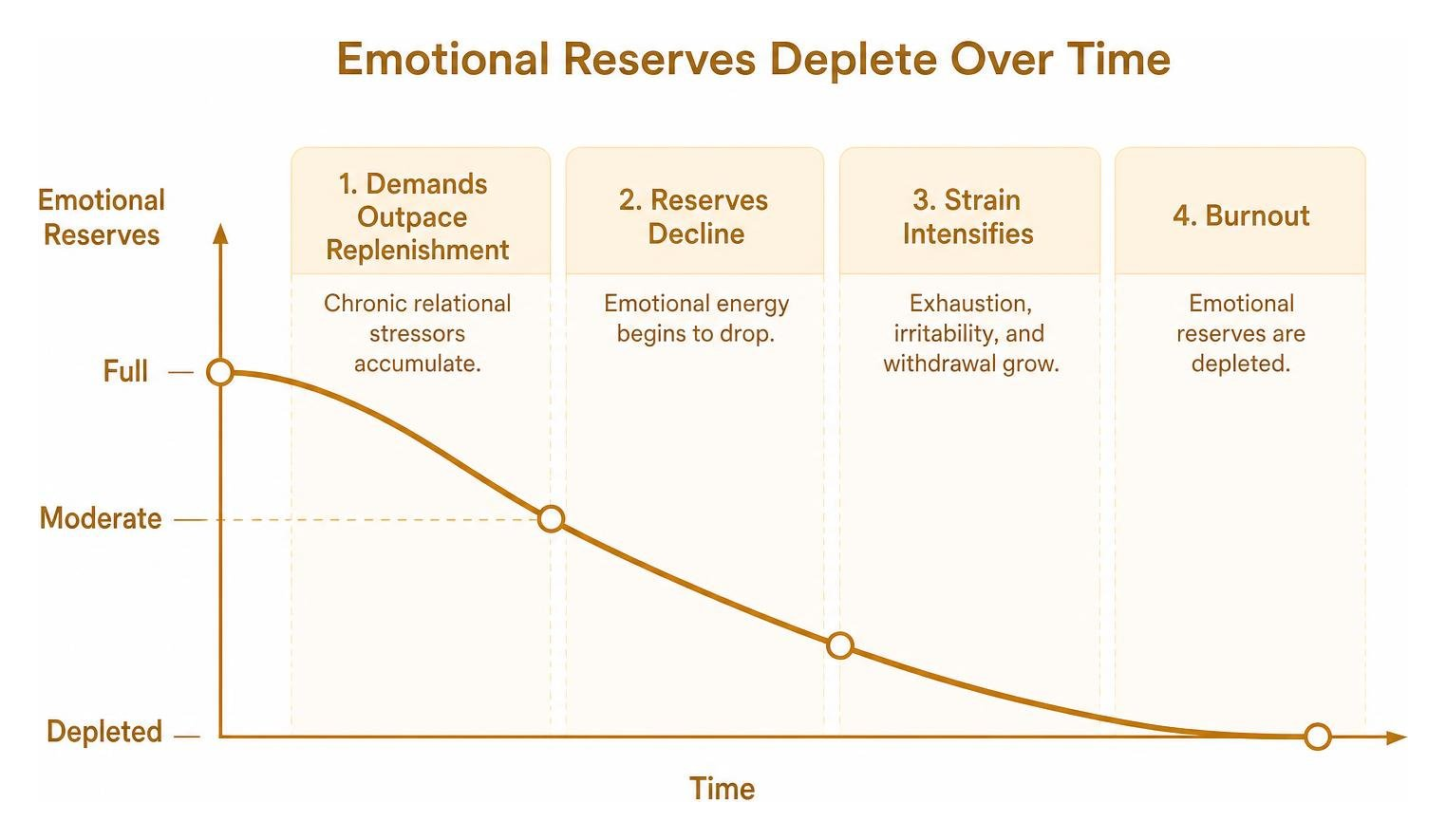
When we think about burnout, our minds usually drift toward demanding work hours, impossible deadlines, or endless overflowing inboxes. Yet intimate partnerships are just as vulnerable to severe energetic depletion. Understanding Recognizing Burnout in Relationships starts with recognizing that personal bonds operate on dynamic emotional reserves. When demands continuously outpace replenishment, the relationship's vitality simply empties out.
Relational burnout is a systemic state of emotional exhaustion, profound physical fatigue, and cognitive weariness resulting from chronic, unmanaged relational stressors. Just as clinical research details the neurophysiological footprint of chronic stress (Khammissa et al., 2022), intimate partners experiencing chronic strain undergo measurable physiological changes. Sustained relational friction dysregulates the nervous system, hyperactivates the amygdala, and lowers our bandwidth for empathy. The partnership gradually stops functioning as a sanctuary from the world and instead becomes another exhausting demand on our nervous systems.
What Is Relational Burnout Compared to Classic Workplace Burnout?
While workplace burnout and relationship burnout share core neurobiological features, their emotional contexts and long-term implications differ significantly:
| Characteristic | Workplace Burnout | Relational Burnout |
|---|---|---|
| Primary Arena | Occupational environment, deadlines, organizational demands. | Intimate partnership, domestic life, shared emotional spaces. |
| Boundaries & Separation | Possible to disconnect physically at the end of the shift or take time off. | Bound to your home life, intimate identity, and cohabiting spaces. |
| Core Dynamic | Depersonalization toward tasks or professional role. | Emotional detachment, defensiveness, or numbness toward your partner. |
| Attachment System | Professional identity and performance metrics. | Primary secure base, attachment bonds, and core vulnerability. |
| Resolution Pathway | Workload adjustments, sabbatical, role restructuring, job transitions. | Relational repair, attunement, somatic soothing, restorative boundaries. |
In professional settings, burnout is recognized by the World Health Organization as an occupational phenomenon characterized by energy depletion, cynicism, and reduced efficacy. In a relationship, this translates into profound emotional withdrawal, conversational fatigue, and a lingering sense that nothing you do creates lasting harmony.
The Systemic Perspective: The Relational Burnout Model (RBM)
Burnout rarely stems from a single person's flaws. According to the Relational burnout model – on relationships that make and break us - Burnout Aid, burnout is best understood as a systemic, co-created dynamic rather than an individual deficit.
The Relational Burnout Model (RBM) demonstrates that energy, meaning, and mutual recognition operate within a continuous circular system. When recurring, unconscious entanglements occur—such as one partner slipping into an over-functioning caretaker role while the other retreats into avoidance—the natural emotional flow between two people breaks down. Healing requires addressing the systemic patterns of interaction rather than assigning blame.
Recognizing the Key Signs and Symptoms of Relational Exhaustion
Recognizing the subtle shift from ordinary tiredness to chronic depletion is crucial. Tracking your internal Signs of Burnout Symptoms helps surface patterns before disconnection hardens into habitual detachment.
Negative Sentiment Override and Emotional Flooding
When relational burnout sets in, couples often enter a state known as negative sentiment override. In this state, your brain filters neutral or positive bids for connection through a lens of suspicion, frustration, or exhaustion. A simple question like "What are we doing for dinner?" gets heard as an exhausting critique or another task added to your mental load.
Over time, this cognitive filter triggers emotional flooding. Your nervous system perceives partner interactions as impending threats, activating fight, flight, or freeze responses. In our practice, we explore How Burnout Impacts Couples by observing how chronic survival states shut down the prefrontal cortex, blocking natural empathy and mutual repair.
Isolation, Autopilot Living, and Conversation Fatigue
A defining paradox of relational exhaustion is feeling entirely alone while sitting in the same room as your partner. Life reduces to operational logistics—managing schedules, paying bills, maintaining chores—while emotional depth evaporates.
This state of autopilot living causes profound conversation fatigue. Even pleasant conversations begin to feel like items on an overwhelming to-do list, leading partners to withdraw into silent self-preservation.
Underlying Causes: Why Relational Exhaustion Takes Hold
Relational exhaustion rarely happens overnight; it develops quietly across months or years of unresolved friction, unexpressed emotional longings, and external life pressures.
What Is Relational Burnout in the Context of Insecure Attachment?
Our attachment styles shape how we process emotional risk and relational strain. Under chronic stress, insecure attachment strategies can accelerate relational burnout:
- Anxious Attachment: Partners with an anxious style often respond to perceived distance with hyperactivation—over-communicating, repeatedly seeking reassurance, and constantly monitoring the relationship's temperature. This continuous vigilance rapidly exhausts their internal reserves.
- Avoidant Attachment: Partners with an avoidant style tend to manage stress through deactivation—pulling away, minimizing emotional needs, and building internal walls. While this protects their nervous system in the short term, it leaves their partner feeling abandoned and creates a compounding loop of distance.
- Disorganized Attachment: Partners caught between a desire for intimacy and fear of closeness alternate between approaching and retreating, keeping the nervous systems of both partners in perpetual tension.
Through Emotionally Focused Therapy (EFT) and Accelerated Experiential Dynamic Psychotherapy (AEDP), we help couples identify these protective cycles, moving past surface-level reactivity to access the vulnerable attachment needs beneath.
Invisible Mental Load and Accumulated Relationship Debt
Beyond attachment dynamics, systemic burnout frequently traces back to the unequal distribution of invisible labor and the accumulation of what organizational researchers term "Relationship Debt" (Lundgren, 2025). Relationship Debt is the compounding buildup of unresolved tensions, unacknowledged emotional effort, and unmet expectations over time.
When one partner carries the bulk of the domestic logistics and emotional tracking without recognition, the resulting resentment drains intimacy. Left unaddressed, this hidden debt slowly erodes mutual trust and safety.
Is Burnout the End? Evidence-Based Strategies to Rebuild 'We-ness'
Experiencing relational exhaustion does not mean your bond is broken beyond repair. Instead, it signals that your current ways of relating, coping, and managing stress require mindful restructuring. Working with a dedicated Relational Therapist for Burnout allows you to step off the autopilot wheel and build a shared foundation of emotional safety.
In our clinical work across Oregon, Washington, and Illinois, we utilize experiential modalities—including EFT, AEDP, Experiential Therapy, and Brainspotting—to help clients process deep-seated emotional blocks and reset their nervous systems.
Daily Rituals of Connection and Stress-Reducing Conversations
Recovery begins with tiny, manageable shifts rather than sweeping relationship overhauls. Integrating restorative Burnout Prevention Daily Habits into your daily routine helps rebuild safety and shared joy:
- Mindful Threshold Awareness: Practice noticing when your nervous system reaches its capacity limit. Use gentle pauses to ground yourself before initiating sensitive conversations.
- Micro-Connections: Establish small daily touchpoints—a mindful three-breath embrace before leaving for work, or sharing one moment of gratitude over morning coffee.
- De-escalated Unloading: Schedule a daily 15-minute conversation dedicated entirely to external stressors, where problem-solving is put aside in favor of emotional attunement and validation.

Managing Conflict and Repairing Hurtful Moments
Rebuilding an exhausted relationship requires shifting how you navigate conflict. When both partners operate from depleted emotional reserves, reactive defensiveness naturally surfaces.
Through structured Couples Therapy Burnout Recovery, partners learn to pause automatic conflict responses, openly voice underlying attachment longings, and offer sincere emotional repairs after misattunements. Shifting focus from who is right to understanding the systemic pattern allows safety and connection to re-emerge.
Many clients consider using insurance benefits to cover relational counseling. While in-network coverage can make therapy financially accessible in the short term, insurance companies mandate a formal mental health diagnosis that permanently attaches to your medical record. This diagnosis can create unforeseen complications for future life choices, such as private disability insurance underwriting, high-value life insurance policies, security clearances, adoption evaluations, and specific employment opportunities. Direct self-pay ensures your relational healing remains private, confidential, and focused on personal growth.
Frequently Asked Questions About Relational Burnout
Can a relationship survive severe relational burnout?
Yes. Severe relational burnout reflects an exhausted system rather than an absence of love. When both partners commit to slowing down, exploring experiential healing, and restructuring their daily emotional exchanges, relationships frequently recover with greater depth and resilience than before.
How long does it take to recover from relationship burnout?
Recovery is a gradual process rather than an overnight fix. Depending on the depth of the exhaustion and how long patterns have persisted, intentional recovery often takes several months of consistent work. You can explore clinical perspectives on timelines in our guide on How Long Does It Take to Recover from Burnout?.
How do you distinguish relational burnout from falling out of love?
Relational burnout is characterized by emotional numbness, nervous system depletion, and physical fatigue; the capacity to care remains buried beneath layers of exhaustion. Falling out of love, by contrast, typically involves an absence of interest or desire to reconnect, even when well-rested. When burned-out partners receive nervous system regulation and emotional space, their caring feelings naturally re-emerge.
Conclusion: Restoring Connection and Emotional Vitality
Relational burnout is a profound signal that your partnership's current operating rhythm is no longer sustainable. By approaching this exhaustion with curiosity rather than despair, you and your partner can gently step off the autopilot treadmill, heal old emotional wounds, and rediscover shared joy.
Led by May Han, our team at Spark Relational Counseling provides virtual individual and couples therapy across Oregon, Washington, and Illinois (serving communities throughout Portland, Seattle, Chicago, and surrounding areas). Using mindfulness-based relational therapy, EFT, AEDP, and brainspotting, we help you counter negative brain autopilots, regulate your nervous system, and restore long-term vitality to your partnership.
If you are ready to move from survival mode back into deep emotional connection, we invite you to explore therapy for relationship issues and personal growth with our team.
References
Khammissa RAG, Nemutandani S, Feller G, Lemmer J, Feller L. "Burnout phenomenon: neurophysiological factors, clinical features, and aspects of management.." The Journal of international medical research, 2022. PMCID PMC9478693. Johanna H Lundgren. "Relationship Debt and Its Impact on Employee Burnout in Private Western Technology Companies." 2025. DOI 10.20944/preprints202501.2279.v1.