
How to Heal from Infidelity and Find Your Footing Again
When the Ground Disappears: Understanding Why Healing from Infidelity Is So Hard

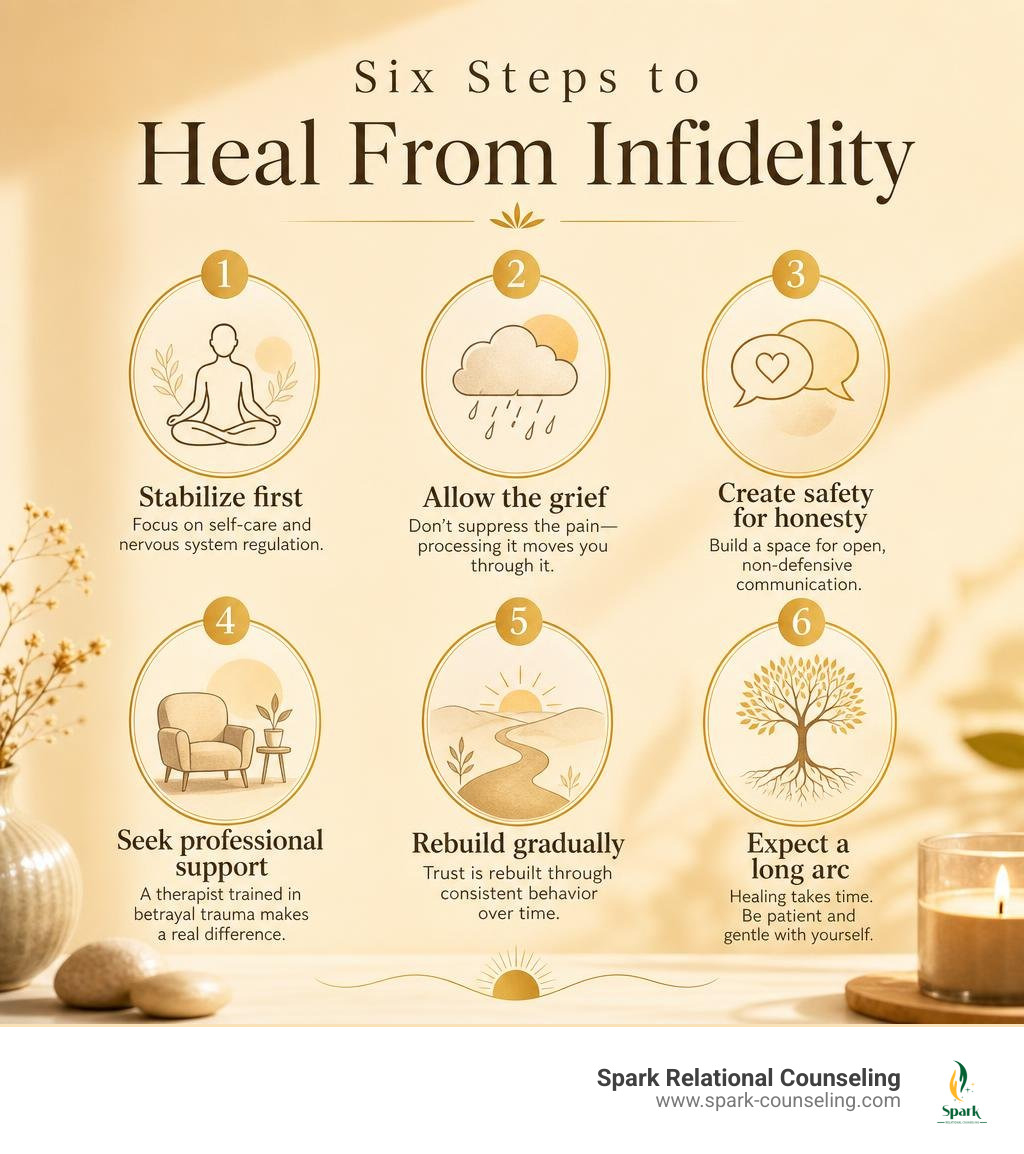
If you're asking how do I heal from infidelity, here is a direct answer before we go deeper:
| Step | What It Involves |
|---|---|
| 1. Stabilize first | Focus on basic self-care and nervous system regulation before making any big decisions |
| 2. Allow the grief | Don't suppress the pain — processing it is what moves you through it |
| 3. Create safety for honesty | Both partners need a structured space for open, non-defensive communication |
| 4. Seek professional support | A therapist trained in betrayal trauma significantly improves outcomes |
| 5. Rebuild gradually | Trust is rebuilt through consistent behavior over time, not promises |
| 6. Expect a long arc | Acute pain typically begins to ease between 12 and 24 months, with 18 months often a turning point |
Imagine coming home on an ordinary Tuesday evening. Nothing feels unusual. And then, in a single moment, something shifts — and the version of your life you thought you knew is simply gone. That kind of rupture is not just emotional. It is biological. Your nervous system registers the loss of your primary bond as a survival-level threat, flooding your body with stress hormones and pulling your capacity for clear thinking completely offline. This is why the pain of infidelity feels so disorienting, so all-consuming, and so unlike anything else you have been through.
You are not overreacting. Your body is doing exactly what it was wired to do.
Research consistently shows that approximately 20 to 25 percent of married men and 10 to 15 percent of married women report experiencing infidelity at some point — yet the path to healing is rarely talked about with the honesty it deserves. Most people find themselves cycling between numbness, obsessive questioning, grief, and brief moments of calm, wondering if they will ever feel steady again. The answer, with the right support, is yes.
I'm May Han, a Licensed Marriage and Family Therapist at Spark Relational Counseling, and I've spent years working with individuals and couples navigating the aftermath of betrayal using mindfulness-based and Emotionally Focused approaches — the very practices that make the question of how do I heal from infidelity answerable, not just survivable. In this guide, I'll walk you through what the healing process actually looks like, phase by phase, so you can find your footing again.
How Do I Heal from Infidelity: The Neurobiology of Betrayal Trauma

When we experience a profound breach of trust, our brains do not process it as a simple disagreement or a relationship hurdle. Instead, our biology treats it as an existential threat. Human beings are wired for attachment; we rely on our primary partners for emotional and physical safety. When that bond is fractured, the threat-detection system in our brain—specifically the amygdala—goes into overdrive.
This sudden biological alarm triggers a massive flood of stress hormones, primarily cortisol and adrenaline. Your heart rate spikes, your breathing becomes shallow, and your prefrontal cortex—the rational, logical part of your brain—goes offline. This is why you might feel completely unable to think straight, organize your thoughts, or make simple daily decisions in the days and weeks following discovery.
Understanding this neurobiological response is crucial because it helps depathologize your reactions. You are not losing your mind; your nervous system is in a state of acute survival. This biological cascade is why betrayal trauma shares so many clinical features with Post-Traumatic Stress Disorder (PTSD), including hypervigilance, intrusive thoughts, and emotional numbing. To explore this biological connection further, you can read our clinical guide on How to Recover from Infidelity PTSD or learn more about rebuilding health from the Infidelity: Mending your marriage after an affair - Mayo Clinic .
How Do I Heal from Infidelity When My Nervous System Is in Survival Mode?
When your body is locked in a state of fight, flight, or freeze, cognitive strategies alone are rarely enough. You cannot simply think your way out of a nervous system hijack. True healing must begin at the somatic level.
By practicing somatic tracking—paying close attention to physical sensations in your body without judgment—you can begin to identify your emotional thresholds. When you feel your chest tighten or your breath catch, that is your body reaching an emotional threshold. Recognizing these physical cues allows you to pause and implement self-regulation strategies before a full emotional flood takes over.
In our practice at Spark Relational Counseling, where May Han and our team specialize in trauma recovery, we often utilize experiential modalities like brainspotting and Accelerated Experiential Dynamic Psychotherapy (AEDP). These approaches help access the deeper, subcortical parts of the brain where trauma is stored, allowing you to process the pain where it actually lives. If you are struggling to find calm in the chaos, you may find it helpful to read our articles on How to Stop the Pain of Infidelity and How to Process Betrayal.
Recognizing the Impact of Betrayal Trauma on Driven Individuals
For high-achieving, driven individuals, betrayal trauma often introduces a unique layer of pain known as the competence paradox. If you are someone who is used to solving complex problems, managing high-stress situations at work, and maintaining a high level of control over your life, discovering infidelity can cause a severe identity rupture.
You may find yourself asking, “How could I not have seen this? I am so capable in every other area of my life, yet I was completely blind to this.” This mismatch between your external competence and your internal helplessness can breed deep shame.
Driven individuals often respond to this discomfort by trying to "fix" the crisis quickly or by performing immense emotional labor to keep up appearances. At Spark Relational Counseling, May Han and our therapists work to help you step out of this exhausting cycle. Healing does not mean managing the crisis perfectly; it means giving yourself permission to put down the heavy burden of performance and tend to your raw, human pain. You can read more about navigating this specific type of grief in our piece on Healing After Betrayal.
The Phases of Relational Repair and Rebuilding Trust

Relational repair after betrayal is not a single, heroic event. It is a slow, phased process that requires courage and patience from both partners. In the framework of Emotionally Focused Therapy (EFT), we view this journey in distinct stages, starting with de-escalation and moving toward emotional attunement and secure attachment.
In the early stages, the primary goal is stabilization. This involves lowering the emotional temperature in the relationship so that both partners can feel safe enough to communicate without triggering a survival response. Only after stabilization can we begin the deeper work of emotional attunement—where the unfaithful partner learns to truly hear and validate the hurt partner's pain. To understand how these phases unfold over time, you can explore What Are the Phases of Affair Recovery and our guide on how to Rebuild Trust After Affair.
How Do I Heal from Infidelity by Moving from Relationship 1.0 to 2.0?
One of the most important shifts in affair recovery is accepting that your old relationship—Relationship 1.0—is gone. It cannot be repaired, and attempting to return to the way things were is often a recipe for repeating the same painful patterns. Instead, healing requires grieving the loss of that first relationship and committing to building an entirely new one: Relationship 2.0.
Building Relationship 2.0 involves creating new, explicit relationship agreements. It requires both partners to look honestly at the old relational patterns that left the marriage vulnerable—not to excuse the betrayal, but to understand the context in which it happened. This process can lead to profound post-traumatic growth, resulting in a relationship that is far more honest, resilient, and emotionally intimate than the original. For insight into the realistic timeline of this transformation, read How Long Does It Take to Get Past Infidelity.
The Role of Radical Accountability and Transparency
For the unfaithful partner, the road to rebuilding trust requires radical accountability. This goes far beyond a standard apology. It means carrying out daily "proof of work" through consistent, observable behavioral changes over an extended period.
The unfaithful partner must take on specific tasks, including:
- Providing complete, non-defensive transparency with schedules, devices, and communication.
- Proactively checking in on the hurt partner's emotional state rather than waiting for them to bring it up.
- Engaging in non-defensive listening, which means staying present with the hurt partner's anger and grief without explaining, justifying, or turning the focus back to their own distress.
To understand how to navigate these conversations without causing further harm, read about The Role of Truth Accountability and Emotional Safety in Affair Recovery and learn Why Some Apologies Help After Betrayal and Others Make Things Worse.
Cultivating Emotional Safety and Honest Communication
To heal from betrayal, a couple must learn to communicate in a way that builds emotional safety rather than fueling defensive cycles. This is where Emotionally Focused Therapy (EFT) is incredibly powerful. EFT helps couples move away from surface-level arguments and instead connect with the deeper, underlying attachment needs and fears that drive their behavior.
In practical terms, this means practicing reflective listening and genuine validation. When the hurt partner expresses pain, the unfaithful partner's task is not to solve the problem or correct the facts, but to reflect back what they hear and validate the emotional reality of that pain. For example: “I hear how incredibly lonely and scary it feels when I don't answer my phone, and it makes complete sense that your mind goes to the worst-case scenario. I am here, and I want to help you feel safe.”
If you are looking for professional guidance to establish these communication patterns, consider looking into Betrayal Trauma Couples Counseling and exploring how Therapy Infidelity can support your recovery.
Navigating Triggers and the Emotional Rollercoaster
Triggers are an inevitable part of the healing journey. A song on the radio, a specific calendar date, or a sudden change in plans can instantly send the hurt partner back into the acute trauma of discovery. When these triggers occur, couples need a structured way to respond.
We recommend using the Empathize-Reassure-Report framework:
- Empathize: The unfaithful partner immediately acknowledges the pain of the trigger. ("I see that this song brought up that painful memory, and I am so sorry.")
- Reassure: They offer physical and emotional reassurance. ("I am right here with you, and I am not going anywhere.")
- Report: They provide clear, transparent facts to counter any intrusive "mind movies." ("I am on my way home now, and I will text you when I get in the car.")
This structured response helps de-escalate the nervous system and prevents the trigger from turning into a multi-day conflict. For more strategies on managing these sudden emotional waves, read our guide on Navigating the Emotional Rollercoaster of Affair Recovery.
Reconnecting Through Mindful and Gradual Intimacy
Rebuilding physical connection after betrayal is often highly complex. For some, physical intimacy is a natural path to reassurance; for others, it can feel like a minefield of triggers and painful mental images.
To navigate this safely, couples must prioritize somatic safety and emotional intimacy outside the bedroom first. Physical connection should never be rushed or forced. Instead, practice gradual, mindful touch—such as holding hands, hugging, or sitting close without the expectation of sex.
If tears or triggers arise during physical intimacy, the unfaithful partner should gently slow things down, hold the hurting partner, and offer comfort. By pacing physical connection and keeping communication completely open, you allow your body to learn that intimacy can be safe again. To explore this topic further, read Does the Hurt from Betrayal Ever Go Away and Will the Pain of Infidelity Ever Go Away.
Reclaiming Your Personal Peace and Self-Trust

Whether you choose to stay in your relationship or rebuild your life on your own, your personal healing is a separate, vital journey. Healing from betrayal requires reclaiming your own peace and learning to trust your own inner voice again—a voice that may have been quieted by months of gaslighting or self-doubt.
Individual self-care in this stage is not about bubble baths; it is about setting manageable boundaries to protect your emotional energy. It means giving yourself permission to say no to social obligations, stepping away from unproductive conversations, and focusing on basic physical needs like rest, hydration, and gentle movement. To learn more about focusing on your own well-being, read How Do I Heal Myself From Infidelity.
Differentiating Between Temporary Relief and Lasting Repair
As you navigate recovery, it is important to understand the difference between temporary emotional relief and lasting emotional repair.
- Temporary Relief: This often looks like constant reassurance-seeking, obsessive monitoring of your partner's devices, or avoiding difficult conversations altogether to keep the peace. While these behaviors might quiet your anxiety for an hour or a day, they do not change the root of the problem and can lead to self-abandonment.
- Lasting Repair: This involves root-level nervous system regulation, consistent behavioral changes over time, and a shared commitment to emotional depth. It is built on steady, daily actions rather than quick fixes.
If you are looking for professional support to help you navigate this distinction, May Han and our team at Spark Relational Counseling offer specialized care to help you heal and rebuild trust.
When Is Infidelity a Deal-Breaker vs. Repairable?
Not every relationship can or should be saved after betrayal. While many couples do successfully recover and build beautiful lives together, there are certain situations where infidelity may be a clear deal-breaker.
Infidelity is often incredibly difficult to repair if:
- The betrayal is chronic, systemic, or part of a long-term pattern of deception.
- The unfaithful partner refuses to take full accountability, blames the hurt partner for the affair, or continues to contact the affair partner.
- The unfaithful partner treats the hurt partner's pain as an inconvenience or demands that they "get over it" on an arbitrary timeline.
Recognizing your own safety thresholds and boundaries is a profound act of self-trust. If you need help evaluating your relationship and finding clarity, professional Infidelity Counseling can provide a supportive, objective space to explore your options, offering virtual care tailored to your needs across Oregon, Washington, and Illinois.
Frequently Asked Questions About Affair Recovery
How long does the healing process typically take?
The timeline for healing from betrayal trauma is highly individual, but clinical experience and research suggest that acute pain typically takes 12 to 24 months to substantially decrease. The 18-month mark is frequently reported by clients as a significant turning point where they begin to feel a renewed sense of stability and personal peace.
Can a relationship truly be stronger after betrayal?
Yes. While the pain of betrayal is devastating, the process of working through it with a skilled therapist can lead to post-traumatic growth. Couples who commit to the hard work of emotional attunement and radical honesty often report that their "Relationship 2.0" is built on a much deeper, more authentic foundation than they had before the affair.
What is the difference between relief and real emotional repair?
Relief is temporary and often relies on external reassurance or avoiding painful topics to keep the peace. Real emotional repair is a deeper, root-level process that involves consistent, long-term behavioral changes, nervous system regulation, and the creation of emotional safety that allows both partners to be fully vulnerable.
Conclusion
The journey of healing from infidelity is undoubtedly one of the most challenging paths a person or a couple can walk. It requires immense courage to face the pain, sit with the discomfort of a dysregulated nervous system, and do the slow work of rebuilding trust. But please know this: you do not have to walk this path alone.
At Spark Relational Counseling, May Han and our team offer virtual individual and couples counseling using mindfulness-based relational therapy in Oregon, Washington, and Illinois. Our approach is designed to counter negative brain autopilots, helping you move out of survival mode and into a space of lasting peace and loving connection. Whether you are seeking to repair your relationship or find your own footing again, we are here to support you with clinical expertise and deep empathy.
To learn more about what is required to truly heal after betrayal, read our detailed guide on Affair Recovery Counseling What Healing Really Requires After Betrayal. When you are ready, reach out to us to take the next step toward reclaiming your peace.
