
EFT for Infidelity: Stepping Out of Distress and Rebuilding Secure Attachment
When Betrayal Shatters the Bond: What You Need to Know About EFT for Infidelity

Emotionally focused couple therapy for clients dealing with infidelity is a structured, attachment-based approach that helps partners heal betrayal trauma, repair broken trust, and rebuild a secure emotional bond — without bypassing the pain that makes real healing possible.
Here is what you need to know at a glance:
| Question | Quick Answer |
|---|---|
| What is EFCT for infidelity? | A research-backed therapy that treats infidelity as an attachment injury and guides couples through structured emotional repair |
| How does it work? | Through three stages: de-escalating conflict, deepening emotional engagement, and consolidating new relational patterns |
| Does it actually help? | Yes — research shows 70–73% of couples recover from distress and 90% significantly improve with EFT |
| How long does it take? | Typically 12–20 sessions, though deeper repair often unfolds over a year |
| Is it only for the betrayed partner? | No — EFT addresses the emotional world of both partners, including the shame and unmet needs of the unfaithful partner |
Infidelity is one of the most painful ruptures a relationship can experience. It does not just break rules — it shatters the sense of safety that an entire emotional bond is built on. Research describes it as an attachment injury: a violation of trust at a moment of deep vulnerability that can produce symptoms strikingly similar to PTSD, including hypervigilance, intrusive thoughts, and emotional flooding. And yet, with the right support, repair is genuinely possible.
The discovery of an affair can feel like an earthquake. One moment the ground is solid. The next, everything you thought you knew about your relationship — and yourself — feels uncertain. That disorientation is not weakness. It is your nervous system responding to a real and profound threat to your closest bond.
EFT does not ask couples to skip that pain or rush toward forgiveness. Instead, it creates a structured, emotionally attuned space where both partners can face what happened — and find their way back to each other, or forward with clarity.
I am May Han, a Licensed Marriage and Family Therapist at Spark Relational Counseling, and I have trained in emotionally focused couple therapy for clients dealing with infidelity using mindfulness-based and experiential approaches rooted in attachment science. In the sections ahead, I will walk you through exactly how this process works — from the theory behind it to the specific stages, techniques, and evidence that make EFT one of the most effective paths through betrayal.
The Theoretical Foundation of Emotionally Focused Couple Therapy for Clients Dealing with Infidelity
To understand why infidelity hurts so deeply, we must look at how we are wired for connection. Emotionally Focused Couple Therapy (EFCT) is built on the profound insights of attachment theory, pioneered by John Bowlby and expanded into adult romantic relationships by Dr. Sue Johnson. Attachment theory teaches us that our need for a reliable, loving partner is not a sign of dependency or weakness; it is a wired-in biological survival imperative.
Our primary partner serves as our "safe haven" — the place we return to for comfort when the world is overwhelming — and our "secure base," which gives us the confidence to explore the world and take risks. When this secure base is intact, we experience emotional responsiveness: we know that if we reach out, our partner will be there, accessible and engaged.
When infidelity occurs, this entire system is thrown into chaos. Rather than viewing an affair merely as a breach of a cognitive contract or a behavioral failure, EFCT conceptualizes it as a profound rupture of this survival bond. It is an existential threat to our sense of safety and self.
Attachment Theory and Adult Romantic Bonds
How we respond to this rupture depends heavily on our attachment styles, which are shaped by our earliest relationships and act as internal working models for how we expect others to treat us.
- Secure Attachment: Individuals with a secure history expect others to be generally reliable and supportive. However, a major betrayal like an affair can shatter even a secure foundation, leaving the partner disoriented.
- Anxious Attachment: Partners with an anxious attachment style are hyper-vigilant to signs of abandonment. When betrayal occurs, their attachment system goes into overdrive (hyperactivation), resulting in intense, pursuing protests, desperate demands for reassurance, and overwhelming distress.
- Avoidant Attachment: Partners with an avoidant attachment style cope with distress by pulling away and minimizing their emotional needs (deactivation). Following an affair, they may shut down, withdraw, or adopt an intellectual, detached posture to protect themselves from further pain.
Understanding these styles allows us to see that the intense anger of a pursuing partner and the cold distance of a withdrawing partner are not random acts of hostility. They are survival strategies designed to cope with the agonizing fear of losing the connection altogether.
How Emotionally Focused Couple Therapy for Clients Dealing with Infidelity Restores Safety
In our work at Spark Relational Counseling, May Han and our team utilize mindfulness-based relational therapy and experiential therapy to help couples slow down their nervous systems and recognize these automatic survival states. Instead of relying on symptom-focused tools that merely manage symptoms, EFCT focuses on expanding and reorganizing emotional responses to foster genuine coregulation.
By integrating experiential techniques, we guide partners to drop below their defensive surface reactions and touch their primary, vulnerable emotions. This creates a container of emotional accessibility. When a couple can share their rawest fears without triggering a defensive counter-attack, the nervous system begins to settle. This somatic shift is the first step in Therapy for Infidelity, paving the way for lasting relational peace. For those seeking specialized local support, our therapists offer dedicated EFT: Emotionally Focused Therapy in Seattle, WA | Edan Zebooloon as well as virtual care throughout Washington, Oregon, and Illinois.
Conceptualizing Betrayal: Infidelity as an Attachment Injury
In EFCT, we define a betrayal as an attachment injury. This is not just any hurt; it is a specific violation of trust that occurs when one partner is in a state of high vulnerability or intense need, and the other partner fails to offer comfort, protection, or presence.
When infidelity is discovered, the injured partner experiences a profound relational trauma. The brain's threat-detection center, the amygdala, registers this betrayal as a life-threatening emergency. This explains why the betrayed partner often experiences PTSD-like symptoms, including:
- Hypervigilance: Constantly checking phones, analyzing tone of voice, and anticipating another betrayal.
- Intrusive Images and Flashbacks: Unwanted, vivid memories of the discovery or details of the affair.
- Emotional Flooding: Sudden, overwhelming waves of panic, grief, or rage that override logical thinking.
These reactions are not pathological; they are natural biological responses to a shattered reality. To begin the healing process, couples must learn How to Process Betrayal by recognizing these trauma responses as signals of a damaged bond rather than permanent personal defects. This trauma-informed perspective is thoroughly supported by modern clinical research, including studies published in the Journal of Applied Psychological Research, vol 17, Issue 1, 2026, which highlight the deep intersection of emotional regulation and relational recovery.
The Emotional Impact on Both Partners
An affair leaves a complex trail of pain for both individuals, and a non-blaming therapeutic space must hold the distress of both sides:
- The Betrayed Partner: Experiences a total collapse of their self-worth, a profound sense of abandonment, and intense grief. They often vacillate between angry, hyper-focused protests ("How could you do this?") and protective, numb withdrawal.
- The Unfaithful Partner: Often struggles with a heavy burden of shame, guilt, and fear of permanent rejection. This shame can be so paralyzing that they "freeze" or minimize the affair, which the betrayed partner frequently misinterprets as a lack of remorse.
For healing to occur, both partners must be supported in moving beyond these protective walls. The journey of Healing After Betrayal requires acknowledging that while the unfaithful partner is solely responsible for the choice to cross relationship boundaries, both partners are caught in an agonizing web of pain that requires deep, compassionate exploration.
The Attachment Injury Repair Model (AIRM)
To repair this deep rupture, EFCT utilizes a highly structured, empirical clinical sequence known as the Attachment Injury Repair Model (AIRM). Healing cannot occur through intellectual apologies or promises to "do better." It requires a somatic, emotionally engaged dialogue where:
- The injured partner is helped to touch and articulate the full depth of their pain and the attachment significance of the betrayal (e.g., "When you turned to them, I felt completely disposable").
- The offending partner remains emotionally present, resisting the urge to defend, minimize, or collapse into self-pity.
- The offending partner takes clear, compassionate responsibility, expressing genuine remorse and empathy for the specific pain they caused.
- The injured partner slowly risks expressing their vulnerable need for comfort and reassurance directly to the partner who hurt them.
- The offending partner responds with a warm, caring presence that acts as a direct somatic antidote to the traumatic wound.
This delicate dance is explored deeply in our guide on The Role of Truth, Accountability, and Emotional Safety in Affair Recovery, emphasizing that accountability is the cornerstone of renewed emotional safety.
The Three Stages of EFT: A Roadmap for Rebuilding Trust
Healing from betrayal is not a linear path; it is a structured journey that moves through three distinct stages of Emotionally Focused Therapy. Each stage has clear clinical markers and serves to transition the couple from high-conflict reactivity to deep, secure bonding.

To help visualize this journey, the table below outlines the progression of Rebuild Trust After Affair through the structured lens of EFT:
| Stage of EFT | Primary Focus | Key Clinical Milestones |
|---|---|---|
| Stage 1: De-escalation | Stabilizing the relationship and mapping the negative cycle | Identifying the pursuer-distancer pattern; containing trauma triggers; establishing basic emotional safety. |
| Stage 2: Restructuring | Deepening emotional engagement and repairing the attachment injury | Withdrawer re-engagement; blamer softening; vulnerable sharing of core needs; receiving comfort. |
| Stage 3: Consolidation | Integrating new patterns and writing a shared narrative | Creating a resilient story of the affair and its repair; cementing new communication habits; planning for the future. |
Stage 1: De-escalation and Identifying the Negative Cycle
In the immediate aftermath of an affair, couples are usually trapped in a highly reactive, negative interaction cycle. The most common pattern is the pursuer-distancer cycle: the betrayed partner, flooded with anxiety and pain, pursues with intense questions, anger, and demands for reassurance. Met with this wall of intensity, the unfaithful partner, consumed by shame and fear, withdraws, shuts down, or offers logical, defensive explanations. This withdrawal further terrifies the pursuing partner, escalating the cycle.
In Stage 1, our primary goal is stabilization and containment. We help couples practice mindfulness of emotional thresholds — learning to notice the exact moment their nervous system begins to redline into fight-or-flight. By slowing down the interaction, we help partners set manageable boundaries around when and how they discuss the affair, preventing toxic, late-night interrogation sessions that cause further trauma.
Stage 2: Restructuring the Bond and Healing Attachment Injuries
Once the negative cycle is de-escalated and a baseline of safety is established, we enter Stage 2: Restructuring. This is the heart of experiential therapy, where we facilitate two major change events: withdrawer re-engagement and blamer softening.
- Withdrawer Re-engagement: The partner who previously shut down and withdrew is helped to step out of their protective shell, access their deeper feelings of shame, fear, and sadness, and express their desire to connect and protect the relationship.
- Blamer Softening: The pursuing partner, seeing the genuine emotional presence of their spouse, begins to lower their defensive shield. They shift from angry accusations (secondary emotions) to expressing their raw, primary emotions — their fear of being abandoned, their grief over the lost innocence of the relationship, and their deep longing for comfort.
This stage is where the actual repair of the attachment injury occurs. It requires both partners to show up with radical vulnerability. To understand what this deep, emotional work looks like in practice, explore our detailed resource on Affair Recovery Counseling: What Healing Really Requires After Betrayal.
Stage 3: Consolidation and Integrating Emotionally Focused Couple Therapy for Clients Dealing with Infidelity
The final stage of therapy is Consolidation. Here, the couple integrates their new, secure emotional patterns into their daily lives. They construct a clear, coherent, and shared narrative of the affair — one that acknowledges the pre-existing vulnerabilities in the relationship's emotional bond, details the pain of the betrayal, and highlights the resilient journey of repair they traversed together.
This shared narrative does not erase the past, but it strips the memory of its traumatic power. The affair is no longer an unspeakable skeleton in the closet; it becomes a painful but fully resolved chapter in a story of survival and deepened love. For a broader look at how this integration leads to long-term resilience, see our guide on How Do Couples Recover from Cheating.
Integrating Trauma-Informed Care: EFT and EMDR/BrainSpotting for Betrayal Trauma
Standard couples therapy can sometimes stall when one or both partners are locked in severe, physiological trauma responses. In these cases, integrating Eye Movement Desensitization and Reprocessing (EMDR) with EFCT can be exceptionally powerful.
While EFCT works beautifully to restructure the relational bond, EMDR target-processes the acute, somatic trauma of the betrayal within the individual's nervous system. By using bilateral stimulation (such as side-to-side eye movements or tactile taps), EMDR helps the betrayed partner process intrusive flashbacks and hypervigilance, reducing the physiological charge of the trauma.
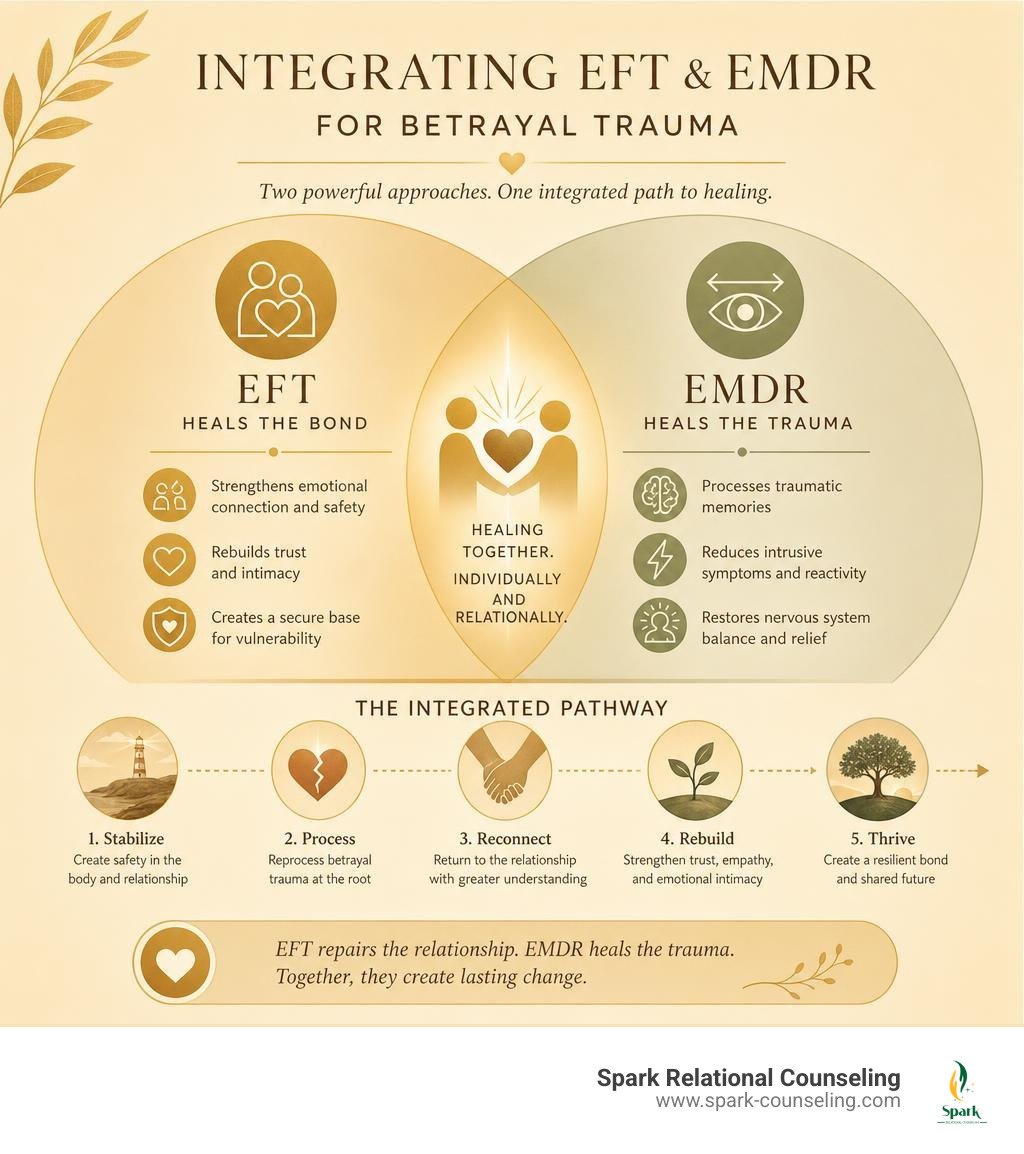
This integrated approach is highly effective because it addresses both the individual nervous system and the relational space simultaneously. For a deeper clinical dive into this integration, you can read the seminal paper, Emotionally Focused Therapy and Eye Movement Desensitization and Reprocessing: An Integrated Treatment to Heal the Trauma of Infidelity.
At Spark Relational Counseling, May Han and our team specialize in these multi-modal, trauma-informed approaches. We offer specialized individual and conjoint pathways to address these deep wounds, which you can explore in our articles on What is the Therapy for Infidelity Trauma and How to Recover from Infidelity PTSD.
Addressing Complicating Factors and Diverse Relationship Structures
Clinical work must always adapt to the unique lived realities of each couple. Infidelity recovery does not happen in a vacuum; it is influenced by cultural, structural, and social factors:
- Justice-Involved Couples: Incarceration adds intense attachment barriers, forcing couples to navigate betrayal recovery through teletherapy or restricted visitation. EFT can be adapted to process these injuries by focusing heavily on emotional accessibility despite physical distance.
- Cultural and Societal Differences: Different cultures carry unique stigmas, expectations, and family pressures regarding marital continuity and infidelity. A culturally humble EFT therapist respects these dynamics rather than imposing a standardized Western model of forgiveness, as highlighted in studies on diverse relationship dynamics in Nexus.
- Consensual Non-Monogamy and Open Relationships: Betrayal can occur in polyamorous or open structures when agreed-upon boundaries, transparency, or emotional agreements are violated. EFCT is highly effective here, focusing on repairing the specific emotional bond and boundary rupture, regardless of the relationship's structural design.
Frequently Asked Questions about EFT for Infidelity
How long does emotionally focused couple therapy for clients dealing with infidelity typically take?
The timeline for healing from an affair varies depending on the depth of the betrayal, pre-existing relationship distress, and individual trauma histories. Generally, a standard EFCT course spans 12 to 20 sessions to achieve initial de-escalation and stabilization.
However, deep attachment repair and trust-building are gradual processes that often unfold over several months to a year. Healing cannot be rushed. It requires a sustained commitment to consistent, transparent actions over time. To better understand this emotional timeline, read our guide on Navigating the Emotional Rollercoaster of Affair Recovery.
Will we have to discuss every graphic detail of the affair in sessions?
No. A skilled EFT therapist will actively contain the disclosure process to prevent re-traumatizing the injured partner. We focus heavily on the meaning and emotional impact of the affair, rather than graphic, physical, or lurid details.
While the betrayed partner does need a clear, honest timeline to settle their nervous system, digging into graphic details often feeds a cycle of obsessive rumination and hypervigilance, which hinders healing. We work to keep the conversations safe, structured, and emotionally productive.
Can a relationship truly survive and thrive after an attachment injury like infidelity?
Absolutely. The empirical evidence supporting EFCT is exceptionally strong. Landmark clinical outcome research shows that 70–73% of couples fully recover from severe marital distress, and 90% show significant, lasting improvement after completing EFT.
Furthermore, follow-up studies confirm that these changes remain stable over time without relapse. By transforming insecure, reactive patterns into a secure attachment bond, many couples find that their relationship becomes more honest, intimate, and resilient after therapy than it was before the betrayal. For those ready to explore this path, we offer specialized Marriage Therapy for Infidelity to guide you through every step of the repair process.
Conclusion
The discovery of an affair is a devastating crossroads, but it does not have to be the end of your story. Through emotionally focused couple therapy for clients dealing with infidelity, couples can step out of the exhausting cycle of blame, defensiveness, and pain, and begin the profound work of rebuilding a secure, resilient, and deeply connected bond.
At Spark Relational Counseling, May Han and our dedicated team of therapists specialize in guiding couples through these complex emotional landscapes. By combining the scientifically validated structure of EFT with mindfulness-based relational therapy and somatic trauma processing, we help you counter negative brain autopilots to find lasting peace and cultivate truly loving relationships.
We proudly serve clients across our licensed states of Oregon, Washington, and Illinois, with local expertise tailored to communities in Portland, Seattle, Chicago, Lake Oswego, Bellevue, and beyond. If you are ready to move from the wreckage of betrayal toward a renewed sense of emotional safety and shared hope, we invite you to explore our specialized Infidelity Counseling services and schedule a consultation with us today.