Everything you need to know about how couples therapy works
What "How Does Couples Therapy Work?" Really Means — and Why It Matters

How does couples therapy work? Here's the short answer:
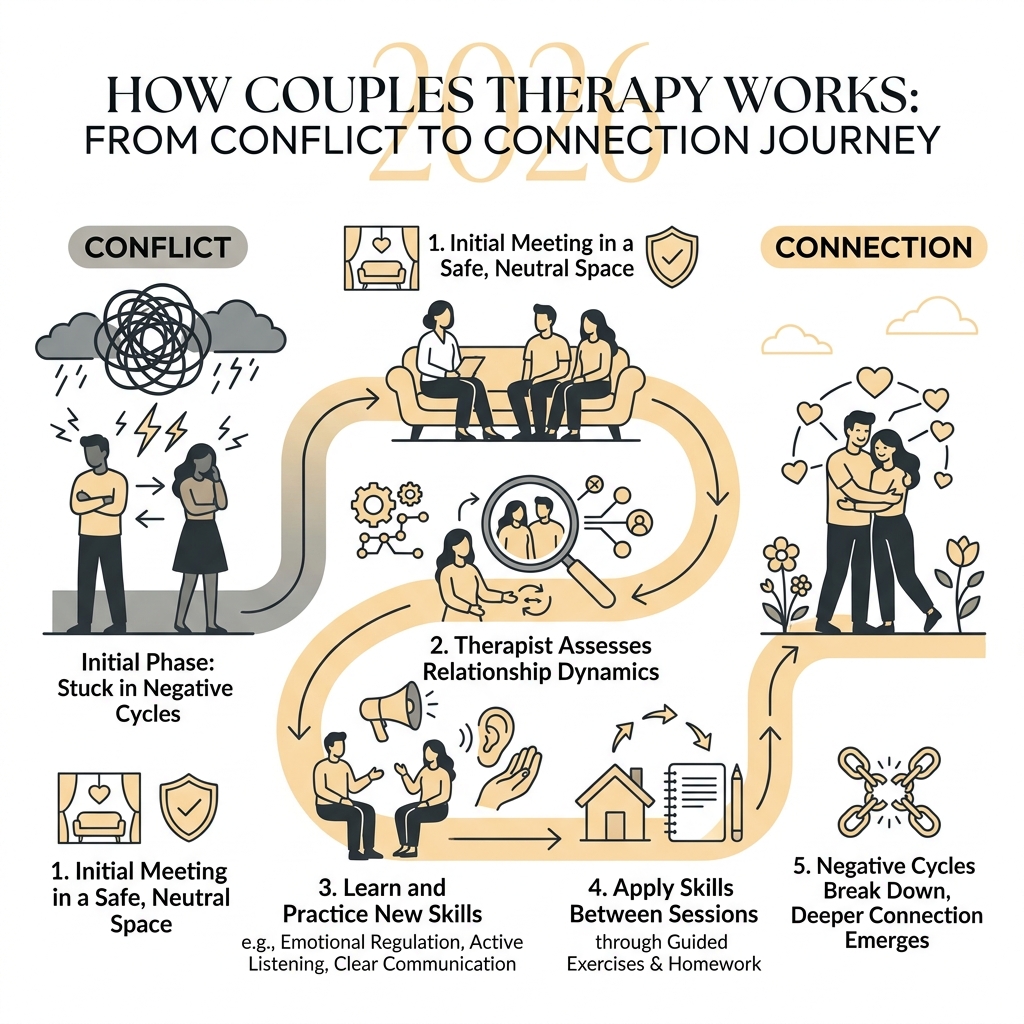
- A licensed therapist meets with both partners in a safe, neutral space
- The therapist assesses your relationship dynamics — patterns, history, triggers, and goals
- You learn and practice new skills — like emotional regulation, active listening, and clear communication
- You apply those skills between sessions through guided exercises and homework
- Over time, negative cycles break down and a deeper connection takes their place
The "client" in couples therapy isn't you or your partner individually — it's the relationship itself.
You and your partner aren't fighting about the dishes. You're fighting because somewhere along the way, the two of you stopped feeling truly heard. The arguments repeat. The distance grows. And despite loving each other, you feel stuck — like you're running on autopilot, reacting instead of connecting.
That's one of the most common experiences that brings couples to therapy. And it makes sense. Research shows that couples wait an average of six years before seeking help — six years of the same patterns deepening into grooves that feel impossible to escape on your own.
Couples therapy is designed to interrupt exactly that cycle.
I'm May Han, a Licensed Marriage and Family Therapist at Spark Relational Counseling, practicing in Oregon, Washington, and Illinois. My work centers on the question of how does couples therapy work at a neurological and emotional level — using mindfulness-based and Emotionally Focused approaches to help partners move out of autopilot and back into genuine connection. In the sections below, I'll walk you through everything you need to know.
Understanding the Foundation: What is Couples Therapy?
Imagine you’re driving a car that has started to pull slightly to the left. At first, you barely notice it. You just nudge the steering wheel a bit to compensate. But over months and years, that constant nudging becomes exhausting. Your arms ache, and eventually, the car isn't just pulling; it’s veering toward the edge of the road.
Couples therapy is the professional alignment for that car. It is a specialized form of psychotherapy where a trained clinician works with two people in a romantic relationship to improve their interactional patterns and overall satisfaction. Whether you are married, engaged, or dating, the goal is to foster a deeper understanding of one another.
One of the most important shifts May Han and the team at Spark Relational Counseling make is viewing the relationship as the primary client. In individual therapy, the focus is on your personal history and internal world. In our work together, the focus is on the "space between" the two of you. According to Harvard Health, this neutral third-party perspective is essential because it allows both partners to feel seen without the therapist "taking sides."
Beyond Crisis Management
Many people believe that couples therapy is only a "last-ditch effort" for relationships on the brink of divorce. While we certainly help couples in crisis, therapy is also a powerful tool for Premarital Counseling and preventive care.
Life transitions — like moving to a new city like Seattle or Chicago, starting a family in Portland, or navigating retirement — can bring unresolved issues to the surface. By addressing these early, we help you build a foundation of resilience. You can learn more about preparing for this journey in our guide on how to prepare for a relationship therapy session.
How does couples therapy work? The Step-by-Step Process
When you first enter our virtual office, you might feel a mix of hope and trepidation. Understanding the structure of the process can help settle those nerves. At Spark Relational Counseling, May Han and her team follow a clear, research-backed path to help you move from frustration to peace.
1. The Assessment Phase
We begin by gathering the "data" of your relationship. This isn't just about who said what during last night's argument. It’s about the "Story of Us." We look at your relationship history, your individual backgrounds, and the specific triggers that send you into a tailspin. This phase is crucial because it allows us to identify your "negative brain autopilots" — those knee-jerk reactions like shutting down or lashing out that happen before you even realize you’re upset.
2. Collaborative Goal Setting
Once we understand the patterns, we work together to define what success looks like for you. For some, it’s healing from a specific event, like infidelity. For others, it’s simply wanting to feel like a team again. We ensure these goals are shared and realistic, providing a roadmap for our sessions.
3. The Intervention Phase
This is where the "work" happens. We use specific techniques to interrupt your old cycles and replace them with new, healthier ones. We don't just talk about your problems; we experience new ways of relating in real-time. This is a core part of Marriage Counseling, where we practice the skills needed to maintain a loving bond.
| Feature | Assessment Phase | Intervention Phase |
|---|---|---|
| Primary Focus | Gathering history and identifying patterns | Changing behaviors and emotional responses |
| Therapist Role | Investigative and observant | Active coach and facilitator |
| Timeframe | Usually the first 2–4 sessions | Ongoing throughout the therapeutic process |
| Goal | Understanding the "Why" | Implementing the "How" |
For a deeper dive into these stages, you can explore our complete guide to therapy for relationship issues.
Core Therapeutic Approaches: From EFT to Mindfulness
Not all therapy is created equal. The effectiveness of how does couples therapy work often depends on the specific modality used. At Spark Relational Counseling, May Han and her team move away from traditional "advice-giving" and instead focus on deep, experiential change.
Emotionally Focused Therapy (EFT)
EFT is widely considered the gold standard of couples therapy, with research showing long-term success rates of up to 75%. It is based on attachment theory — the idea that we all have a fundamental need to feel safe and secure with our partner. In EFT, we help you identify the "protest" beneath the anger and the "longing" beneath the withdrawal. When you can express these vulnerable needs, your partner's natural empathy can finally reach you.
Mindfulness-Based Relational Therapy
This is our signature approach. We help you become aware of your physiological state during conflict. When your heart rate spikes and your "lizard brain" takes over, you cannot communicate effectively. By incorporating mindfulness, we teach you how to "pause" the autopilot. This creates the space needed to choose a response based on love rather than fear.
AEDP and Experiential Therapy
Accelerated Experiential Dynamic Psychotherapy (AEDP) and Experiential therapy focus on the "here and now." Instead of just recounting a fight from Tuesday, we might notice how you are feeling in the room as you speak to your partner. This helps process emotions as they arise, leading to faster and more profound healing.
Brainspotting
For couples dealing with deep-seated trauma or infidelity, we may use Brainspotting. This technique identifies "spots" in the visual field that correlate with emotional or physical pain stored in the brain. It allows for the processing of trauma that talk therapy alone sometimes can't reach.
Choosing the right approach is vital. If you're wondering which might fit your needs, check out our post on what type of therapist is best for couples therapy.
What to Expect in Your Sessions and Beyond

A typical session lasts about 50 to 60 minutes, though some couples opt for longer "intensive" sessions. Here is a glimpse into the rhythm of the work.
The First Session: The Intake
The first time we meet, the focus is on safety. We establish ground rules — such as no interrupting and using "I" statements. We want to hear from both of you about what brought you here. It is a time for us to see if we are a good fit for one another. You can read more about what to expect in these initial stages.
Individual "Vent" Sessions
Sometimes, we recommend a one-on-one session with each partner. These aren't for keeping secrets from the other person. Rather, they provide a space for you to express your individual worries, hopes, and personal history without the pressure of your partner’s immediate reaction. This helps us understand the individual "ingredients" that make up the relationship "stew."
Homework and Integration
The real change happens in the 167 hours of the week when you aren't in therapy. We often assign "homework" — perhaps a 10-minute daily check-in or a specific mindfulness exercise. These tasks are designed to help you practice your new conflict-resolution skills in the real world. For those in the Portland area, these exercises might involve taking a mindful walk together in a local park to practice active listening.
Success Rates and the Timeline for Healing
One of the most frequent questions we hear is: "Is this actually going to work?"
The data is encouraging. According to the American Psychological Association, about 70-75% of couples report significant improvement in their relationship satisfaction after therapy. Furthermore, over 97% of couples surveyed by the American Association for Marriage and Family Therapy said they got the help they needed.
However, success is not a magic wand. It requires:
- Consistency: Showing up for sessions regularly.
- Honesty: Being willing to share authentic feelings, even when they’re uncomfortable.
- Motivation: A shared desire to do the work.
How Long Does it Take?
Most couples find that 12 to 20 sessions provide a solid foundation for change. Some may see results sooner, while those working through complex trauma like infidelity may require longer-term support. The key is to remember that you are undoing years of habits.
In Seattle, where life can be and high-stress, we find that giving the process time to breathe is essential. Rushing the healing often leads to surface-level fixes that don't last. You can explore whether the investment is right for you in our article: Is it worth it to go to couples therapy?
Frequently Asked Questions about the Therapy Process
How does couples therapy work for improving communication?
Communication isn't just about talking; it's about being heard. We use techniques like "Reflective Listening," where one partner repeats back what they heard before responding. This ensures accuracy and makes the speaker feel valued. We also focus on "I-statements" (e.g., "I feel lonely when we don't spend time together") rather than "You-statements" (e.g., "You never care about me"), which trigger defensiveness. Through effective communication, we help you move from "attacking" to "expressing."
How does couples therapy work if we are considering separation?
Sometimes, therapy isn't about staying together; it's about gaining clarity. We offer "Discernment Counseling," a short-term approach for couples where one partner is leaning out of the relationship and the other wants to save it. The goal is to decide whether to try to restore the marriage, move toward separation, or take a "time out." Even if a couple chooses to separate, therapy can facilitate a "healthy uncoupling," which is especially vital for co-parenting.
When is couples therapy not appropriate for a relationship?
Safety is our absolute priority. Couples therapy is not recommended in situations of active domestic violence or physical abuse. In these cases, the power imbalance makes the "neutral" space of therapy unsafe for the victim. Additionally, if one partner has an untreated active addiction or a severe, unmanaged mental health crisis, individual stabilization is usually required before couples work can be effective. We always provide referrals for individual support in these instances.
Conclusion
At the heart of every relationship struggle is a desire to be seen, known, and loved. Whether you are in Portland, Seattle, or Chicago, the journey toward a healthier relationship begins with a single step out of autopilot.
At Spark Relational Counseling, May Han and our team of dedicated therapists are here to guide you. Our mindfulness-based approach doesn't just give you "tips"; it helps you rewire your emotional responses for lasting peace. Your relationship is an investment, and it is worth the effort to move from conflict to connection.
If you’re ready to reclaim the love and ease you once shared, we invite you to start your journey with our specialized marriage counseling. We offer virtual sessions across Oregon, Washington, and Illinois, bringing expert care directly to the comfort of your home. Let's work together to build the relationship you both deserve.
