Stop Swiping and Start Healing with Local Dating Counseling support

When Swiping Stops Working: Finding Dating Counseling Near Me
If you've been searching for dating counseling near me, here is a quick answer to help you get started:
| What You Need | What to Do |
|---|---|
| Find a licensed therapist | Look for an LMFT, LCSW, or licensed psychologist who specializes in relationships and dating |
| Check virtual options | Many licensed therapists offer telehealth across Oregon, Washington, and Illinois — no commute needed |
| Know what to expect | Weekly 50–55 minute sessions focused on your patterns, not just dating tips |
| Start before you're ready | You don't need to be actively dating — many people begin to build clarity and confidence first |
| Look for cultural fit | Seek a therapist who is LGBTQIA+ affirming, culturally aware, and neurodiversity-informed |
You re-read the text thread for the fourth time. You're not sure if you said too much. You wonder if this one will end the same way the last three did. The apps feel exhausting. The dates blur together. And somewhere underneath the fatigue is a quieter question: Why does this keep happening?
That feeling — that mix of hope and dread and quiet resignation — is exactly what dating counseling is designed to address. Not with scripts or dating rules, but with real, evidence-based support that helps you understand the patterns keeping you stuck and build the emotional foundation for something that actually lasts.
I'm May Han, a Licensed Marriage and Family Therapist at Spark Relational Counseling, practicing across Oregon, Washington, and Illinois, where I use mindfulness and emotionally focused approaches to help individuals and couples break free from the cycles that make dating counseling near me such a meaningful search in the first place. With a background from Northwestern University and a deep focus on relational science and minority mental health, I've walked alongside many high-achieving adults navigating the same exhaustion you may be feeling right now.
Navigating Modern Love: Why Search for Dating Counseling Near Me?
When most people think of relationship therapy, they picture married couples sitting on opposite ends of a couch, trying to repair decades of accumulated conflict. But relational health does not begin at the altar, nor does it start when you sign a lease together. The blueprint for how we love, choose partners, and handle vulnerability is active every time we open a dating app, sit down for a first-date coffee in Seattle’s Ballard neighborhood, or decide whether to send that follow-up text after a quiet weekend in Chicago.
This is where working with a specialized Dating Therapist diverges from traditional couples therapy. While couples work focuses on the space between two partners, dating counseling focuses on the space within you. It is a specialized branch of individual therapy that examines your relational history, your attachment style, and the unconscious strategies you use to keep yourself safe from rejection.
If you are navigating the modern dating landscape in Portland, Eugene, or Bellevue, you might find yourself repeatedly asking: Why do I keep choosing partners who are emotionally unavailable? or Why do I shut down the moment someone shows genuine interest in me? Searching for dating counseling near me is the first step toward answering these questions. Through secure Online Therapy platforms, we help you transition from a state of reactive dating—where you are constantly trying to read the other person’s mind—to a state of intentional connection, where you are grounded in your own values and emotional thresholds.

Overcoming the App Fatigue: How Dating Counseling Near Me Restores Hope
Modern dating has been largely gamified. Algorithms encourage us to view potential partners as commodities, leading to a profound sense of dating app burnout. You swipe, you match, you exchange superficial pleasantries, and then the conversation fades into the digital ether. Over time, this repetitive cycle can trigger a deep-seated fear of being alone, making you feel as though time is running out.
Working with a dedicated Therapist for Dating allows you to step off this exhausting treadmill. In our sessions, we address the root of this fatigue by shifting your mindset away from "winning or losing" a date. When you view dating as a high-stakes performance where rejection equals unworthiness, anxiety inevitably takes the driver's seat.
Instead, we cultivate a stance of gentle, mindful curiosity. We explore the cultural myths you may have absorbed—such as the belief that your worth is defined by your relationship status, or that love should be entirely effortless. By processing these beliefs, you can begin to build an internal sense of wholeness. When you no longer look to a partner to rescue you from loneliness or validate your desirability, the entire energy of your dating life shifts. You begin to date from a place of abundance rather than scarcity.
What to Look for When Selecting Dating Counseling Near Me
Choosing a therapist is a deeply personal decision, particularly when you are preparing to discuss your most vulnerable relational fears. If you are exploring your options for dating counseling near me in Washington, Oregon, or Illinois, it is essential to look for clinical licensing and specialized training.
While dating coaches offer structured advice and motivational strategies, they are not clinically licensed to treat the underlying trauma, anxiety, or deep-seated attachment wounds that drive relational patterns. A licensed clinical therapist—such as a Licensed Marriage and Family Therapist (LMFT) or Licensed Clinical Social Worker (LCSW)—holds a master's or doctoral degree and is bound by strict ethical standards and state licensing boards.
When you are ready to learn How to Start Therapy, look for a practitioner who specializes in relational science and somatic or experiential modalities. If you reside in Oregon, Washington, or Illinois, virtual therapy offers a highly accessible way to integrate this deep work into your busy lifestyle. Whether you are seeking support from your home in Lake Oswego, Redmond, or downtown Chicago, virtual sessions provide the same clinical depth and confidentiality as in-person visits without the stress of a commute.
The Science of Connection: EFT, AEDP, and Brainspotting in Dating Therapy
To create lasting change in your love life, we must go deeper than surface-level communication tips. Our relational habits are wired into our nervous systems. When we experience emotional distress—such as a partner pulling away or a date going cold—our brain's threat-detection system lights up, often triggering automatic survival strategies like chasing, clinging, or completely shutting down.
At Spark Relational Counseling, where May Han and our clinical team practice, we utilize evidence-based, depth-oriented modalities to help you rewire these nervous system responses:
- Emotionally Focused Therapy (EFT): EFT is grounded in attachment theory, viewing our need for secure connection as a primary human survival drive. In the context of individual dating therapy, as outlined in our Couples Therapy Dating Guide 2026, we use EFT to help you identify your personal "pursue-withdraw" cycles. Research shows that Emotionally Focused Therapy helps 70–75% of couples move from distress to recovery, with improvements that last. We apply these same attachment-focused principles to individuals, helping you make sense of your fears of abandonment or engulfment.
- Accelerated Experiential Dynamic Psychotherapy (AEDP): AEDP focuses on processing deep emotional states in the safety of the therapeutic relationship. Instead of just talking about your feelings, we process them experientially in the present moment. This helps heal old relational wounds and fosters a sense of resilience.
- Brainspotting: Often, our dating anxieties are tied to past heartbreaks or childhood relational traumas that are stored in the subcortical brain. Brainspotting uses your visual field to access and release these deeply held emotional blocks, helping you quiet the physical "pit in your stomach" that arises during moments of dating vulnerability.
By utilizing these experiential therapies, our virtual sessions across Washington, Oregon, and Illinois provide a safe, supportive container where you can practice being authentic and vulnerable, preparing you to carry that same presence into your real-world relationships.
Reclaiming Your Agency: Mindfulness, Boundaries, and Healing Brain Autopilots
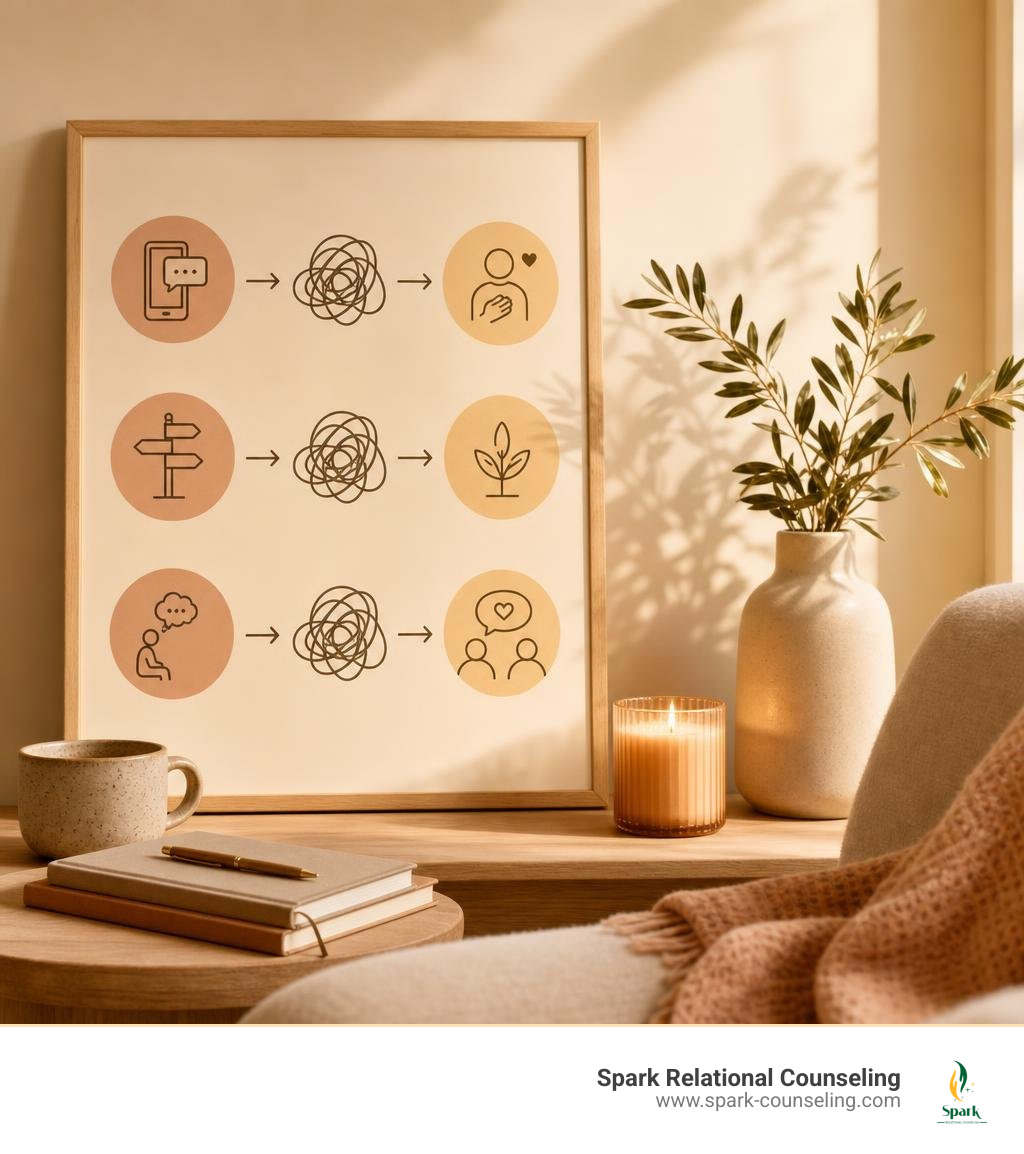
Many of our relationship struggles are governed by "brain autopilots"—the repetitive, unconscious patterns of thinking and behaving that we developed early in life to protect ourselves. For instance, if you learned as a child that your feelings were "too much" for your caregivers, your brain autopilot might tell you to hide your needs, please others at your own expense, or over-analyze every text message to prevent abandonment.
Through mindfulness-based relational therapy, we help you wake up from these autopilot patterns. Mindfulness allows you to notice your emotional thresholds in real time. Instead of reacting instantly to a spike in dating anxiety, you learn to pause, breathe, and choose a response that aligns with your true values.
This self-awareness is the foundation of healthy boundary-setting. When you understand your emotional limits, you can set manageable boundaries that protect your peace without shutting others out. This is particularly vital when navigating complex dynamics, such as managing dating anxiety in cross-cultural relationships or recovering through Individual Therapy for Relationship Issues.
To help visualize this shift, consider how moving away from your brain autopilot toward mindful relational presence changes your dating experience:
| Dating Scenario | Brain Autopilot Reaction | Mindful Relational Response |
|---|---|---|
| A partner takes several hours to reply to a text. | Overthinking, re-reading past messages, or sending a passive-aggressive follow-up. | Noticing the physical anxiety, offering yourself comfort, and returning to your own day. |
| You realize a date does not share your core values. | Ignoring the red flags, hoping they will change, or people-pleasing to remain liked. | Acknowledging the incompatibility with compassion and gently ending the connection. |
| A partner asks for space to process their feelings. | Panicking, chasing them, or demanding immediate reassurance. | Honoring their request while setting a clear, supportive time to reconnect. |
Frequently Asked Questions About Dating Therapy
Why is it important to choose a licensed clinical therapist for dating issues?
While dating coaches can be helpful for practical advice, they lack the clinical training required to address mental health diagnoses, developmental trauma, and deep attachment wounds. A licensed therapist provides a safe, highly regulated clinical space. We don't just give you a list of rules to follow; we work with the deep, underlying patterns of your nervous system to foster authentic, lasting change.
Can dating counseling help with heartbreak and moving on?
Absolutely. A painful breakup or divorce is a profound grief experience. It involves mourning not only the loss of the person but also the loss of "what could have been." In dating counseling, we help you process this grief without self-blame. By exploring the relationship's dynamics through an attachment lens, we help you integrate the experience, rebuild your self-connection, and heal the underlying wounds so you can step forward with a clear, open heart.
Is virtual dating counseling as effective as in-person therapy?
Yes, clinical research confirms that secure online therapy is highly effective for relational and individual growth. At Spark Relational Counseling, where May Han and our clinical team practice, our virtual platform allows us to deliver deep, experiential therapies—including EFT, AEDP, and mindfulness-based relational work—directly to your home. This format offers exceptional convenience and continuity of care for residents throughout Oregon, Washington, and Illinois.
Conclusion: Begin Your Journey to Relational Wholeness
Dating does not have to feel like an endless cycle of anxiety, exhaustion, and hope deferred. You do not have to navigate the modern dating landscape on autopilot, repeating the same painful patterns while waiting for "luck" to find you.

At Spark Relational Counseling, May Han and our clinical team work together to help you counter negative brain autopilots, guiding you toward lasting peace and deeply loving relationships. Through virtual individual and couples counseling using mindfulness-based relational therapy across Oregon, Washington, and Illinois, we meet you exactly where you are and help you build the emotional resilience you deserve.
If you are ready to stop swiping in frustration and start healing from the inside out, we invite you to take the first step. Explore our specialized services in marriage counseling, learn more about our approach to Individual Therapy for Relationship Issues, or reach out today to begin your journey toward relational wholeness.
