Does Therapy Work After Cheating? What the Clinical Research Shows

When an affair is uncovered, it shatters the fundamental contract of a relationship. The person who once represented your ultimate emotional haven suddenly becomes the primary source of threat. Clinical research confirms this reality: couples entering therapy after an affair report significantly higher baseline distress and far more severe depressive symptoms than couples seeking help for routine communication difficulties.
Yet the empirical data offers profound hope. In a landmark clinical study examining couples navigating severe attachment injuries, approximately 15 out of 24 couples (roughly two in three) fully resolved the emotional rupture. Furthermore, broader outcome studies track that couples who complete targeted relational therapy after infidelity become statistically indistinguishable in their relationship satisfaction from non-infidelity couples within six months post-treatment.
Understanding how therapy helps couples rebuild trust after infidelity requires recognizing that therapy transforms chaotic emotional volatility into an organized, step-by-step repair process. As clinicians discuss in NPR's expert discussion on what happens after someone cheats, a therapist does not serve as a judge deciding whether a marriage survives; rather, therapy illuminates the systemic conditions that preceded the breach, creates containment for the injured partner's nervous system, and establishes a safe harbor to process trauma.
Modalities and Success Rates: Does Therapy Work After Cheating in the Long Term?
Not all therapeutic interventions are created equal when addressing the acute trauma of an affair. Traditional open-ended talk therapy often lacks the experiential depth required to de-escalate crisis cycles. Instead, relational healing demands specialized models designed for attachment injury resolution and deep affective processing.
Using Emotionally Focused Couple Therapy for clients dealing with infidelity, we guide partners through structured steps to access vulnerable, unexpressed attachment longings rather than remaining trapped in secondary reactions like rage or emotional shutdown. Research shows that structured EFT resolves attachment injuries in an average of 13 targeted sessions by restructuring interactional patterns.
To support sustained healing, our clinical practice integrates complementary relational and somatic modalities:
- Accelerated Experiential Dynamic Psychotherapy (AEDP): Focuses on processing intense, somatic emotional experiences in the present moment, undoing the betrayed partner's profound sense of aloneness.
- Experiential Therapy: Helps both individuals step out of intellectualized explanations and physically experience new relational dynamics in the therapy room.
- Brainspotting: A powerful neurobiological tool that locates points in the visual field corresponding to unprocessed trauma, releasing deep-seated shock and betrayal-related triggers from the subcortical brain.
A critical insight from couple therapy meta-analyses is that while couples achieve medium-to-large gains immediately following treatment (g = 0.60), those improvements can attenuate over 6 to 12 months if emotional integration is not maintained. Preventing relational relapse requires shifting away from negative brain autopilots and anchoring mindfulness practices that help partners continuously track internal emotional thresholds.
Couples Therapy vs. Marriage Counseling for Infidelity Recovery
Couples frequently wonder whether they need systemic couples therapy, traditional marriage counseling, or coaching. While the terms are often used interchangeably, their scope, clinical depth, and regulatory oversight differ significantly.
| Dimension | Systemic Couples Therapy | Traditional Marriage Counseling | Relationship Coaching |
|---|---|---|---|
| Primary Focus | Deep attachment injuries, nervous system regulation, and relational trauma | Conflict resolution, communication skills, and situational adjustment | Goal-oriented action steps, forward-looking strategies, and habit building |
| Clinical Modalities | EFT, AEDP, Brainspotting, Experiential Therapy | Supportive talk therapy, psychoeducation, behavioral adjustment | Proprietary frameworks, motivational exercises, advice-giving |
| Practitioner Credentials | Licensed Marriage and Family Therapists (LMFTs), LPCs, LCSWs | Licensed counselors, pastoral counselors, generalist clinicians | Unregulated certifications; no clinical license required |
| Depth of Trauma Work | High: Directly treats post-traumatic stress, flashbacks, and somatic dissociation | Moderate: Addresses relational friction and situational stressors | None: Clinically unequipped to treat acute psychological trauma |
| Scope of Treatment | Systemic: Explores intrapsychic and relational cycles | Interpersonal: Focuses on immediate marital dynamics | Behavioral: Focuses on adherence to specific relationship rules |
When evaluating care, many explore utilizing insurance benefits. While using in-network health insurance can provide immediate financial relief, it comes with considerable constraints. Insurance reimbursement mandates an individual mental health diagnosis (such as Major Depressive Disorder or PTSD) permanently attached to your medical record. This diagnostic paper trail can compromise personal privacy and lead to unforeseen complications during life insurance underwriting, background checks for security clearances, adoption evaluations, or specialized career licensing.
Investing in private-pay marriage counseling and systemic therapy ensures absolute confidentiality, complete clinical autonomy, and tailored treatment free from third-party restrictions.
Non-Negotiable Preconditions for Successful Infidelity Recovery
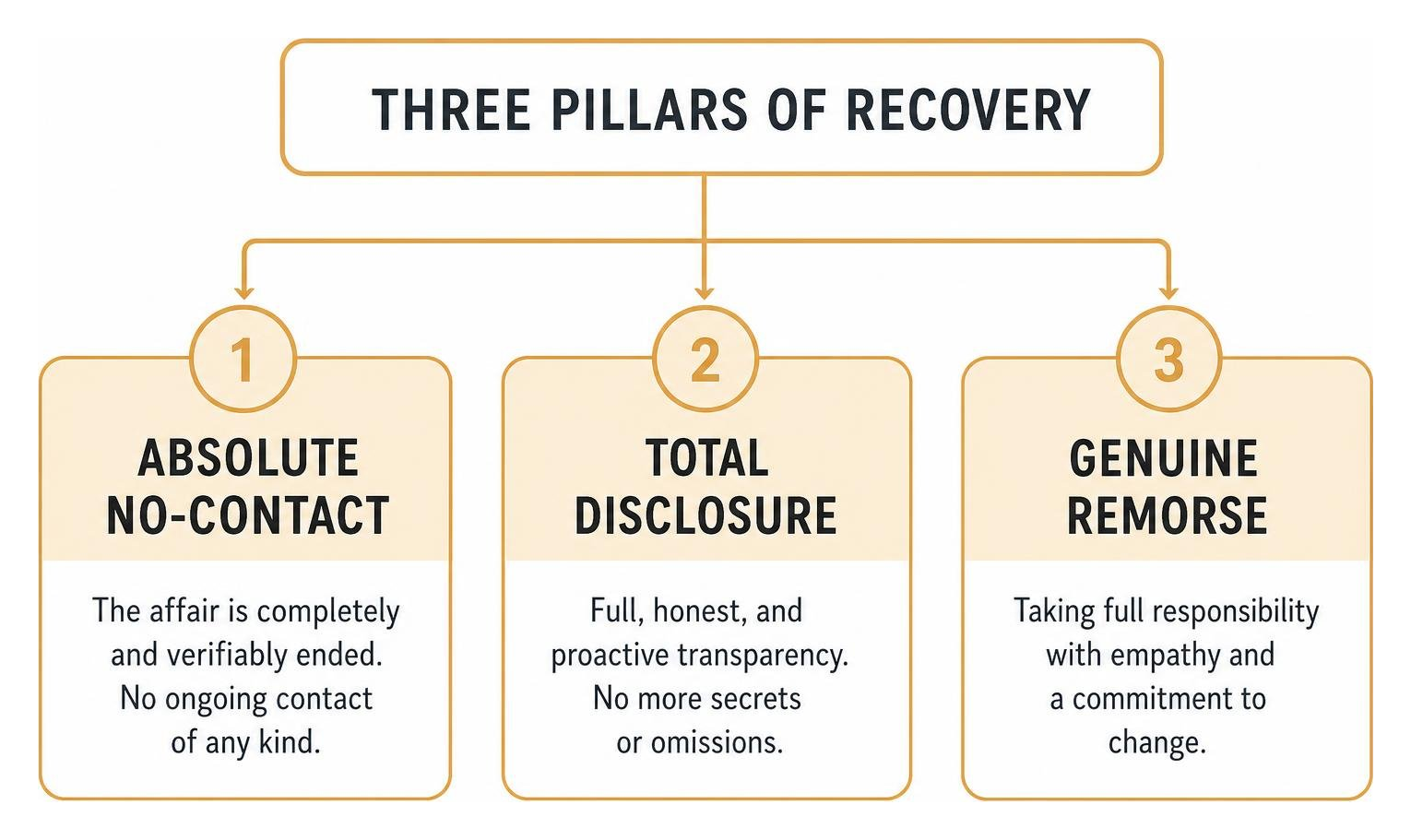
Therapy cannot repair a relationship if foundational safety mechanisms are missing. Attempting relational counseling while deception is ongoing is like trying to remodel a home while it is actively burning. For therapy for infidelity to produce lasting healing, three baseline requirements must be established from the outset.
Verifiable No-Contact and Ending the Affair
Rebuilding trust cannot begin while the third party remains in the background. The affair must be completely and verifiably terminated. Ambiguous boundaries—such as claiming to stay "just friends" or maintaining occasional digital check-ins—perpetuate the attachment injury and prevent the betrayed partner's nervous system from stepping out of fight-or-flight mode.
When the affair involves a workplace colleague, strict protocols must be enacted:
- Written Boundaries: All communication must be strictly restricted to professional, project-critical tasks via transparent company channels.
- No Private Channels: Complete elimination of unsanctioned messaging apps, personal phone numbers, or one-on-one off-site lunches.
- Long-Term Career Transition: Developing an intentional exit strategy or department transfer if ongoing physical proximity continues to reactivate trauma.
Accountability is not punitive; it provides the psychological scaffolding necessary to restore basic safety.
Full Disclosure vs. Damaging Trickle-Truth
One of the most destructive patterns in affair recovery is trickle-truth—the piecemeal revelation of facts over weeks or months, usually only when cornered with new evidence. Each new discovery resets the recovery timeline back to day one because it proves that deception continued even while promises of honesty were being made.
As explored in our guide to affair recovery counseling, clinical best practice involves a single, comprehensive disclosure. The injured partner needs a clear factual timeline and an understanding of the emotional context (the "why") to resolve cognitive dissonance.
However, we caution against demanding graphic, play-by-play sexual details. Granular visual imagery often imprints traumatic flashbacks without providing relational clarity. For deeper frameworks on structured transparency, reviewing How to Rebuild Trust After an Affair: The Honest Operations Manual can help establish safe boundaries around disclosures.
Distinguishing Genuine Remorse from Defensive Regret
There is a vital clinical distinction between genuine, guilt-based remorse and performative, shame-based regret:
- Shame-Based Regret (Self-Focused): The unfaithful partner collapses into self-pity ("I'm a terrible person," "You'll never forgive me anyway"). This defensive posture forces the injured partner to comfort them, shifting emotional labor onto the victim.
- Guilt-Based Remorse (Partner-Focused): The unfaithful partner turns outward toward their spouse’s pain without defending their actions. They tolerate uncomfortable questions, offer non-defensive validation, and take active responsibility for creating relational safety.
Healing requires moving away from the internal discomfort of shame and embracing the consistent, behavioral accountability of repair.
The Timeline and Process of Rebuilding Trust
The common belief that affair recovery follows a neat, predictable timeline is a misconception. Trust is not restored by the turning of calendar pages; it is rebuilt through repeated, verifiable micro-moments of attunement and honesty. Understanding how do couples recover from cheating requires honoring a non-linear process that oscillates between emotional closeness and sudden grief.
The Four Clinical Stages of Affair Recovery
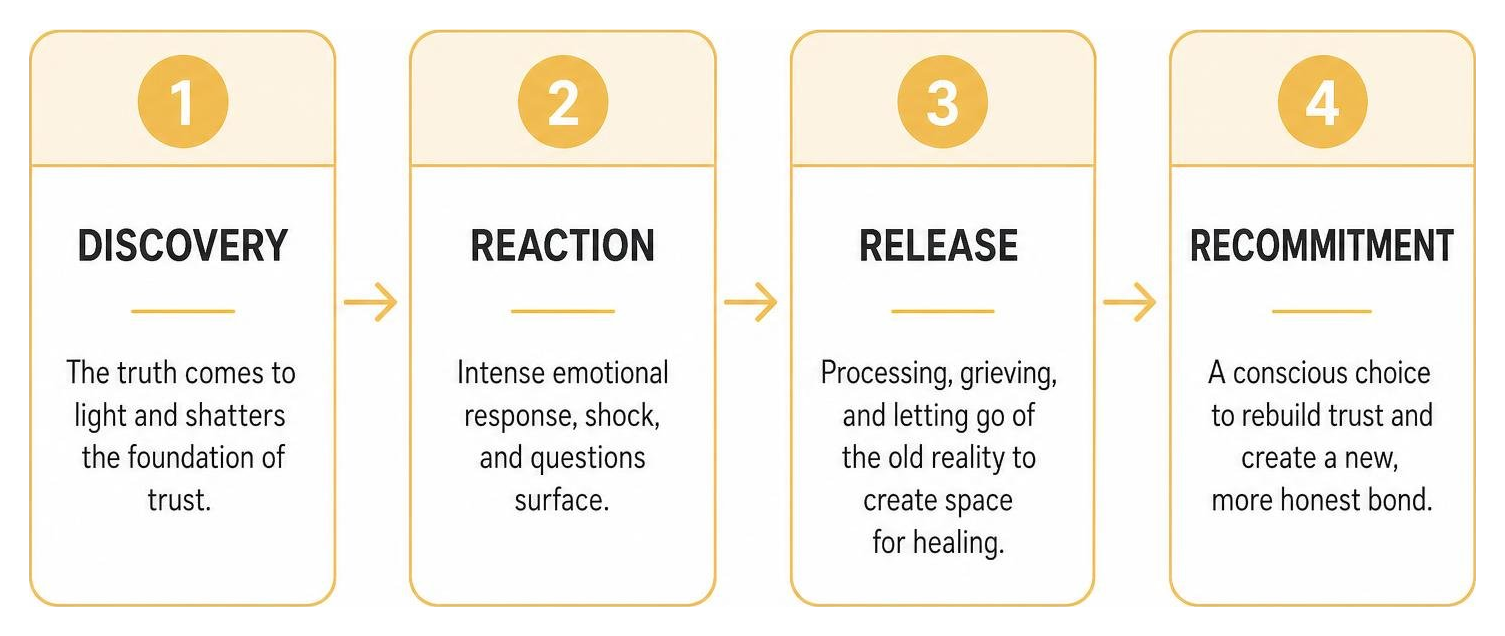
Clinically, sustainable recovery traverses four essential phases:
- Stage 1: Discovery & Acute Crisis (0–6 Weeks): Marked by profound shock, hypervigilance, disruption of sleep and appetite, and emotional swings. The clinical goal here is nervous system stabilization, containment, and establishing physical and digital boundaries.
- Stage 2: Emotional Reaction & Deconstruction (~6 Weeks to 6 Months): The initial shock gives way to anger, grief, and questioning. The couple deconstructs the systemic vulnerabilities of the pre-affair dynamic without shifting blame for the choice to cheat.
- Stage 3: Injury Release & Meaning-Making (~6 Months to 12 Months): The intensity of intrusive thoughts begins to soften. The unfaithful partner demonstrates sustained, unprompted transparency, allowing the betrayed partner to release hypervigilant monitoring.
- Stage 4: Recommitment & Building the New Normal (12–18+ Months): The couple ceases trying to "get back to normal." Instead, they consciously co-create a new relationship contract grounded in deep vulnerability, mature differentiation, and shared values.
For a broader perspective on realistic recovery timelines, explore Affair Recovery: What Actually Helps Rebuild Trust (and How Long It Takes).
Healing Attachment Injuries and Re-Processing Betrayal Trauma
Infidelity can induce severe post-traumatic symptoms, including intrusive flashbacks, intense panic triggers, and emotional dissociation. When the nervous system perceives relational threat, cognitive logic goes offline.

Learning how to recover from infidelity PTSD involves leveraging mindfulness to identify early somatic cues—such as a tightening chest or shallow breathing—before crossing an emotional threshold into a trauma storm.
In therapy, we utilize Brainspotting alongside somatic mindfulness to help the injured partner re-process stuck traumatic memories. Over time, the betrayal shifts from an active, electric shock to a closed scar—remembered, but no longer running the nervous system's daily alarm system.
Navigating Physical Intimacy and Hysterical Bonding
In the immediate wake of discovery, many couples experience hysterical bonding—a sudden surge of intense, urgent sexual intimacy. This phenomenon can be deeply confusing and disorienting.
Hysterical bonding is not proof of premature forgiveness or instant healing. It is a biological, attachment-driven impulse. When an attachment bond is severed, the mammalian nervous system seeks urgent physical connection to reclaim safety and drive away the threat of abandonment.
As shock subsides, this initial wave often yields to emotional numbness, physical aversion, or grief. Couples must approach intimacy with intentional pacing, honoring boundaries and ensuring physical connection emerges from emotional safety rather than panic.
Evaluating Progress: Green Flags, Red Flags, and Knowing When to Leave
Deciding whether to continue working on a relationship requires objective evaluation. Healing is a two-sided endeavor, and progress must be measured by consistent actions rather than spoken promises.
Signs Reconciliation Is Working
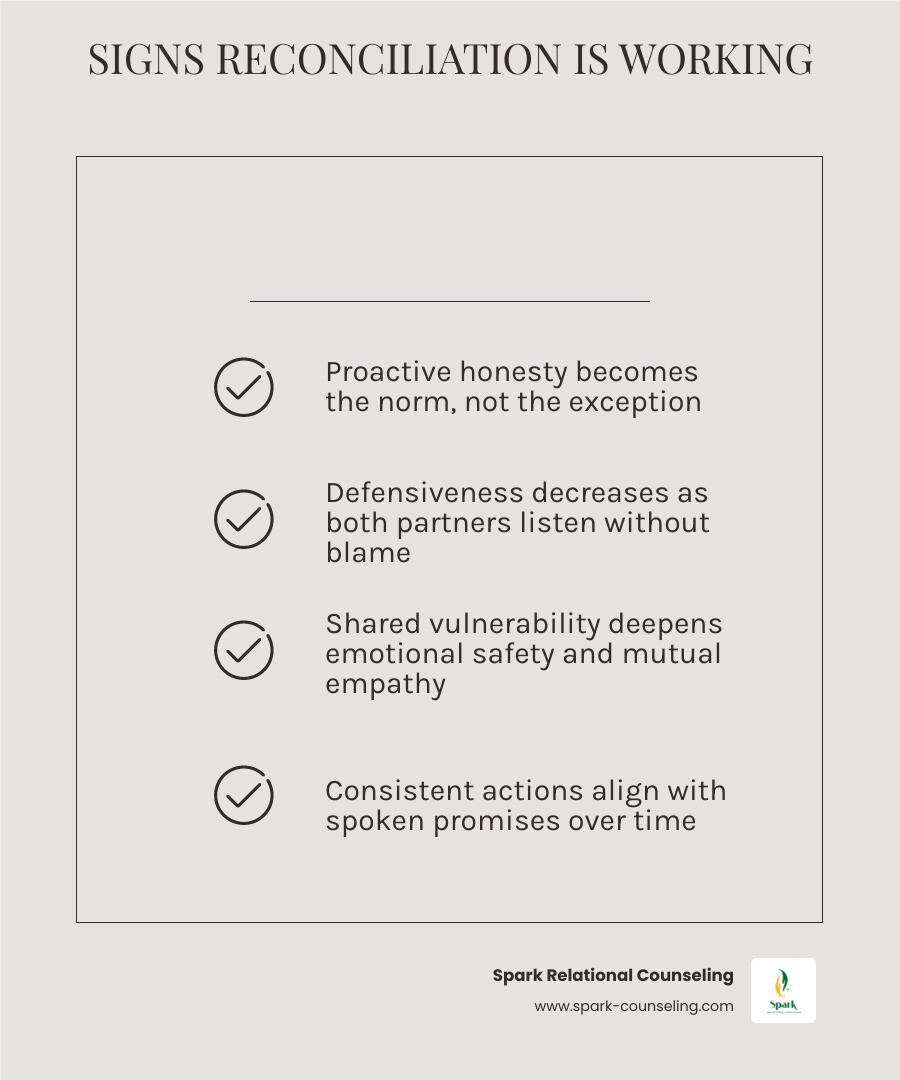
You can recognize that the therapeutic process is taking root when:
- The unfaithful partner offers proactive, voluntary transparency without being asked or audited.
- Repetitive questions from the injured partner are met with patience, empathy, and comfort rather than irritation ("I thought we were past this").
- Both partners utilize mindfulness to notice emotional flooding and take constructive pauses during conflict.
- Conversations expand beyond the affair into shared curiosity, emotional vulnerability, and genuine connection.
Critical Warning Signs That Therapy Is Failing
Conversely, certain chronic dynamics indicate that the foundation for repair is missing:
- Persistent Defensiveness: Demanding immediate forgiveness on a set schedule.
- Blame-Shifting: Insisting that marital dissatisfaction "forced" the choice to step outside the relationship.
- Continued Secrecy: Guarding devices, altering passwords, or deleting message logs.
- Gaslighting: Minimizing the injured partner's trauma responses as "crazy" or "controlling."
Making the Decision: When Leaving Is the Healthiest Form of Recovery
Therapy does not fail simply because a relationship ends. If a partner is unwilling or unable to take full accountability, maintaining the relationship comes at the expense of your own psychological well-being.
Leaving an unrepentant or emotionally abusive dynamic with your self-trust, nervous system balance, and dignity intact is a profound, valid form of recovery. Closure does not require your partner's total understanding; it begins when you choose to honor your own non-negotiable boundaries.
Frequently Asked Questions About Infidelity Recovery
Does therapy work after cheating if trust feels completely broken?
Yes. Rebuilding trust does not require an immediate leap of faith. In the early stages of therapy, the clinical framework provides the scaffolding your relationship currently lacks. Trust is slowly restored as your partner demonstrates sustained, verifiable transparency over time, allowing your nervous system to register emotional safety.
How long does it realistically take to rebuild trust after an affair?
While structured therapies like EFT often yield significant relief from acute distress within 12 to 20 sessions, full relational restoration typically requires 12 to 18 months of consistent behavioral alignment. Trust is rebuilt through repeated micro-moments of attunement rather than an arbitrary calendar deadline.
Should we stay together for the children while working through an affair?
Children thrive on emotional safety and authentic parental stability, not just the physical presence of two adults living under one roof. Chronic tension, cold detachment, or unaddressed volatility can quietly dysregulate a child's developing nervous system.
Whether you repair the marriage through therapy or transition to an intentional, amicable co-parenting dynamic, prioritizing true emotional health benefits children far more than staying in an unhealed environment.
Conclusion: Moving Forward on Your Path to Healing
The discovery of an affair is one of the most painful disruptions a person can experience. It upends your shared history, destabilizes your sense of reality, and leaves you questioning how to move forward. Yet an attachment injury does not have to be the final chapter of your story.
With evidence-based clinical guidance, deep experiential processing, and dedicated accountability, couples can emerge from betrayal into a relationship that is fundamentally more honest, grounded, and attuned. And for those who discover that the relationship cannot be safely repaired, therapy provides the clarity, self-compassion, and strength needed to step forward into personal healing.
If you are navigating the shock of an affair and searching for guidance, founder May Han and the team at Spark Relational Counseling provide specialized, virtual infidelity counseling across Oregon, Washington, and Illinois. We help individuals and couples disrupt painful brain autopilots, cultivate nervous system resilience, and find lasting relational clarity.
