The Easiest Way to Learn Conflict Resolution Skills
Science-Backed Strategies for Conflict Resolution in Relationships

The easiest way to develop conflict resolution in relationships is to practice three foundational communication habits: opening difficult conversations with gentle, non-blaming language, actively validating your partner's emotional experience, and calling structured timeouts when physiological stress peaks. Rather than trying to eliminate disagreements entirely, effective conflict resolution focuses on regulating your nervous system, maintaining emotional safety, and uncovering the unexpressed attachment needs beneath recurring tensions.
By drawing upon evidence-based frameworks such as Constructive Conflict: A Step-by-Step Communication Protocol, couples can replace destructive escalation loops with structured emotional regulation. When partners understand the deeper dynamics beneath their surface tensions, they can begin addressing root relationship issues with compassion rather than blame.
Solvable vs. Perpetual Problems: The 69% Rule
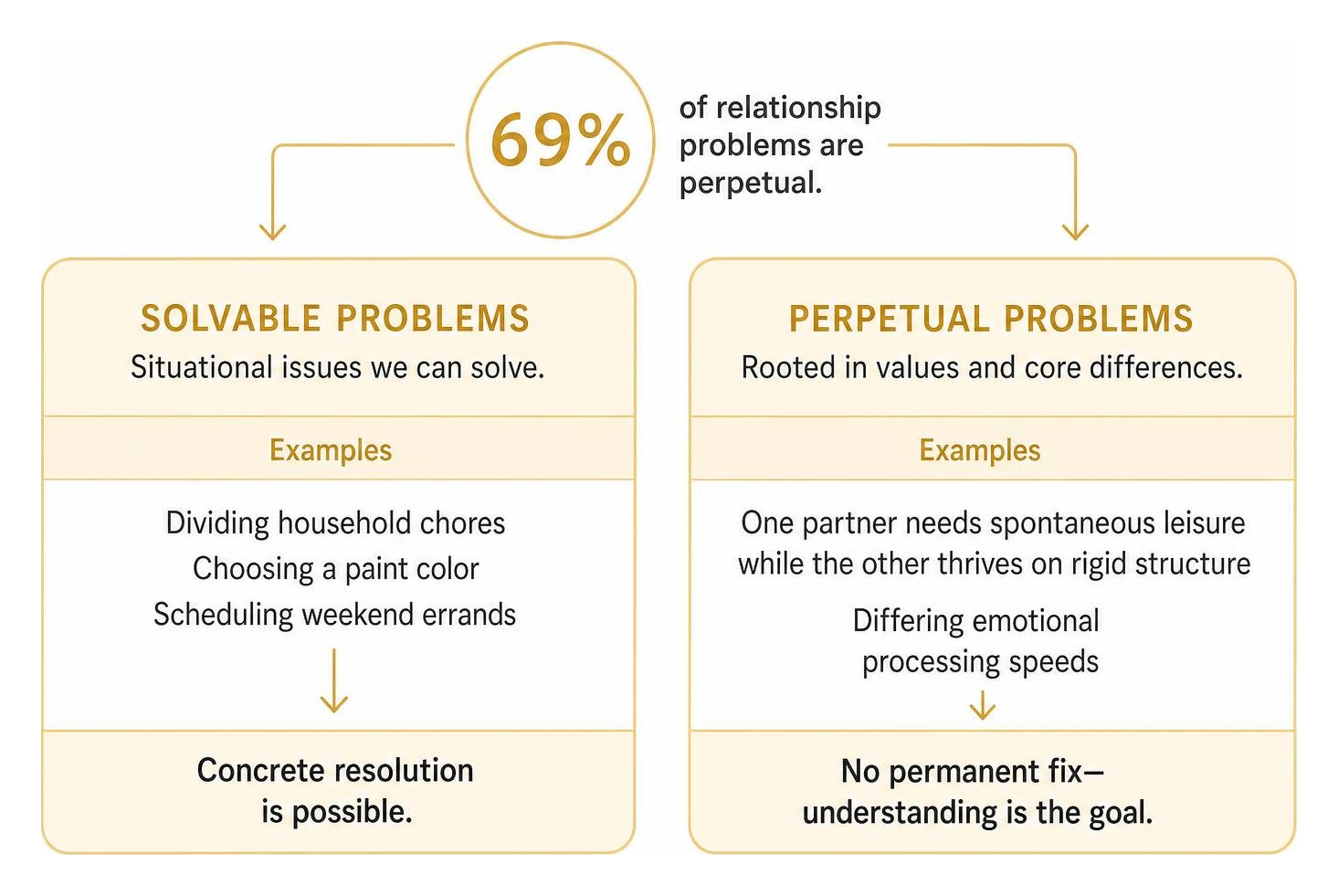
One of the most liberating discoveries in modern relationship science is that more than two-thirds of what couples argue about is unresolvable. Roughly 69% of relationship problems are perpetual, stemming from fundamental differences in personality, lifestyle preferences, nervous system wiring, and personal values.
When we try to "solve" a perpetual issue, we inadvertently demand that our partner change who they fundamentally are. This inevitably produces gridlock, exhaustion, and chronic frustration.
- Solvable Problems: Situational challenges that have a concrete resolution (e.g., dividing household chores, choosing a paint color, or scheduling weekend errands).
- Perpetual Problems: Recurring themes rooted in core temperaments (e.g., one partner needing spontaneous leisure while the other thrives on rigid structure, or differing emotional processing speeds).
Learning how to resolve conflict effectively means shifting our objective. Instead of seeking total eradication of differences, healthy couples focus on managing recurring topics through mutual acceptance, shared humor, and ongoing dialogue.
The Four Destructive Conflict Styles to Avoid
Left unmanaged, everyday misunderstandings can decay into destructive relational behaviors that predict long-term distress. In clinical practice, we observe four primary communication traps that dismantle emotional safety. Understanding these patterns allows us to swap automatic defensiveness for what is healthy communication.
| Destructive Style | Relational Impact | Healthy Antidote |
|---|---|---|
| Criticism | Attacks the partner's character or personality rather than addressing a specific behavior. | Use a gentle startup that states personal feelings and specific needs without blame. |
| Contempt | Expresses superiority through sarcasm, cynicism, name-calling, or eye-rolling. This is the biggest predictor of divorce or separation. | Cultivate a culture of appreciation; focus on gratitude and somatic grounding before speaking. |
| Defensiveness | Deflects responsibility, makes excuses, or plays the victim to counter an perceived attack. | Take ownership for even a small portion of the issue; validate your partner’s emotional experience. |
| Stonewalling | Emotionally or physically withdraws from interaction, shutting down dialogue entirely. | Practice mindful self-soothing; take a structured, agreed-upon twenty-minute timeout to regulate. |
Core Communication Skills for De-Escalating Arguments
Transforming reactive arguments into collaborative problem-solving requires deliberate, practiced techniques. When couples cultivate somatic awareness and regulate their nervous systems, they create the safety needed to navigate challenging topics without mutual injury. Learning how to stop having arguments in a relationship starts with mastering the foundational mechanics of de-escalation.
The Role of Softened Startups in Conflict Resolution in Relationships
Research shows that the affect in the first three minutes of a conflict discussion predicts the outcome of the entire conversation. Harsh startups—characterized by accusations, global generalizations ("you always," "you never"), or sharp vocal tones—trigger immediate defensiveness.
Drawing upon Emotionally Focused Therapy (EFT) and evidence-based communication frameworks, couples can master the softened startup. This involves three essential components:
- Describe what is happening without judgment: Stick strictly to observable facts.
- State how you feel: Use simple emotion words ("I feel overwhelmed," "I feel anxious") rather than disguised thoughts ("I feel like you don't care").
- State a positive need: Clearly ask for what you do want, rather than cataloging what you do not want.
By opening with non-blaming language, partners keep their defenses lowered and foster collaboration from the outset.
Active Listening and Emotional Validation
During conflict, most people listen to formulate a rebuttal rather than to understand their partner's inner world. Active listening interrupts this autopilot by redirecting focus toward curiosity, presence, and validation.
To practice active listening effectively:
- Maintain an open posture and steady, calm presence.
- Reflect back what you heard: "What I'm hearing you say is that when plans change at the last minute, you feel anxious and unconsidered. Is that right?"
- Validate their emotional reality before offering any perspective: "It makes sense that you felt that way given how hectic your week has been."
When we assume good intentions, we give our partner the benefit of the doubt instead of assigning malicious motives to their stress responses. Discovering how mindfulness builds loving relationships helps partners observe internal triggers without reacting impulsively, laying the groundwork for true empathy.
Managing Flooding with Structured Timeouts
When emotional intensity peaks, individuals often enter a state of physiological flooding. Heart rates climb above 100 beats per minute, adrenaline surges, and the prefrontal cortex—the region responsible for empathy, nuanced reasoning, and logic—temporarily goes offline. In this state, productive conflict resolution is neurologically impossible.
As detailed in 5 Simple Ways to Argue Less as a Couple, implementing a structured timeout protects the relationship from reactive speech.
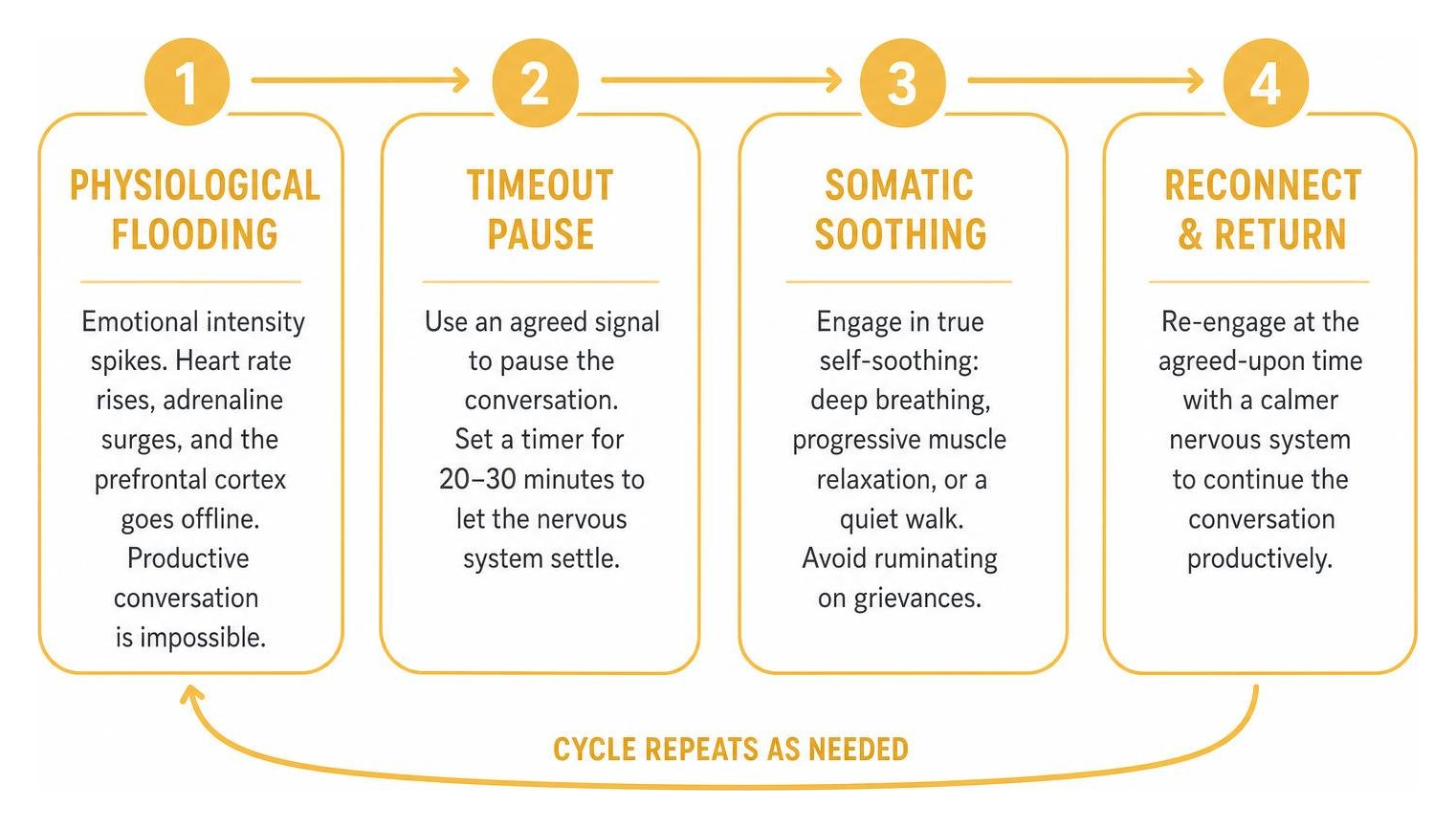
Best practices for an effective timeout include:
- Establish a neutral signal: Agree in advance on a phrase or sign that either partner can invoke without debate.
- Commit to a specific duration: Set a timer for at least 20 to 30 minutes to allow the nervous system to return to baseline.
- Engage in true self-soothing: Focus on deep breathing, progressive muscle relaxation, or a quiet walk. Avoid ruminating on grievances, which prolongs physiological activation.
- Always return: Re-engage at the agreed-upon time to complete the conversation with renewed calm.
Repairing Ruptures and Moving from Gridlock to Dialogue

Disagreements inevitably lead to emotional misattunements and minor relational fractures. The health of a partnership is determined not by the absence of ruptures, but by the speed and sincerity of the repair. Understanding how to stop fighting and repair a relationship turns moments of disconnection into opportunities for deeper emotional safety.
Effective Apologies and Healing Attachment Injuries
An attachment injury occurs when one partner feels abandoned, betrayed, or dismissed during a moment of acute vulnerability. If left unaddressed, these injuries form scar tissue that fuels future arguments.
A genuine repair requires far more than a hasty "I'm sorry you feel that way." Healing attachment wounds involves:
- Acknowledging the impact: Validating the pain caused, regardless of your original intent.
- Taking unreserved ownership: Identifying the specific behavior without making excuses or shifting blame.
- Offering restorative vulnerability: Expressing genuine remorse and outlining proactive steps to prevent recurrence.
Rebuilding safety is central to understanding secure attachment style and trust, allowing both partners to rely on each other as safe emotional havens.
Uncovering Hidden Dreams to Break Gridlock
When couples find themselves having the exact same fight repeatedly, they are rarely arguing about the surface topic. Dishes, schedules, and spending habits are often stand-ins for unexpressed core dreams, values, and attachment needs.
To move from rigid gridlock into constructive dialogue, explore the deeper narrative beneath the position:
- What does this issue represent to you on a deeper level?
- What childhood experiences or core beliefs shape your perspective here?
- What is your underlying dream or fear regarding this decision?
When couples discover the hidden meaning behind their partner's stance, defensiveness softens into curiosity. Exploring how to break the argument cycle with the help of couples therapy helps unearth these underlying values, transforming chronic stalemates into shared meaning and sustainable compromise.
Daily Habits to Build Resilience and Prevent Resentment
Relational resilience is built during calm, everyday moments, long before conflict arises. By consistently investing in the emotional bank account, couples build a reserve of goodwill—known clinically as positive sentiment override—which buffers the relationship when tensions flare. For a broader perspective on sustained intimacy, exploring our emotional connection therapy complete guide provides valuable roadmaps for daily attunement.
Everyday Rituals of Appreciation and Connection
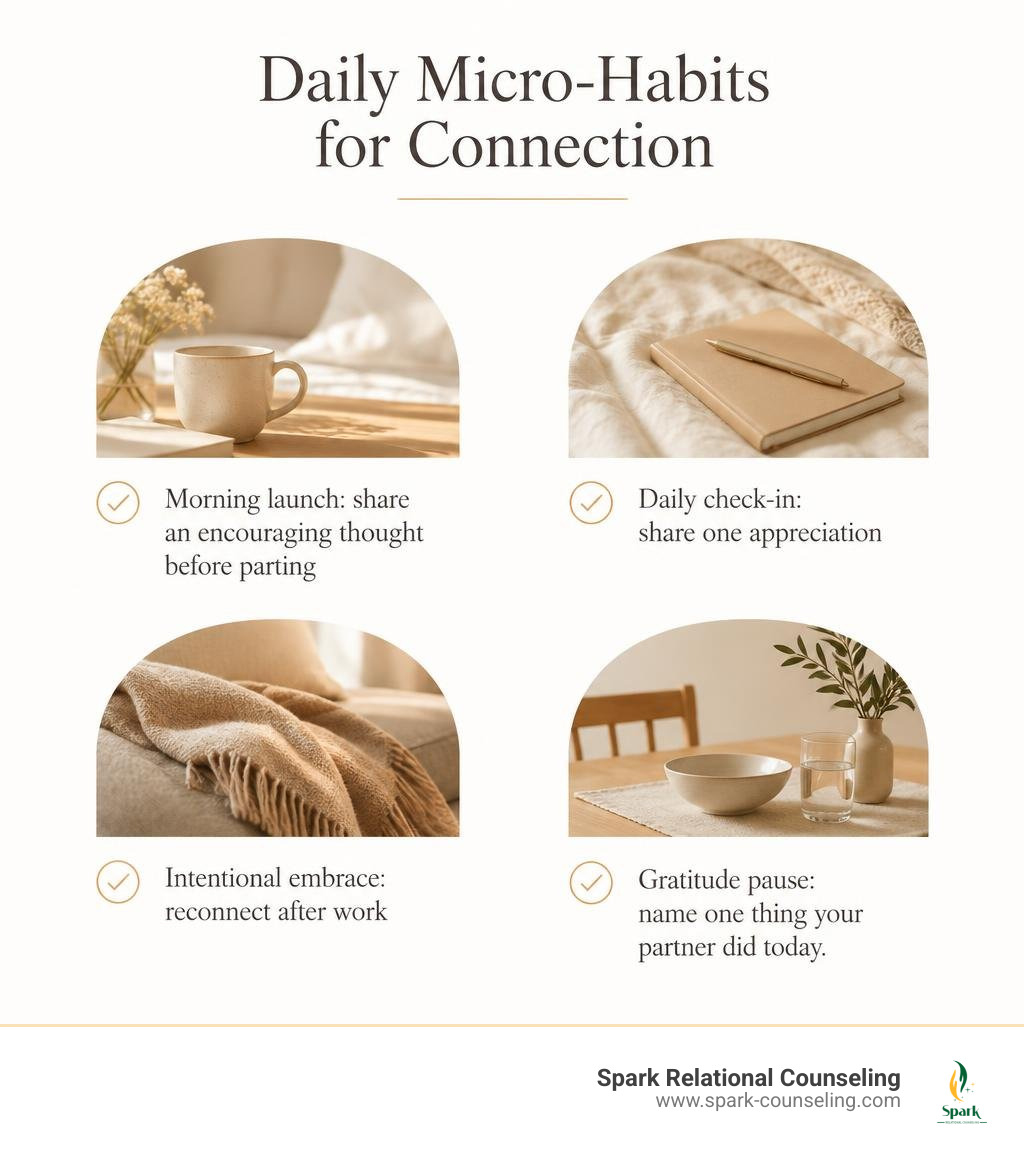
Integrating small, intentional micro-habits into your daily routine creates a durable foundation for emotional safety:
- The Morning Launch: Spend two minutes connecting before parting ways, sharing an encouraging thought or intentional embrace.
- Mindful Reconnection: Dedicate fifteen minutes at the end of the day to a stress-reducing conversation where problem-solving is paused in favor of listening and emotional validation.
- Expressing Daily Appreciation: Verbalize at least one specific trait, action, or effort you noticed and appreciated in your partner each day.
- Mindful Presence: Establish screen-free zones during meals to prioritize eye contact, turn-taking, and shared presence.
Understanding what emotional connection means in daily life ensures that conflicts carry less destructive weight, as both partners feel fundamentally valued and secure.
When to Seek Professional Support for Your Partnership
While self-guided communication tools are invaluable, certain entrenched dynamics benefit significantly from external clinical guidance. Recognizing when self-help has reached its limit allows couples to intervene before chronic resentment permanently erodes intimacy. If you are wondering whether outside guidance is appropriate, reading about whether is it worth it to go to couples therapy can clarify your next steps.
When Professional Conflict Resolution in Relationships Is Needed
Professional therapy offers a structured, neutral container to safely unpack deeply entrenched conflict loops. Modalities such as Emotionally Focused Therapy (EFT), Accelerated Experiential Dynamic Psychotherapy (AEDP), Experiential therapy, and Brainspotting help couples identify the somatic triggers and underlying attachment panic that drive repeated clashes.
Working with a skilled clinician can help answer the question: can a therapist help with communication? Therapy assists partners in reorganizing emotional responses, softening rigid defenses, and forming secure, lasting bonds.
When seeking professional support, many clients consider using insurance. While utilizing in-network benefits can help offset upfront session costs, it is vital to understand the structural constraints involved. Insurance providers require a formal mental health diagnosis on your permanent medical record to authorize reimbursement. This clinical paper trail can present privacy concerns and may carry unintended long-term implications for future life choices, such as underwriting for private disability or life insurance, security clearances, formal adoption processes, or certain employment opportunities. Investing in private-pay therapy safeguards your confidentiality, provides complete autonomy over your treatment plan, and ensures that your relational growth remains private.
Individual Therapy Options for Relational Growth
Relational healing does not always require both partners in the room from day one. When one partner begins addressing personal reactivity, exploring personal attachment patterns, and developing emotional regulation, the relational dance shifts naturally.
If your partner is hesitant to attend sessions, exploring can just one person go to marriage counseling explains how individual relational counseling creates significant positive ripple effects throughout an entire partnership.
Frequently Asked Questions About Relational Conflict
How do we stop having the same recurring fight?
To interrupt repeating loops, step away from the content of the argument and analyze the process. Map the cycle: identify the trigger, the somatic response, the defensive behavior, and the underlying attachment fear. Discovering how to stop fighting what to do when you keep having the same fight with your partner involves addressing these unexpressed emotional needs rather than debating surface logistics.
How long should a timeout last during a heated argument?
A structured timeout should last a minimum of 20 to 30 minutes. This provides sufficient time for stress hormones such as cortisol and adrenaline to metabolize, allowing your heart rate to drop and your prefrontal cortex to come back online. Always agree on a specific return time so the pause feels like a regulated strategy rather than abandonment.
What is the single biggest predictor of relationship breakdown?
Clinical research identifies contempt as the single strongest predictor of relationship dissolution. Contempt conveys disgust and moral superiority through sneering, hostile humor, eye-rolling, or sarcasm. The antidote is cultivating an active culture of appreciation, somatic self-soothing, and expressing vulnerable personal needs directly.
Conclusion
Healthy conflict is not a sign of a failing relationship; it is an invitation to deepen intimacy, refine boundaries, and understand your partner's inner world with greater clarity. By identifying destructive habits, mastering softened startups, and embracing mindful self-regulation, you can transform recurring friction into a pathway toward lasting security.
Led by May Han, Spark Relational Counseling provides specialized virtual couples and individual therapy across Oregon, Washington, and Illinois—serving communities in Portland, Seattle, Chicago, Lake Oswego, Bellevue, and beyond. We utilize mindfulness-based relational therapy, Emotionally Focused Therapy (EFT), and somatic modalities to help you dismantle negative brain autopilots and build authentic emotional safety.
If you are ready to move away from exhausting arguments and step into a calmer, more connected partnership, transform your partnership through expert marriage counseling with our team today.