
The Science of Psychological Immunity: Understanding Resilience in Clinical Practice

Therapy builds resilience by expanding your nervous system's window of tolerance through somatic regulation, experiential processing, and secure relational support. Rather than simply teaching you to think differently, resilience-focused therapy works directly with the body's stress responses, helping you register distress, process it in real time, and rebound to baseline functioning instead of spiraling into chronic overwhelm. This active, teachable process is what clinicians often describe as psychological immunity (Abate et al., 2024).
For decades, traditional mental health models treated resilience as a fixed personality trait—something you were either born with or lacked entirely. Today, neurobiology and clinical research demonstrate that resilience involves neurobiological readiness: the brain's innate capacity to form new synaptic connections, reorganize neural pathways after injury or stress, and adapt flexibly to changing environments.
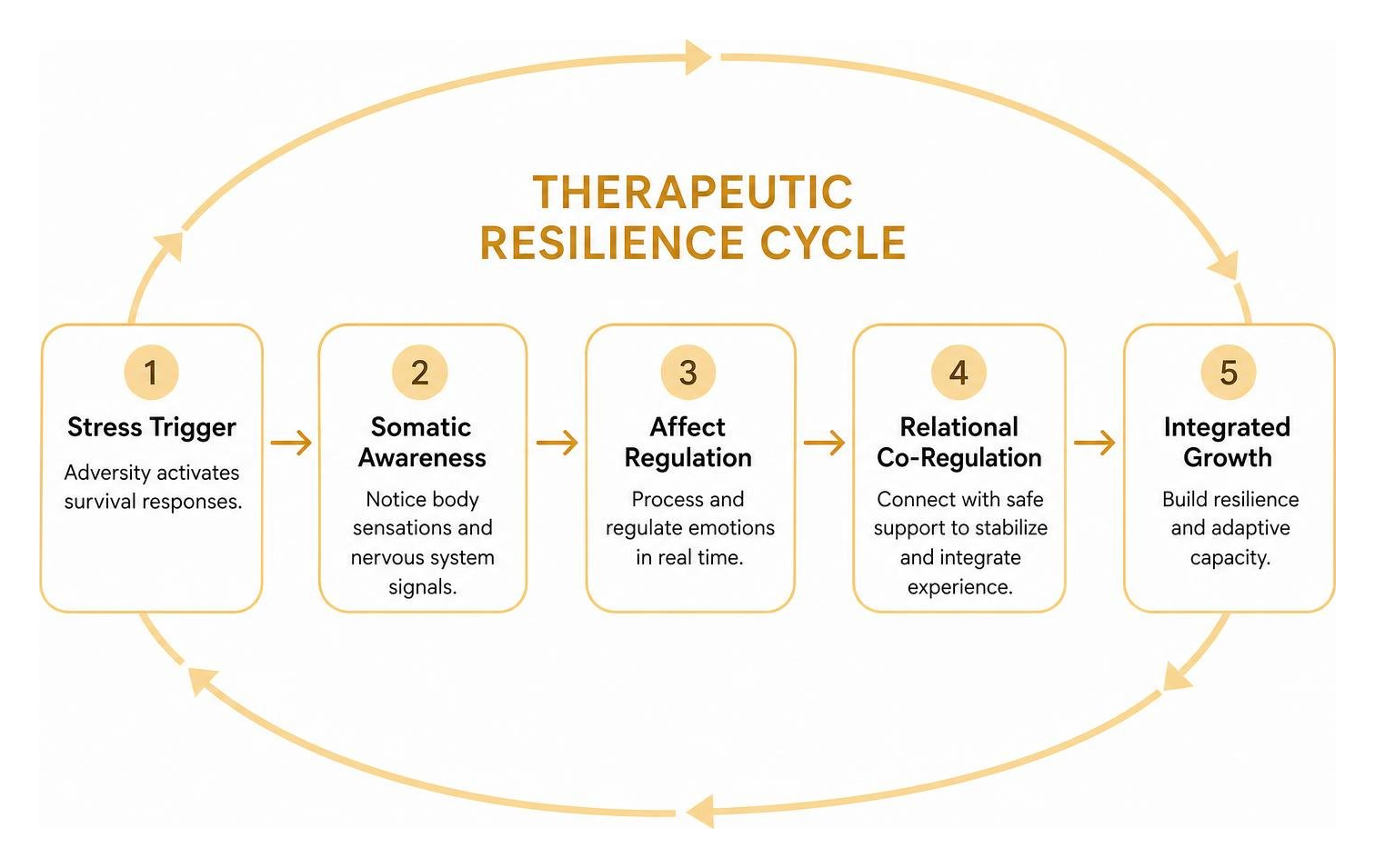
When adversity strikes, your brain's survival circuits activate automatically. Without intentional intervention, these pathways become rigid autopilots, locking you into habitual states of hyperarousal (anxiety, panic, irritability) or hypoarousal (numbness, detachment, burnout). Experiential and somatic therapies interrupt these reflexive loops, teaching your body and mind that present adversity does not equal permanent danger.
Evaluating Your Baseline: How Therapy Assesses Emotional Capacity and Coping Strengths
Before constructing new emotional stamina, a therapist helps you map your current psychological terrain. Assessing resilience is never about assigning a passing or failing grade to your coping mechanisms; rather, it identifies where your nervous system holds excess strain and where natural strengths already exist.
Therapists often utilize multidimensional frameworks to measure resilience, assessing core facets such as emotional fluidity, social connectedness, somatic capacity, and cognitive adaptability. We also examine your developmental history, specifically looking at Adverse Childhood Experiences (ACEs). Extensive clinical research on resilience protective factors shows that while early adversity can make high baseline resilience harder to maintain, internal self-regulation and external relational support serve as potent protective buffers across the lifespan (Abate et al., 2024).
During early sessions, we explore questions such as:
- What somatic signals tell you that you are approaching your emotional threshold?
- Where in your daily life do you sustain focus and care, even when facing minor hurdles?
- How quickly does your nervous system settle after an interpersonal conflict or sudden shock?
By clarifying these baselines, therapy avoids generic self-help advice and crafts a targeted, somatic-relational pathway tailored to your specific physiological patterns.
How Therapy Builds Resilience by Rewiring Cognitive and Emotional Autopilots
Imagine you are preparing to present a project at work, or perhaps you are about to bring up a vulnerable topic with your partner. Suddenly, your stomach clenches, your throat tightens, and an internal voice whispers, “If this goes wrong, everything falls apart.” That thought is not an objective fact; it is a rapid, protective autopilot learned from past experiences where vulnerability felt unsafe.
In therapy, we do not simply offer surface-level positive affirmations. Instead, modalities like Emotionally Focused Therapy (EFT), Accelerated Experiential Dynamic Psychotherapy (AEDP), and Brainspotting access the deeper subcortical structures where these reflexive fear responses live. By processing the unprocessed emotional pain trapped beneath the panic, you release the autonomic survival charge.
Therapy expands your window of tolerance, creating the neurobiological space needed to choose a measured response over a panic-driven reaction. As discussed in clinical literature on integrating resilience as a psychotherapy goal, shifting the focus from temporary symptom reduction to structural emotional agility builds long-term psychological strength. If chronic worry has kept your nervous system on high alert, working through specialized evidence-based anxiety treatment helps retrain those neural pathways, allowing you to remain grounded even when life feels turbulent.
Core Modalities and Mechanisms: How Therapy Builds Resilience
Cultivating resilience requires more than intellectual understanding; it demands experiential practice. You cannot think your way out of a physiological threat response that your body feels in its core. Therapeutic resilience-building relies on paced, trauma-informed interventions that respect your nervous system's capacity while gently stretching its limits.
By pairing experiential techniques with somatic precision, therapy guides you through three critical phases of development:
- Stabilization and Safety: Establishing somatic anchors, breath pacing, and emotional regulation tools so you can encounter distress without becoming flooded.
- Experiential Processing: Utilizing modalities like Brainspotting and AEDP to access and integrate deep-seated emotional pain in the presence of an attuned, secure therapist.
- Adaptive Meaning-Making: Transforming past survival responses into deliberate, values-aligned actions and healthy boundaries.
Emotional Regulation and Distress Tolerance for Life's Hardest Moments
Emotional regulation is the cornerstone of psychological stamina. When life presents intense stressors—a sudden job loss, medical news, or relational strain—an untrained nervous system swings wildly between overwhelm and emotional shutdown.
Therapy integrates Polyvagal principles and somatic mindfulness to help you track your autonomic state. You learn to recognize when your nervous system is shifting into sympathetic fight-or-flight or dorsal-vagal freeze. Through mindful interoception, you discover how to apply micro-grounding techniques before crossing your emotional threshold.
As outlined in this trauma-informed resilience guide, true distress tolerance is not about enduring pain through white-knuckled suppression. It is about expanding your capacity to hold difficult emotions—grief, fear, anger—with self-compassion until they naturally shift. Engaging in holistic therapy for stress and anxiety gives you concrete somatic practices to de-escalate acute stress responses and keep your footing in challenging seasons.
How Therapy Builds Resilience Through Interpersonal Safety and Support Systems
Resilience is never an isolated, solitary endeavor. Human beings are neurobiologically wired for co-regulation; our nervous systems find their deepest calm and restorative power through secure, attuned connection with others.
Through Emotionally Focused Therapy (EFT) and experiential modalities, therapy illuminates how your attachment history shapes your current relational dynamics. When you learn to identify underlying attachment fears—such as fear of abandonment or fear of inadequacy—you can communicate core needs clearly without defensive posturing.
Therapy also provides "expert companionship," offering a safe relational container where you experience being fully seen, validated, and supported. This secure therapeutic bond becomes an internal blueprint for setting boundaries and cultivating nourishing relationships in your everyday life.
| Feature / Dynamic | Passive & Isolating Coping | Active Therapeutic Resilience |
|---|---|---|
| Primary Mechanism | Avoidance, emotional suppression, numbing | Experiential processing, somatic regulation |
| Relational Stance | Hyper-independence or chronic people-pleasing | Secure vulnerability, explicit boundary setting |
| Internal Narrative | "I have to survive this completely alone" | "I can hold this pain and seek safe connection" |
| Nervous System State | Chronic hyperarousal or functional freeze | Flexible movement within the window of tolerance |
| Long-Term Outcome | Emotional burnout and recurring distress | Sustainable vitality and post-traumatic growth |
Learning how to visualize emotional safety and calm through guided internal imagery further anchors this progress. Understanding how visualization techniques aid recovery reinforces these newly built neural pathways, allowing you to access relational calm even outside the therapy room.
Practical Strategies: Daily Habits, Goal-Setting, and Post-Traumatic Growth
Resilience flourishes when the insights discovered during therapy sessions are integrated into everyday routines. Just as physical conditioning relies on daily movement, psychological stamina is sustained through intentional micro-habits, restorative rhythms, and meaningful goal-setting.

Establishing Somatic Foundations and Meaningful, Values-Driven Action
Your mind and body exist in a continuous feedback loop. When physical reserves are depleted by chronic sleep deprivation, irregular nutrition, or sensory overload, emotional resilience declines rapidly.
In therapy, we examine your baseline wellness habits not as rigid chores, but as foundational acts of self-preservation:
- Sleep Hygiene as Neural Reset: Sleep acts as the brain's biological restoration cycle, clearing metabolic waste and consolidating emotional processing.
- Sensory Boundaries: Mindfully stepping away from digital hyper-connectivity prevents cognitive fatigue and protects your capacity for deep reflection.
- Values-Based Micro-Actions: Breaking overwhelming life goals into small, values-aligned steps builds self-efficacy without triggering panic or exhaustion.
If prolonged occupational strain has eroded your reserves, participating in effective therapy for burnout recovery offers structured support to recalibrate your nervous system and realign your daily habits with your deeper values.
Cultivating Self-Compassion, Optimism, and Narrative Coherence
Adversity often fractures our sense of identity, leaving behind fragmented memories and harsh internal criticism. When unexpected hardships disrupt your life path, a common defensive reaction is to blame yourself for feeling shaken.
Therapy helps you replace internal self-criticism with deliberate self-compassion. From research highlighted in evidence-based resilience building strategies, developing narrative coherence—the ability to weave life's painful chapters into a meaningful, integrated life story—is essential for post-traumatic growth.
You begin to recognize that experiencing emotional pain is a normal human response, not an indicator of weakness. By pairing mindful self-compassion with experiential processing, you can look back at past trials not as evidence of brokenness, but as tangible proof of your endurance, capacity for repair, and innate strength.
Frequently Asked Questions About Building Resilience in Therapy
Can someone develop resilience later in life if they experienced severe childhood trauma?
Yes. Because the human brain retains neuroplasticity throughout life, you can cultivate resilience at any age (Abate et al., 2024). Experiential and trauma-informed therapies like Brainspotting and Emotionally Focused Therapy help process unresolved developmental trauma, allowing your nervous system to build new protective buffers, enhance self-regulation, and form secure relational attachments regardless of your starting point.
What is the difference between symptom relief and building true resilience?
Symptom relief focuses on alleviating immediate distress—such as calming a panic spike or lifting an acute depressive episode. While essential, symptom relief alone does not prevent future overwhelm. Building true resilience involves expanding your nervous system's capacity, increasing distress tolerance, and developing emotional agility so that when future challenges arise, you possess the internal and relational resources to navigate them without losing your footing.
How long does it typically take to feel more resilient through therapy?
The timeline for building resilience varies based on your personal history, attachment patterns, and current stress levels. Many clients notice an increased sense of grounding and emotional stability within the first 8 to 12 sessions as they implement somatic tools. Deep, lasting structural resilience—such as shifting long-standing relational autopilots and processing core trauma—develops progressively through consistent experiential practice over several months.
Navigating Care and Investing in Long-Term Growth
When seeking therapy to build resilience, understanding how to structure your care is an empowering first step. While utilizing in-network insurance benefits can offer short-term cost savings, it is valuable to consider the potential constraints that come with insurance-mandated mental health treatment.
Insurance providers require a formal psychiatric diagnosis on your permanent medical record to justify coverage. This clinical label can sometimes have unintended long-term implications for private life insurance policies, specific disability coverage, security clearances, or international adoption processes. Additionally, insurance carriers often dictate session frequency, restrict modality choices, and limit overall treatment length regardless of your clinical needs.
Opting for private-pay therapy safeguards your absolute confidentiality, protects your medical record, and gives you and your therapist the freedom to design a customized, experiential treatment plan paced entirely for your growth.
Led by May Han, Spark Relational Counseling offers virtual individual and couples therapy across Oregon, Washington, and Illinois—including communities in Portland, Seattle, Chicago, Lake Oswego, Bellevue, and Spokane. By integrating mindfulness-based relational therapy, EFT, AEDP, and Brainspotting, we help you quiet negative brain autopilots and cultivate deep, lasting emotional stamina.
If you are ready to move beyond survival mode, explore our practical guide on how to start therapy or schedule a consultation for individual therapy for relationship issues and personal growth. Together, we can build the emotional foundation that keeps you standing through life's greatest challenges.
References
Abate BB, Sendekie AK, Tadesse AW, Engdaw T, Mengesha A, Zemariam AB, Alamaw AW, Abebe G, Azmeraw M. "Resilience after adversity: an umbrella review of adversity protective factors and resilience-promoting interventions.." Frontiers in psychiatry, 2024. PMCID PMC11487322.